
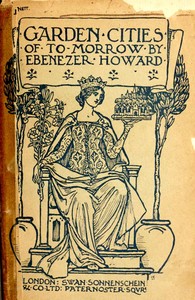
Garden Cities of To-Morrow by Sir Ebenezer Howard
Okay, let's be clear up front: this is not a story with characters and a plot twist. Put that expectation aside. Instead, imagine you're reading someone's incredibly detailed, passionately argued plan for fixing where we live.
The Story
The 'story' here is Howard's vision. He starts by diagnosing the problem: late-1800s London was an overcrowded, polluted mess, while the countryside was emptying out, losing its vitality. He called these the 'Town Magnet' and the 'Country Magnet,' each with good and bad pulls. His solution? Create a new, third magnet: the 'Town-Country Magnet.' This would be the Garden City.
The book then becomes a practical guide. Howard doesn't just say 'build nicer towns.' He draws diagrams. He plans the circular layout with central gardens, public buildings, and radiating avenues. He figures out the economics—how to buy the land, manage it for the community's benefit, and use the rising property values to fund public works. He even sketches where the factories, farms, and railways should go. It's a complete system, designed to be replicated.
Why You Should Read It
You should read it to see where a lot of our modern urban planning ideas started. Ever lived in or visited a suburb with a lot of green space, or a 'new town'? Howard's DNA is in there. Reading his original vision is fascinating because it's both wildly ambitious and strangely humble. He wasn't trying to be a dictator; he was proposing a cooperative model. His writing has this quiet, persuasive confidence. You get the sense he really thought this could work, and his detailed maps make it feel possible. It's a hopeful book. It argues that our physical surroundings shape our lives, and that with careful thought, we can build places that make people happier and healthier.
Final Verdict
This is for the curious reader who enjoys big ideas. Perfect for history buffs, architecture fans, or anyone who's ever looked at their city or suburb and thought, 'Why is it like this?' It's also a great pick if you like 'what if' scenarios from history. The prose is straightforward (it was revised to be clearer), so don't be intimidated. Just be ready to look at some diagrams and think about railroads and land values. It's less of a page-turner and more of a mind-expander. You'll finish it looking at the world outside your window a little differently.
There are no legal restrictions on this material. It is now common property for all to enjoy.
John Lopez
1 year agoLooking at the bibliography alone, the inclusion of diverse viewpoints strengthens the overall narrative. A trustworthy resource that I'll keep in my digital library.
Sarah Martin
7 months agoThe methodology used in this work is academically sound.
Nancy Lopez
1 year agoClear, concise, and incredibly informative.
Barbara Jones
8 months agoGiven the current trends in this field, the author clearly has a deep mastery of the subject matter. It’s hard to find this much value in a single source these days.


Michael Wilson
8 months agoFrom a researcher's perspective, the footnotes provide extra depth for those who want to dig deeper. A trustworthy resource that I'll keep in my digital library.