1

Busy Brownies — A Closer Reading
(1 User reviews)
239
Project Gutenberg
2017
Not confirmed
Fantasy fiction; Children's stories; Fairies -- Juvenile fiction
Readers of public-domain and historical texts
Project Gutenberg digital edition
en
Edition facts
Words
7,033
Reading time
31 min
Text sections
1
Busy Brownies — A Closer Reading can be approached with a clearer sense of reading commitment from its source measurements: 7,033 words, 31 min estimated reading time, and 1 detected text section.
The text analysis averages about 24.3 words per sentence, while the detected sections provide another way to judge how the source is divided.
Project Gutenberg metadata also associates the work with “Fantasy fiction,” connecting these edition facts with the source record’s subject description.
Source:
Project Gutenberg record #54159
In this 1896 collection, Palmer Cox's Brownies rebuild a fairy queen's palace, ride borrowed horses, and attend school—all in moonlight. The excerpts show a pattern of cooperative mischief, practical tools, and gentle moral framing.
Editorial Edition Score
4.4/5
★★★★★
★★★★★
Calculated from edition completeness, EPUB availability, text structure and catalogue metadata. Not a user rating.
How this score is calculated
- Description quality20 pts
- Title & short description10 pts
- Source metadata20 pts
- Text length15 pts
- Chapters / structure15 pts
- EPUB file integrity20 pts
Total of 100 points, scaled to a 2.5-5.0 range. Editions with an empty description or a missing EPUB file are not scored.
Edition quality
Read the Text
sorry to think that they had left their camera at home for they would have been happy to give the children a picture of the house as it looked when it was finished.
Although they were tired and their eyes were growing heavy with sleep they felt repaid for all their efforts, especially when the Fairy Queen seemed the proudest and happiest of them all. She thanked them heartily for their loving service, and when they had seen her safely settled in her new home, they all disappeared, to be seen no more until there was more good work to be done.
THE BROWNIES’ VISITORS.
The Isle of Fun and Frolic was the home of the Brownie boys and girls, and no one can e’er deny that the island was well named. These youngsters had no thought but to run and play, to sleep and to eat. They loved the flowers and they loved the birds--and the butterflies led them lively chases in their games of hide and seek. But one day came a change in their lives, and they learned that others lived in the world besides themselves. Little Peak Hat discovered it, as she stood on the rock looking out toward the sea. It was a great vessel ploughing the waves, its white sails flapping in the winds, and as she watched she saw it moving steadily towards the island. All the Brownies came rushing at her call, and their wonder knew no limit. On came the vessel closer and closer, the Brownies watched as long as they dared, and then fearful of being seen hurried away to hide themselves where they might occasionally take a peep. What great big creatures were landing on the island, and what loud voices they had as they called to each other. It sounded to the Brownies like the roar of distant thunder. All day long the little people remained hidden, but when night came they stole from their hiding places to talk it over. What kind little hearts these Brownies had. All the nice pieces of wood should be piled up for these strange people’s comfort, the best grapes should be saved for them, they would coax the fish to nibble, and do all in their power to make these queer guests happy. Indeed they seemed to think of nothing else, and had you visited their home in the old forest, you would have found them busily engaged in planning how they could add to the comfort of their strange guests. The Brownies are never so happy as when they are busy making others happy. They believe that the best way to enjoy life, is to give pleasure to those they meet. Of course the visitors did not know what was making their visit so pleasant, for these busy little creatures always work quietly and secretly. The visitors did not stay long, but the Brownies did good service, and when they had gone they quite missed the pleasure they had felt in making others happy, and they were continually wishing that some favoring wind would bear some other ship to their shores that they might again have an opportunity of renewing their acquaintance with these queer people.
THE BROWNIES’ PLUM PUDDING.
’Twas the evening of the twenty-fourth of December. The clouds had been gray and heavy all day, and now the snow flakes were beginning to fall thick and fast; so fast that already quite a white blanket was spread over the earth.
This did not please the Brownies; they had work to do, and a snow storm would hinder rather than help its progress.
Somewhere in the woods nobody knew where, for the Brownies kept the secret all to themselves, was a great big Christmas Pudding full of plums and citron, raisins and spices, and the Brownies wanted to bring that pudding home.
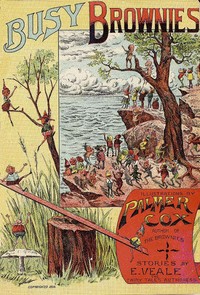
The Brownies of Palmer Cox's illustrated series are introduced here as tireless builders. When a storm destroys the Fairy Queen's palace, they gather with axes, hammers, and a mortar hod, working through a single moonlit night. The narrator notes they 'work when the darkness has put all the world to sleep,' establishing a nocturnal rhythm that recurs throughout. The construction scene is dense with specific tools—pulleys, a grindstone, a plane—and small accidents, like a paint spill that douses workers below. This opening establishes the Brownies as capable but not infallible, a tone that persists across the excerpts.
Moonlight Labor and Cooperative Chaos
The palace-building episode is the longest continuous scene in the excerpts, and it sets a template for Brownie activity: a communal task undertaken with enthusiasm, visible tools, and mild mishaps. The Brownies work 'as if by Magic,' yet the text lingers on the physical details—chopping wood, mixing mortar, sharpening tools. The grindstone 'hummed quite a tune,' and the paper hanger's scissors 'shut with a click.' These sound effects give the work a playful, almost musical quality. Notably, the Brownies are not solitary; they operate in a crowd, with a 'master worker' giving directions. The narrator emphasizes their generosity: 'No chance of doing good to one in trouble ever escapes these generous little fellows.' This moral note is undercut by the later, more mischievous episodes, suggesting the Brownies' helpfulness is balanced by a love of fun.
Mischief with Horses and Harness
In 'The Brownies Ride,' the smallest Brownie, Dot, proposes borrowing horses from a pasture for a moonlight ride. The plan is hatched after school, with dinner pails thrown down. The Brownies forget saddles, so they 'crawled through the windows in the harness maker’s shop' to borrow them. The ride quickly turns chaotic: saddles slip, bridles come undone, and Brownies and horses tumble into mud. Yet the episode ends with everyone pronouncing it 'one of the best frolics.' The narrator frames the mischief as a 'lark' and even suggests it benefits the horses, who 'do nothing but eat all day.' This rationalization is typical of the book's gentle moralizing: the Brownies' pranks are harmless and often justified. The scene also introduces a recurring character, Croak, who 'always objects to everything,' providing a foil to the group's enthusiasm.
Schoolroom Order and the Absence of Names
'Brownies at School' shifts from outdoor adventure to structured learning. The Fairy Queen commands all Brownie children to attend school, using the same room as human children but at night. The teacher, Prof. Lofty, assigns letters to be worn on backs because 'Brownies have no names you know.' This detail is striking: the Brownies are identified by temporary tags, much like kindergarteners on a picnic. The scene implies a society without individual names, where identity is situational. The narrator notes that the Brownies 'proved good students, and soon became very wise,' but the excerpt ends there, leaving the curriculum and any classroom conflicts unexplored. This episode contrasts with the earlier chaos, suggesting that Brownie society values both work and play, and that order can be imposed—at least temporarily—by royal decree.
The Donkey Ned and the Promise of Kindness
A later excerpt introduces Ned, a donkey who finds a home with Widow Love. The Brownies are glad because she will be 'very kind and gentle,' providing soft straw and fine oats, with 'no cruel children to beat and kick him.' This passage is the most overtly sentimental in the excerpts, framing the Brownies as protectors of animals. The narrator states that Ned 'lived a long while' and remained a 'faithful servant.' The episode reinforces the book's moral framework: the Brownies intervene to ensure fair treatment, and their actions have lasting positive outcomes. It also hints at a wider world beyond the Brownies' own community, where human characters like Widow Love and Grimes (from the horse episode) exist. The donkey's story is brief but provides a counterpoint to the more boisterous adventures, showing the Brownies' capacity for quiet, practical kindness.
These excerpts reveal a pattern: the Brownies work, play, and learn in communal settings, often under moonlight. Their world is governed by a Fairy Queen, but their actions are self-directed and occasionally mischievous. Readers should note the recurring emphasis on tools, accidents, and moral justifications. The absence of individual names and the use of letter tags in school suggest a collective identity. The book's short length (7,033 words) and episodic structure make it suitable for reading aloud, with each chapter offering a self-contained scene of Brownie life.
The rain kept time against the window while the Brownies rebuilt that fairy palace, their borrowed horses and quiet mischief somehow feeling ancient. That afternoon’s gentle order reminded me of another collection altogether, tucked away on a lower shelf. Myths and Legends of California and the Old Southwest — Story, Setting & Ideas fell open to coyote stories, and the same warm moonlight seemed to follow me there.
There are no comments for this eBook.
Reader reflection
How did this book work for you?
Your answers remain private and are stored only in this browser.
Your progress
0
/
10
2
How much did you enjoy the reading experience?
3
Would you encourage someone else to read it?
4
Did the language feel accessible?
5
Did the book offer a fresh perspective?
6
Did the story or argument move comfortably?
7
Which element worked best for you?
8
Would you start a conversation about this book?
9
In one sentence, what did you learn?
10

Scarlett Campbell
3 weeks ago