
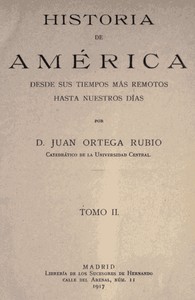
Historia de América desde sus tiempos más remotos hasta nuestros días, tomo II
Let's be clear from the start: this isn't a light beach read. Historia de América desde sus tiempos más remotos hasta nuestros días, tomo II is a serious, old-school history book. But don't let that scare you off. Juan Ortega Rubio, writing over a century ago, had a mission to tell a complete story, and in this volume, he tackles one of the most dramatic periods in human history.
The Story
This book picks up in the turbulent 16th century, right in the thick of the Spanish conquest. Rubio charts the fall of the great indigenous empires—the Aztecs and the Incas—not as a simple triumph, but as a catastrophic collision. He then follows the aftermath: the establishment of the sprawling Viceroyalties, the brutal systems of labor like the encomienda, and the slow, painful mixing of peoples and cultures. The narrative marches through the colonial centuries, showing how this new society was governed, how it fought off other European powers, and how discontent simmered. It all builds toward the explosive wars of independence in the early 1800s, which shattered Spanish rule and created the patchwork of new nations we recognize today.
Why You Should Read It
What makes this worth your time is the perspective. Reading a history written in the late 1800s is like getting a snapshot of how people understood their own past before modern archaeology and historiography. Rubio's work is a product of its time, with all the biases that implies, but that's partly what's fascinating. You see the shaping of a national story. Beyond that, he has a knack for organizing a massive amount of information. You get a sense of the scale and complexity of building an empire across an ocean, the administrative headaches, the economic forces, and the social fractures. It’s a grand, sweeping account that connects political events with their human consequences.
Final Verdict
This book is perfect for a specific reader: the history enthusiast who already has a basic timeline of the Americas in their head and wants to dive deeper into the classic, foundational narratives. It's for someone who doesn't mind dense, factual prose and is curious about historical writing itself. It's not the most critical or updated account—you'll need modern books for that—but as a primary source from a key period of historical thinking, it's incredibly valuable. Think of it as a cornerstone text. If you're building your understanding of Latin American history, this is one of the old blocks at the very bottom of the structure.
This digital edition is based on a public domain text. Access is open to everyone around the world.
Kimberly Anderson
2 months agoThis is now a staple reference in my professional collection.
Jennifer Moore
1 year agoI was skeptical about the depth of this book at first, but the quality of the diagrams and illustrations (if applicable) is top-notch. Finally, a source that prioritizes accuracy over hype.
Margaret White
1 year agoIt’s rare to find such a well-structured narrative nowadays, the cross-referencing of different chapters makes it a great study tool. I'll be recommending this to my students and colleagues alike.
Michael Thompson
10 months agoI've gone through the entire material twice now, and the insights into future trends are particularly thought-provoking. The insights gained here are worth every minute of reading.





Emily Williams
3 months agoMy first impression was quite positive because the critical analysis of current industry standards is very timely. I'm glad I chose this over the other alternatives.