1

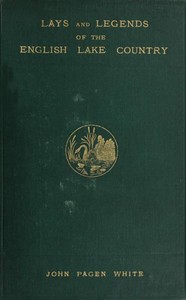
Lays and Legends of the English Lake Country With Copious Notes — Context and Discussion
(7 User reviews)
1389
Project Gutenberg
2015
Not confirmed
Legends -- England -- Lake District; Lake District (England) -- Poetry
Readers of public-domain and historical texts
Project Gutenberg digital edition
en
Edition facts
Words
99,230
Reading time
432 min
Text sections
12
For Lays and Legends of the English Lake Country With Copious Notes — Context and Discussion, the stored edition analysis reports 99,230 words, 7 hr 12 min estimated reading time, and 12 detected text sections.
The text analysis averages about 27.7 words per sentence, while the detected sections provide another way to judge how the source is divided.
Project Gutenberg metadata also associates the work with “Legends -- England -- Lake District,” connecting these edition facts with the source record’s subject description.
Source:
Project Gutenberg record #48207
John Pagen White's posthumous collection of verse and prose notes on Cumbrian folklore, history, and landscape, with a focus on local legends such as the indestructible skulls of Calgarth Hall and the region's border conflicts.
Editorial Edition Score
4.8/5
★★★★★
★★★★★
Calculated from edition completeness, EPUB availability, text structure and catalogue metadata. Not a user rating.
How this score is calculated
- Description quality20 pts
- Title & short description10 pts
- Source metadata20 pts
- Text length15 pts
- Chapters / structure15 pts
- EPUB file integrity20 pts
Total of 100 points, scaled to a 2.5-5.0 range. Editions with an empty description or a missing EPUB file are not scored.
Edition quality
Read the Text
Who was so blest to-day, And thinks on many a lone to-morrow In those old towers of grey.
From many a piping throat so mellow The joyful song bursts forth: On many a field the corn so yellow Makes golden bright the earth.
And mountains o'er the green woods frowning Close round the banner'd walls; While mid-day sunshine, all things crowning, In summer splendour falls.
But ours is not the age they walk in; It is the years of yore: And ours is not the tongue they talk in; 'Tis language used no more.
Yet many an eye in silence bending O'er this unmurmur'd lay, Beholds that knight the vale descending, And feels that summer's day.
Lives it then not? Yes; and when hoary Beneath our years we stand, That scene of summer, love, and glory, Shall still be on the land.
Truth from the earth itself shall perish Ere that shall be no more; The heart in song will ever cherish What has been life of yore.
THE BANNER OF BROUGHTON TOWER.
The knight looked out from Broughton Tower; The stars hung high o'er Broughton Town; "There should be tidings by this hour, From Fouldrey Pile or Urswick Down!"
Far out the Duddon roll'd its tide Beneath; and on the verge afar, The Warder through the night descried The beacon, like a rising star.
It told that Fouldrey by the sea Was signall'd from the ships that bore, With Swart's Burgundian chivalry, The false King from the Irish shore.
And Lincoln's Earl, and Broughton's Knight, And brave Lord Lovel, wait the sign To march their hosts to Urswick's height, To hail him King, of Edward's line.
Brave men as ever swerv'd aside! But faithful to their ancient fame, The white Rose wooed them in her pride Once more; and foremost forth they came.
The Knight looked out beneath his hand; The Warder pointed to the glow; "Now droop my banner, that my band May each embrace it! then we'll go.
"And if we fall, as fall we may, Thus resolute the wronged to raise, The banner that we bear to-day, Shall be our monument and praise!"
One look into his lady's bower; One step into his ancient hall; And then adieu to Broughton Tower, Till blooms the white Rose over all!
High o'er the surge of many a fight, That banner, for the Rose, had led The liegemen of the Broughton knight To victory's smiles, or glory's bed.
And 'twas a glorious sight to see That break of day, from tower and town, Pour forth his martial tenantry, To swell the array on Urswick Down:
To see the glancing pennons wave Above them, and the banner borne All joyously by warriors, brave As ever hailed a battle morn.
And 'twas a stirring sound to hear, Uprolling from the camp,--the drum, The music, and the martial cheer, That told the chiefs, "We come, we come!"
Then in that sunny time of June, When green leaves burdened every spray, With all the merry birds in tune, They marched upon their southward way.
And, as through channel'd sands afar The tides with steady onward force Push inland, roll'd their wave of war To Trent, its unresisted course.
And spreading wide its crest where Stoke O'erlook'd the Royal lines below, Spent its long gathering strength, and broke, And plung'd in fury on the foe.
For three long hours that summer morn King Henry by his standard rode, Through onset and repulse upborne, A tower of strength where'er it glowed.
For three long hours the fated band Of chiefs, that summer morning waged A desperate battle, hand to hand, Where'er the thickest carnage raged,
Till midst four thousand liegemen slain, The flower of that misguided host, Borne down upon the fatal plain, Fame, honour, life, and cause were lost.
Turn ye, who high in hall and tower Sit waiting for your lords, and burn To wrest the tidings of that hour From lips that never may return:
Turn inwards from the news that flies Through England's summer groves, and close The circlets of your asking eyes Against the coming cloud of woes!
Wild rumour, like the wind that wings, None knows or how or whence, its way, Storm-like on Broughton's turret rings The dire disaster of that day.
Storm-like through his dislorded halls And farmsteads lone, the rumour breaks; And far by Witherslack's grey walls, And hamlet cots, despair awakes.
And all old things meet shock and change, Since Broughton, down-borne in his pride On that red field, no more shall range By Duddon's rocks, or Winster's side.
And while the hills around rejoiced, And in the triumph of their King Old strains of peace sang trumpet-voiced, And bade the landscapes smile and sing;
John Pagen White’s Lays and Legends of the English Lake Country, published posthumously in 1873, is a hybrid work that blends original poetry with expansive prose notes. The volume’s subtitle, “With Copious Notes,” is no exaggeration: the notes often overshadow the verses, offering digressive essays on local history, topography, and folklore. White, a surgeon by profession, spent years compiling this material during his leisure hours, as his brother’s introduction explains. The result is a book that functions less as a conventional poetry collection and more as a compendium of Cumbrian lore, where a single legend—such as the tale of the Calgarth skulls—can unfold over several pages of circumstantial detail.
The Calgarth Skulls: A Case Study in Local Legend
The most extended narrative in the excerpts concerns the haunted Calgarth Hall and its two indestructible skulls. White recounts the story with a mixture of antiquarian precision and narrative relish. He notes that the skulls were said to have been buried, burnt, ground to powder, sunk in a well, and thrown into the lake—yet always returned to their niche. The tale is tied to a specific historical grievance: the alleged persecution of an elderly couple by a covetous landowner named Philipson, who framed them for theft to seize their property. The condemned pair, according to tradition, recited the 109th Psalm, a passage of imprecatory curses, before execution. White records that the curse “has ever since cast its blight upon the proprietorship of the estate,” a claim he neither endorses nor dismisses. The account is notable for its accumulation of concrete details—the niche beneath the staircase, the year 1775 when Mr. West saw the skulls, the walling-up as a last resort—which lend the legend an air of documentary authenticity.
Border History and the Making of a Region
White’s preface situates the Lake District within a history of Anglo-Scottish conflict. He describes how, after the Norman Conquest, Cumberland and Westmorland were placed under English rule but remained contested territory. The “rancour and cruelty” of border warfare, he writes, spared “neither age or sex.” This historical framing is not merely introductory; it informs the book’s treatment of local traditions, many of which bear the marks of centuries of instability. The note on Calgarth, for instance, implicitly connects the legend’s themes of dispossession and violent injustice to the broader pattern of land seizures and feuds that characterized the borderlands. White’s interest in the region’s past is archaeological in spirit: he gathers place-names, architectural remnants, and oral tales as evidence of a layered history. The preface’s reference to an “irregular circle, varying from forty to fifty miles in diameter, of which the centre is the mountain Helvellyn” gives the work a geographical anchor, defining the Lake District not by administrative boundaries but by a natural landmark.
The Authorial Voice: Between Poetry and Annotation
The structure of Lays and Legends reveals a tension between White’s poetic ambitions and his scholarly instincts. The motto from Burns, quoted in the introduction, expresses a wish to “sing a sang at least” for “poor auld Cumbria’s sake,” suggesting a desire for lyrical expression. Yet the notes, as the editor concedes, are “very discursive” and “unnecessarily long.” White’s voice in the prose is measured and circumstantial, given to qualifying phrases like “as the report goes” and “it is said.” He often withholds judgment, presenting supernatural claims without endorsement but also without skepticism. The Calgarth account, for example, notes that “many persons now living in the neighbourhood can bear testimony” to the skulls’ presence, yet White does not vouch for the fact himself. This cautious posture allows the legends to retain their ambiguity. The poetry itself, though not excerpted here, is presumably the vehicle for the “lays” promised in the title, while the notes serve as a kind of folkloric apparatus—a combination that makes the book both a literary work and a sourcebook for regional traditions.
Readers approaching Lays and Legends should expect to move between verse and prose, with the notes often commanding more attention than the poems. The book rewards those interested in the texture of local belief—the way a story like that of the Calgarth skulls accumulates variants, witnesses, and material traces. White’s work is best read not as a unified narrative but as a collection of fragments, each note a small excavation into the region’s past.
Years among the stacks taught me how certain books whisper to each other across oceans. Pagen White’s skulls of Calgarth Hall, stubbornly enduring, remind me of the restless spirits in Traditions of the Tinguian: a Study in Philippine Folk-Lore — Themes and Context, where the dead refuse quiet forgetting. Both lands hold their legends close, like old friends who never truly leave.
Henry Lopez
3 weeks agoJoseph Nelson
1 month agoHenry Jackson
1 month agoEmma Ramirez
4 weeks ago-

Brittany Taylor - 1 month ago
While I appreciate the effort to compile these legends and poems, the execution feels dated and tedious. The notes, though detailed, often overshadow the poetry, turning the book into a dry historical document rather than an engaging collection. The language is archaic and might not appeal to modern readers. I found it hard to stay interested, and the lack of narrative cohesion made it a chore to finish. -
Lindsey Reyes - 3 weeks ago
The poems themselves are lovely and evocative, offering a genuine sense of the Lake District's landscapes and legends. However, the copious notes can be overwhelming at times, interrupting the flow of the poetry. If you're a patient reader who appreciates historical context, you'll enjoy this, but those looking for purely lyrical reading might find it a bit dense. -
Jennifer Hart - 2 weeks ago
I was utterly transported by this poetic collection. The verses beautifully capture the rugged beauty of the English Lake District, and the extensive notes add historical and geographical depth that enriches the reading experience. A perfect companion for anyone planning to visit the Lakes or who loves Romantic-era poetry. The author's love for the region shines through every line, making it a treasure for both poetry lovers and travel enthusiasts.
Reader reflection
Your personal reading reflection
Build a private reading journal entry for this title.
Your progress
0
/
10
2
How did the book work for you overall?
3
Would you encourage someone else to read it?
4
How demanding did the text feel?
5
What was the strongest part of the book?
6
Would you start a conversation about this book?
7
What was its emotional impact?
8
Would a second reading be valuable?
9
Which lesson or insight stayed with you?
10

Harper Smith
3 weeks ago