1

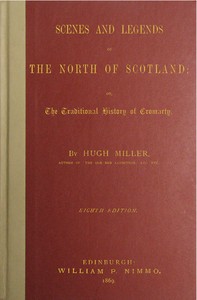
Scenes and legends of the north of Scotland — Reading Notes
(4 User reviews)
1291
Project Gutenberg
2023
Not confirmed
Legends -- Scotland -- Cromarty; Cromarty (Scotland)
Readers of public-domain and historical texts
Project Gutenberg digital edition
en
Edition facts
Words
178,291
Reading time
776 min
Text sections
38
Before opening Scenes and legends of the north of Scotland — Reading Notes, the edition data offers a quick orientation: 178,291 words, 12 hr 56 min estimated reading time, and 38 detected text sections.
The text analysis averages about 31.4 words per sentence, while the detected sections provide another way to judge how the source is divided.
Project Gutenberg metadata also associates the work with “Legends -- Scotland -- Cromarty,” connecting these edition facts with the source record’s subject description.
Source:
Project Gutenberg record #71325
Hugh Miller's collection of folklore and local history from Cromarty, Scotland, blending natural description with supernatural tales, oral traditions, and historical accounts, as seen in excerpts about plague legends and cholera narratives.
Editorial Edition Score
4.9/5
★★★★★
★★★★★
Calculated from edition completeness, EPUB availability, text structure and catalogue metadata. Not a user rating.
How this score is calculated
- Description quality20 pts
- Title & short description10 pts
- Source metadata20 pts
- Text length15 pts
- Chapters / structure15 pts
- EPUB file integrity20 pts
Total of 100 points, scaled to a 2.5-5.0 range. Editions with an empty description or a missing EPUB file are not scored.
Edition quality
Read the Text
My Old Library and its Contents--The Three Classes of Traditions--Legend of Sludach--Singular Test of Character--The Writer’s Pledge, 1
Alypos--Etymological Legends--Epic Poetry of the Middle Ages--Astorimon--The Spectre Ships--Olaus Rudbeck, 10
The Bay of Cromarty--The Old Coast Line--The Old Town--The Storms of the Five Winters--Donald Miller’s Wars with the Sea, 25
Macbeth--Our earlier Data--The Fions of Knock-Ferril--The King’s Sons--The Obelisks of Easter Ross--Dunskaith--The Urquharts of Cromarty--Wallace--The Foray of the Clans--Paterhemon, 36
Remains of the Old Mythology--The Devotional Sentiment--Interesting Usages--Rites of the Scottish Halloween--The Charm of the Egg--The Twelfth Rig--Macculloch’s Courtship--The Extinct Spectres--Legend of Morial’s Den--The Guardian Cock, 55
A Scottish Town of the 17th Century--The Old Castle of the Urquharts--Hereditary Sheriffship, 75
Sir Thomas Urquhart, 86
The Reformation--Outbreaking at Rosemarkie--Sir John Urquhart of Craigfintrie--The Ousted Ministers--Mr. Fraser of Brea--Luggie, 105
The Chaplain’s Lair, 124
The Curates--Donald Roy of Nigg--The Breaking of the Burgh--George Earl of Cromartie--The Union, 143
Important Events which affect the Religious Character--Kenneth Ore--Thomas Hogg and the Man-horse--The Watchman of Cullicuden--The Lady of Ardvrock--The Lady of Balconie, 157
The Fisherman’s Widow, 177
The Story of John Feddes--Andrew Lindsay, 194
The Chapel of St. Regulus--Macleod the Smuggler--The Story of Sandy Wood, 209
The Poor Lost Lad--A Ballad in Prose--Morrison the Painter, 221
The Economy of Accident--The Black Years--Progress of the Pestilence--The Quarantine--The Cholera, 235
Martinmas Market--The Herring Drove--The Whale-Fishers--The Flight of the Drove--Urquhart of Greenhill--Poem--William Forsyth--The Caithness Man’s Leap, 250
Sandy Wright and the Puir Orphan, 267
Tarbat Ness--Stine Bheag o’ Tarbat, 279
The Mermaid--The Story of John Reid--Maculloch the Corn-Agent--The Washing of the Mermaid, 290
The Bad Year--Sandison’s Spulzie--The Meal Mob, 305
The Forty-Five--Nanny Miller’s Onslaught--The Retreat--The Battle of Culloden--Old John Dunbar--Jacobite Psalm, 319
The Dropping Cave--The Legend of Willie Millar--A Boy Adventurer--Fiddler’s Well, 329
Wars of the Town’s-people--Maculloch the Lawyer--The Law-Plea--Roderick and the Captain--Mr. Henderson, 342
The Churchyard Ghost--My Writing Room--The Broken Promise--The Polander--The One-eyed Stepmother--The Pedlar--The Green Lady--Munro the Post, 357
The Literati of Cromarty--Johnie o’ the Shore--Meggie o’ the Shore--David Henderson--Macculloch of Dun-Loth, 377
The Gudewife of Minitarf, 395
The Old School, and what it produced--Dr. Hossack--The hard Dominie--Mr. Russel the minister--The Cock-Fight--Maculloch the Mechanician, 408
The Itinerant Sculptor--Kirk-Michael--The Apprentice’s Dream--The Wild Wife--Gordon of Newhall--Sir Robert Munro--Babble Hanah, 432
George Ross, the Scotch Agent, 449
The Burn of Eathie--Donald Calder--The Story of Tom M’Kechan--Fause Jamie, 461
Our Town Politics--The First Whig--The Revolution--The Democracy--The Procession--Hossack’s Pledge--The County Meeting--The French War--Whiggism of the People, 473
THE TRADITIONAL HISTORY OF CROMARTY.
“Tradition is a meteor, which, if once it falls, cannot be rekindled.”--JOHNSON.
Extremes may meet in the intellectual as certainly as in the moral world. I find, in tracing to its first beginnings the slowly accumulated magazine of facts and inferences which forms the stock in trade on which my mind carries on its work of speculation and exchange, that my greatest benefactors have been the philosophic Bacon and an ignorant old woman, who, of all the books ever written, was acquainted with only the Bible.
[Sidenote: MY OLD LIBRARY AND ITS CONTENTS.]
Hugh Miller opens his dedication by distinguishing sincere gratitude from the 'ceremonies of a dedication,' a move that signals the blend of personal voice and antiquarian purpose running through this collection. The work, subtitled 'The Traditional History of Cromarty,' weaves together local legends, natural description, and historical episodes—such as the account of a labourer who dies after opening a grave in search of treasure, and the story of a yellow cloud of plague captured in a linen bag. Miller's prose shifts between the matter-of-fact and the eerie, often grounding supernatural events in specific locations like the Nigg churchyard.
Grave-Digging and Its Consequences
One excerpt recounts a Cromarty labourer who, believing treasure had been buried with the dead, opens a grave at night. He finds only 'human bones and wasted fragments of woollen cloth,' and dies of a putrid fever days later. Miller notes a parallel story from Miss Seward, but emphasizes that in the Cromarty case no one else suffered—unlike Seward's account where a malignant disease killed seventy villagers. This contrast highlights Miller's method: he presents local variants of widespread folklore, often noting how the Cromarty version differs in scale or outcome. The labourer's motive—expecting treasure—and the swift, isolated punishment give the tale a moral shape familiar in oral tradition, but Miller refrains from explicit moralizing, letting the sequence of actions and consequences speak.
The Yellow Cloud and the Quarantine Fleet
A second legend describes plague arriving at Nigg via a vessel, manifesting as 'a little yellow cloud' moving slowly along the ground. An ingenious local man captures it in a linen bag, 'fashioned somewhat in the manner of a fowler’s net,' and buries it in the churchyard under a rude undressed stone. Miller notes that the sexton never dares open a grave near that stone. The story is presented as 'a wild apocryphal tradition' connected to the quarantine fleet. Miller's framing—calling it apocryphal yet recording it without dismissal—reflects his dual role as collector and commentator. The image of the cloud changing the linen from white to yellow as it is wrapped fold after fold is vividly tactile, and the burial of the plague itself turns the churchyard into a site of both danger and containment.
Cholera's Arrival and Miller's Narrative Pace
Miller shifts from legend to documented history with the arrival of cholera in Britain in 1832. He traces its spread with geographical precision: from Persia to Russia, then to Wick, Sutherland, and the fishing villages of Easter Ross. He notes that the disease travelled 'with the celerity of the mail' and 'the speed of the trading vessels,' a simile that ties contagion to modern transport. He then abruptly checks himself: 'I shall pass hurriedly over the sad story of its ravages,' fearing that dwelling on it would seem misanthropic. This self-interruption is characteristic—Miller is aware of his reader's endurance and of the line between instructive history and gratuitous horror. The cholera section shows him as a chronicler who can zoom from a single grave to a continental epidemic, always attentive to the human scale of disaster.
Miller's voice—earnest, occasionally wry, and alert to the strangeness of local belief—makes this more than a simple folklore collection. Readers will find that the legends gain force from the precise geography and the author's willingness to let contradictions stand: the plague cloud is both absurd and menacing; the cholera is both a divine judgment and a disease obeying the laws of travel. Pay attention to the footnotes and asides, where Miller often reveals his sources or his own doubts.
There’s a particular hush in Hugh Miller’s Scenes and Legends, the way he lingers over a plague-spot or a whispered ghost story as if the land itself holds its breath. Reading it, I found myself thinking of the prairie’s quiet patience—how Mary Eastman listened for the same unhurried voices among the Sioux. Both books are simply thresholds, Dahcotah: Life and Legends of the Sioux Around Fort Snelling — Edition Insights included, where memory settles gently into place.
Liam Walker
1 month agoDaniel Rivera
1 month agoAnthony Brown
2 weeks agoThere are no comments for this eBook.
Reader reflection
What did you think of this book?
Answer a few questions and save a private reflection on this device.
Your progress
0
/
10
2
Did this book hold your interest?
3
Is this a title you would suggest to others?
4
How much effort did this book require?
5
Would you start a conversation about this book?
6
Did the book offer a fresh perspective?
7
Did any part of the book stay with you emotionally?
8
How closely did the book connect with your experience?
9
What is the main idea you are taking away?
10

Jack Campbell
1 month ago