1

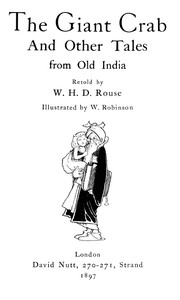
The Giant Crab, and Other Tales from Old India — Key Ideas to Explore
(0 User reviews)
56
Project Gutenberg
2011
Not confirmed
Folklore -- India; Tipitaka. Suttapitaka. Khuddakanikaya. Jataka -- Paraphrases, English
Readers of public-domain and historical texts
Project Gutenberg digital edition
en
Edition facts
Words
28,915
Reading time
126 min
Text sections
5
Before opening The Giant Crab, and Other Tales from Old India — Key Ideas to Explore, the edition data offers a quick orientation: 28,915 words, 2 hr 6 min estimated reading time, and 5 detected text sections.
The text analysis averages about 16.9 words per sentence, while the detected sections provide another way to judge how the source is divided.
Project Gutenberg metadata also associates the work with “Folklore -- India,” connecting these edition facts with the source record’s subject description.
Source:
Project Gutenberg record #36039
W. H. D. Rouse retells twenty-six Jātaka tales for children, freely adapting the Buddhist birth-stories with humor and moral clarity. The collection includes trickster animals, foolish kings, and clever crabs, illustrated by W. Heath Robinson.
Editorial Edition Score
4.7/5
★★★★★
★★★★★
Calculated from edition completeness, EPUB availability, text structure and catalogue metadata. Not a user rating.
How this score is calculated
- Description quality20 pts
- Title & short description10 pts
- Source metadata20 pts
- Text length15 pts
- Chapters / structure15 pts
- EPUB file integrity20 pts
Total of 100 points, scaled to a 2.5-5.0 range. Editions with an empty description or a missing EPUB file are not scored.
Edition quality
Read the Text
Crab was on the watch; and one of them at least never went up out of the water again. The Crab used to nip it with one of his huge claws and pull it under, and then the poor beast was drowned, and made a fine dinner for the big Crab.
This went on for a long time, and the Crab grew bigger and bigger every day, fattening on the animals that came there to drink. So at last all the animals were afraid to go near that lake. This was a pity, because there was very little water in the mountains, and the creatures did not know what to do when they were thirsty.
At last a great Elephant made up his mind to put an end to the Crab and his doings. So he and his wife agreed that they would lead a herd of elephants there to drink, and while the other elephants were drinking, they would look out for the Crab.
They did as they arranged. When the herd of elephants got to the lake, these two went in first, and kept farthest out in the water, watching for the Crab; and the others drank, and trumpeted, and washed themselves close inshore.
Soon they had had enough, and began to go out of the water; and then, sure enough, the Elephant felt a tremendous nip on the leg. The Crab had crawled up under the water and got him fast. He nodded to his wife, who bravely stayed by his side; and then she began:
"Dear Mr. Crab!" she said, "please let my husband go!"
The Crab poked his eyes out of the water. You know a crab's eyes grow on a kind of little stalk; and this Crab was so big, that his eyes looked like two thick tree-trunks, with a cannon-ball on the top of each. Now this Crab was a great flirt, or rather he used to be a great flirt, but lately he had nobody to flirt with, because he had eaten up all the creatures that came near him. And Mrs. Elephant was a beautiful elephant, with a shiny brown skin, and elegant flapping ears, and a curly trunk, and two white tusks that twinkled when she smiled. So when the big Crab saw this beautiful elephant, he thought he would like to have a kiss; and he said in a wheedling tone:
"Dear little Elephant! Will you give me a kiss?"
Then Mrs. Elephant pretended to be very pleased, and put her head on one side, and flapped her tail; and she looked so sweet and so tempting, that the Crab let go the other elephant, and began to crawl slowly towards her, waving his eyes about as he went.
All this while Mr. Elephant had been in great pain from the nip of the Crab's claw, but he had said nothing, for he was a very brave Elephant. But he did not mean to let his wife come to any harm; not he! It was all part of their trick. And as soon as he felt his leg free, he trumpeted loud and long, and jumped right upon the Crab's back!
Crack, crack! went the Crab's shell; for, big as he was, an elephant was too heavy for him to carry. Crack, crack, crack! The Elephant jumped up and down on his back, and in a very short time the Crab was crushed to mincemeat.
What rejoicing there was among the animals when they saw the Crab crushed to death! From far and near they came, and passed a vote of thanks to the Elephant and his wife, and made them King and Queen of all the animals in the mountains.
As for the Crab, there was nothing left of him but his claws, which were so hard that nothing could even crack them; so they were left in the pool. And in the autumn there came a great flood, and carried the claws down into the river; and the river carried them hundreds of miles away, to a great city; where the King's sons found them, and made out of them two immense drums, which they always beat when they go to war; and the very sound of these drums is enough to frighten the enemy away.
Once upon a time there was a troop of Rats that used to live in holes by a river side. A certain Cat often saw them going to and fro, and longed to have them to eat. But he was not strong enough to attack them all together; besides, that would not have suited his purpose, because most of them would have run away.
Rouse’s preface warns that this is “not a scientific book” but a collection meant to amuse children, and he has “ruthlessly altered” the original Jātaka stories to suit that purpose. The result is a set of brisk, often comic fables in which animals speak and act with human motives—greed, cunning, trust, and revenge. The title tale introduces a crab “bigger than a dining-room table,” whose claws are “as big as an armchair,” a scale that signals the book’s playful exaggeration. Elsewhere, a crane tricks fish by pretending to carry them to a cool lake, only to eat them one by one, until a crab outwits him with a simple nip. These are not reverent adaptations; they are lively, sometimes brutal, moral entertainments.
From Buddhist Birth-Stories to Children’s Fables
The catalog lists this work as a paraphrase of the Jātaka, the Pali collection of stories about the Buddha’s former births. Rouse himself translated the second volume of the standard English Jātaka (1895), and he notes that all but two of these tales come from that volume. Yet the preface makes clear that he has freely altered the originals: “probably some of them Buddha himself would fail to recognise.” The stories retain a moral framework—the cunning crane is punished, the grateful beasts reward kindness—but the Buddhist frame of rebirth and enlightenment is stripped away. What remains are crisp narratives with clear winners and losers. Readers expecting doctrinal content will find instead a secular, child-friendly version of the fables, closer to Aesop than to scripture.
Animal Cunning and Its Limits
Several tales turn on a character’s ability to see through deception. In “The Cunning Crane and the Crab,” the fish trust the crane’s promise of a better lake, but the crab refuses to be carried in the crane’s beak, insisting instead on gripping the crane’s neck with his claws. When the crane reveals his true intent, the crab simply nips him—and the crane’s scheme collapses. The story explicitly contrasts the crab’s “more sense than all the fish put together” with their gullibility. Similarly, “The Hypocritical Cat” and “The Dishonest Friend” present predators who disguise their intentions, only to be exposed by a wary victim. The pattern is consistent: cleverness alone is not enough; it must be paired with skepticism. The tales reward the character who tests a promise before acting on it.
Voice and Narrative Economy
Rouse’s prose is direct and conversational, with frequent direct address to the reader: “I daresay you have often seen crabs boiled, and put on a dish for you to eat.” He uses colloquial interjections (“Never mind, he thought; all’s fish that comes to my net!”) and brisk dialogue that moves the action forward. The crane’s “One at a time! I have only one beak, you know!” is both a practical statement and a dark joke. Descriptions are minimal but vivid: the one-eyed fish “rolled up his one eye at the thought of” the imagined feast. The bones of eaten fish are mentioned twice, a small recurring detail that underscores the crane’s method. This economy keeps the stories short—most run two to four pages—and suited to reading aloud. The illustrations by W. Heath Robinson, known for his whimsical mechanical drawings, add a further layer of visual humor.
Because Rouse freely adapted the Jātakas, readers interested in the original Buddhist versions should consult the scholarly translation he helped produce. But taken on its own terms, this collection offers a window into late-Victorian children’s literature: moralistic, unsentimental, and briskly told. The stories reward attention to who trusts whom, and why.
Those tales of clever crabs and foolish kings stayed with me long after the final page. It’s that same lingering quality I felt with Legends of the Middle Ages Narrated with Special Reference to Literature and Art — Inside the Classic — old stories carrying quiet truths that seem to settle somewhere deep, waiting gently to be remembered again.
There are no reviews for this eBook.
Reader reflection
How did this book work for you?
Your answers remain private and are stored only in this browser.
Your progress
0
/
10
2
What was your overall reaction to the book?
3
Would you recommend this book to another reader?
4
How demanding did the text feel?
5
How would you rate its originality?
6
How much did the book move you?
7
Do you expect to return to this book?
8
How useful did the reading feel?
9
In one sentence, what did you learn?
10






Julie Burns - 1 month ago
Jennifer Holly Houston - 3 weeks ago
Jon Holloway - 2 weeks ago