1

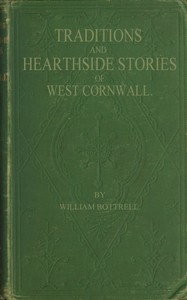
Traditions and Hearthside Stories of West Cornwall, Second Series — Reading Companion
(6 User reviews)
997
Project Gutenberg
2013
Not confirmed
Legends -- England -- Cornwall (County); Cornwall (England : County) -- Social life and customs
Readers of public-domain and historical texts
Project Gutenberg digital edition
en
Edition facts
Words
138,087
Reading time
601 min
Text sections
16
The catalog record for Traditions and Hearthside Stories of West Cornwall, Second Series — Reading Companion provides practical reading context through 138,087 words, 10 hr 1 min estimated reading time, and 16 detected text sections.
The text analysis averages about 28.1 words per sentence, while the detected sections provide another way to judge how the source is divided.
Project Gutenberg metadata also associates the work with “Legends -- England -- Cornwall (County),” connecting these edition facts with the source record’s subject description.
Source:
Project Gutenberg record #41761
This editorial note examines William Bottrell's use of dialect, vivid description, and folk motifs in his second series of Cornish tales, focusing on how his narrative voice and structural choices shape the stories.
Editorial Edition Score
4.9/5
★★★★★
★★★★★
Calculated from edition completeness, EPUB availability, text structure and catalogue metadata. Not a user rating.
How this score is calculated
- Description quality20 pts
- Title & short description10 pts
- Source metadata20 pts
- Text length15 pts
- Chapters / structure15 pts
- EPUB file integrity20 pts
Total of 100 points, scaled to a 2.5-5.0 range. Editions with an empty description or a missing EPUB file are not scored.
Edition quality
Read the Text
There was a great friendship between Duffy and Old Betty, who worked the mill, because this old dame, having long had strange dealings, saw at once, by a stocking Duffy pretended to be knitting, that a stitch was always down and that the work was none of hers.
In the evening, Duffy hearing, when she came in, the devil still spinning, thought she would see him at work and try to learn something. Looking through the latch-hole she saw what she took to be a woman, seated, and spinning with a small treddle-turn such as is used for spinning thread, and the wool-turn (with a wheel as large as that of a coach) put aside. When she looked around she knew that it was only the devil dressed in clothes like what she wore. He had on a loose bed-gown, petticoat, and towser (large coarse apron or wrapper,) with a nackan (large 'kerchief) thrown loosely over his head and shoulders. As Duffy entered, he turned around and said, "How are'e, my dear? Here I am, you see, busy at work for'e. See what I've already spun," he continued, pointing to a heap of balls in the corner, and skeins of yarn hanging on the walls.
She stood wondering, with eyes and mouth wide open, to see how handy the devil spun, and yet seemed to do nothing with his hands but pull off the yarn whilst his foot worked the treddle, and a ball dancing on the floor wound up itself!
"Arreah! faix," said Duffy, "I should have taken 'e for a woman if I hadn't chanced to spy your cloven foot, and your tail hanging down, and I don't much admire 'e in petticoats."
"There's good reason for wearing them, however," replied he; "besides, they are handy for such work, and if you will come here on Saturday night you will find, under that black fleece, ever so many pairs of stockings, both for you and the squire. I know his measure, and see if I don't well fit both of ye. So now good night."
Before she could wish him the same he disappeared, and all the yarn of his spinning along with him, leaving nothing to show that he had ever been there but a strong smell of brimstone.
Duffy didn't wait till dark night on Saturday, but went up to the wool-chamber about sunset. The Bucca-boo had just left work, and, having thrown off his petticoats, stood before her dressed like a sporting gentleman. He bowed as she entered and, handing her half-a-dozen pairs of stockings, all as strong as broadcloth and as fine as silk, said, "Excuse me, my dear, from staying a moment longer, as I must be away before Buryan bells are rung; else, some mishap may befall me."
"I wish 'e well till I see 'e again, and thank 'e, Mr. What-shall-I-call-'e," said Duffy, taking the stockings from his hand.
"You may call me captain," he replied, and vanished in a flash of lightning with a roar of thunder that shook the house.
On Sunday morning, when Squire Lovell was getting ready to don his velvet suit, that he might ride to church in grand state, as was his wont, Duffy brought him a pair of stockings suitable for the occasion.
"You see, master," said she, "that I havn't been idle, to spin and knit ye a pair of such long stockings in three days and the work so fine too." He put on the stockings, admired the beautiful knitting and good fit; then to show his delight at having such nice hose, the like of which were never on his legs before, he kissed Duffy again and again.
It was late when he reached Church-town. After churching, he stopped, as usual, to exchange greetings with other gentry of Buryan. Everyone admired his fine stockings. The ladies enquired how and where he procured them, saying there was no one in the parish who could do such good work; one and all declared they were fit for a king.
The fame of Squire Lovell's stockings drew crowds of people to Buryan church on the following Sunday. Old and young wanted to feel his legs. They couldn't be satisfied with looking, and so they continued to come from farther and farther, Sunday after Sunday. Church-town, for some weeks, was full of people like on a fair or feasten tide.
William Bottrell's Traditions and Hearthside Stories of West Cornwall, Second Series (1873) opens with a Christmas play, 'Duffy and the Devil,' immediately establishing the collection's grounding in performed folk tradition. Bottrell's authorial voice is notable for its blend of antiquarian precision and storytelling verve, often shifting between a collector's detached frame and a narrator's intimate, colloquial tone. The excerpts reveal a writer attentive to the rhythms of oral speech, embedding local dialect and proverbial phrasing into his prose. His descriptions of landscape and custom are dense with sensory detail—the 'load-stone rocks,' the 'black waters' of the Dead Sea—and he frequently uses direct dialogue to advance plot and characterize, as seen in the heated exchange between Nancy and her mother. This note explores three key authorial choices: the use of a framing narrator, the integration of supernatural and mundane, and the role of material culture in anchoring belief.
The Collector as Storyteller
Bottrell does not present himself as a mere transcriber. In the excerpt from 'A Legend of Pargwarra,' he adopts a knowing, slightly ironic stance toward his informants' credulity. The sailor William's tales of the Red Sea and Lot's wife are introduced with the phrase 'he assured them,' signaling that Bottrell is reporting rather than endorsing. Yet the narrator also indulges in the same vivid hyperbole, describing 'black clouds of doomed spirits' and 'apples full of ashes.' This dual voice—part folklorist, part raconteur—allows Bottrell to preserve the flavor of oral performance while maintaining scholarly distance. The effect is a text that feels both documentary and literary, as if the reader is overhearing a fireside session filtered through a literate sensibility.
Dialogue as a Window into Social Hierarchy
Bottrell's dialogue is a primary vehicle for character and conflict. In the Pargwarra story, the mother's reproach to Nancy—'What a fool thou must be… to throw thyself away'—uses the second-person singular 'thou' to mark her as a speaker of dialect, while her argument hinges on class: 'one so much beneath thy degree.' Nancy's defiant reply, 'but little care I for relations' reproach,' employs a parallel structure that underscores her resolve. Bottrell renders these exchanges with minimal authorial intrusion, letting the characters' words reveal their social positions and emotional states. The father's compromise—a three-year trial—is delivered in a single, measured sentence, contrasting with the mother's sharpness. Such choices suggest Bottrell was as interested in the tensions of rural society as in the supernatural tales themselves.
Objects and Rituals as Narrative Anchors
Bottrell frequently grounds supernatural or romantic plots in tangible objects and rituals. The broken gold ring, the 'living spring,' and the fire on the 'Garrack Zans' (holy rock) in the Pargwarra excerpt are not mere decoration; they serve as physical evidence of vows and as mnemonic devices for the listener. The ring is 'broken in two between them,' each keeping a part—a concrete symbol of separation and promise. Similarly, the sailor's promise to build 'a castle of ivory and diamonds' is a hyperbolic object that nonetheless anchors the lovers' hopes. Bottrell's attention to such material details—the 'load-stone rocks,' the 'fingers' of Lot's wife—reflects a folk tradition where belief is inseparable from place and thing. These objects also function as plot points: the ring's breaking anticipates the story's outcome, while the holy rock's location ('Roskestal town-place') ties the tale to a specific geography.
The Rhythm of Repetition and Incremental Detail
Bottrell's prose often employs repetition and incremental listing, a technique borrowed from oral storytelling. In the sailor's account, he piles marvel upon marvel: 'the wreck of Pharaoh's chariots,' 'the Dead Sea across which no bird could fly,' 'apples full of ashes.' Each detail is introduced with 'he had seen' or 'he told them of,' creating a cumulative effect that mimics a storyteller building suspense. This pattern recurs in the description of Nancy's admiration: 'She admired him for his stalwart form, for his strange adventures… and for the rare presents.' The triadic structure ('for… for… and for') gives the passage a ballad-like cadence. Bottrell's willingness to let such repetitions stand—rather than condensing them—preserves the oral texture of his sources, even as his written medium imposes a fixed form.
Readers approaching this collection should attend to the interplay between Bottrell's editorial persona and the voices he records. His choices in diction, dialogue, and descriptive detail reveal a writer deeply engaged with the craft of storytelling, even as he purports to simply transmit tradition. The tales reward close reading for their linguistic texture and social nuance, not merely as folklore specimens. To appreciate Bottrell's achievement, one must listen for the echoes of the hearthside in his prose.
There’s a particular ache in Bottrell’s hearthside tales—how every方言 word feels like a hand reaching back. Reading him, I often think of the vast, dry quiet in Myths and Legends of California and the Old Southwest — Story, Setting & Ideas, where distance itself becomes a kind of character. Both leave a feeling of listening to something older than the page.
-

Ryan Smith - 4 weeks ago
The stories are presented without much comment or analysis, which makes them feel dry. The writing is old-fashioned and may put off casual readers. Additionally, the lack of illustrations and annotations doesn't help immerse you in the culture. Perhaps more background would have improved the experience. -
Elijah Reed - 2 weeks ago
A delightful collection of Cornish folk tales that transports you to a world of myth and legend. The second series expands on the first with even more enchanting stories of piskies, giants, and mermaids. The author's deep knowledge and love for the region shine through, making this a must-read for folklore enthusiasts. -
Chelsea Stewart - 2 weeks ago
The book offers a good selection of Cornish hearthside stories, with interesting local flavor. However, some tales feel repetitive and the language is a bit dated, which might be a hurdle for modern readers. Overall, it's a decent read for those interested in regional folklore.
Reader reflection
How did this book work for you?
Your answers remain private and are stored only in this browser.
Your progress
0
/
10
2
Was reading this book enjoyable?
3
How likely are you to recommend this book?
4
Did the language feel accessible?
5
Did you relate to its people, ideas, or situations?
6
How useful did the reading feel?
7
How understandable was the text?
8
Did the book deliver what you hoped for?
9
In one sentence, what did you learn?
10






Ella Perez
1 month ago