
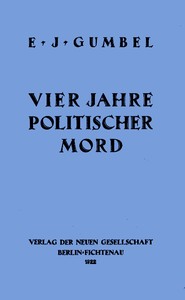
Vier Jahre Politischer Mord by Emil Julius Gumbel
Published in 1922, Vier Jahre Politischer Mord (Four Years of Political Murder) is not a traditional narrative. Emil Julius Gumbel, a statistician and pacifist, presents a forensic study of the political violence that shook Germany from 1919 to 1922. He methodically catalogs hundreds of assassinations and attacks, primarily carried out by far-right paramilitary groups like the Freikorps against leftists, socialists, and republicans.
The Story
Gumbel tells two parallel stories. The first is a grim ledger of violence: names, dates, and methods. The second, and more powerful story, is in the numbers and legal outcomes. He compares the treatment of right-wing and left-wing perpetrators. The pattern he reveals is stark. Right-wing assassins received shockingly light sentences, often being acquitted or pardoned by sympathetic judges. Left-wing offenders, in contrast, were frequently executed or given severe prison terms. Gumbel's "plot" is the systematic exposure of a two-tiered justice system, showing how the institutions meant to protect the new Weimar Republic were often undermining it from within.
Why You Should Read It
This book hits you not with emotion, but with cold, irrefutable data. There's a quiet, building horror in seeing the injustice laid out so clearly in tables and case summaries. Gumbel isn't shouting; he's presenting the receipts. You watch him document the normalization of political violence and the erosion of the rule of law. It makes you think hard about how bias operates not just in chaotic streets, but in courtrooms and newspaper offices. Reading it today, with the benefit of knowing what followed in 1933, is an unnerving experience. You see the warning signs posted in plain sight, documented by a brave man who was later forced into exile for his work.
Final Verdict
This is essential reading for anyone interested in modern history, political science, or social justice. It's perfect for readers who appreciate true-crime investigations, but on a societal scale. If you've ever wondered how a society can slide towards authoritarianism, Gumbel's book provides a clinical, step-by-step case study. Be warned: it's a dense, academic read at times, not a light novel. But its power lies in its clarity and its frightening prescience. It’s a book that stays with you, a reminder of the importance of counting, naming, and remembering.
No rights are reserved for this publication. It is available for public use and education.
Brian Martin
6 months agoFast paced, good book.
Charles Allen
10 months agoEssential reading for students of this field.

Oliver Martinez
4 months agoEssential reading for students of this field.