1

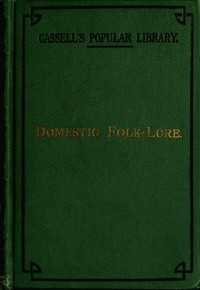
Domestic folk-lore — Text and Context
(9 User reviews)
2438
Project Gutenberg
2014
Not confirmed
Folklore; Superstition
Readers of public-domain and historical texts
Project Gutenberg digital edition
en
Edition facts
Words
53,665
Reading time
234 min
Text sections
8
Before opening Domestic folk-lore — Text and Context, the edition data offers a quick orientation: 53,665 words, 3 hr 54 min estimated reading time, and 8 detected text sections.
The text analysis averages about 31.2 words per sentence, while the detected sections provide another way to judge how the source is divided.
Project Gutenberg metadata also associates the work with “Folklore,” connecting these edition facts with the source record’s subject description.
Source:
Project Gutenberg record #47053
This editorial note examines T. F. Thiselton-Dyer's catalog of domestic superstitions, focusing on his use of literary allusions, proverbial rhymes, and shifts between scholarly and anecdotal registers to document fading folk beliefs.
Editorial Edition Score
4.7/5
★★★★★
★★★★★
Calculated from edition completeness, EPUB availability, text structure and catalogue metadata. Not a user rating.
How this score is calculated
- Description quality20 pts
- Title & short description10 pts
- Source metadata20 pts
- Text length15 pts
- Chapters / structure15 pts
- EPUB file integrity20 pts
Total of 100 points, scaled to a 2.5-5.0 range. Editions with an empty description or a missing EPUB file are not scored.
Edition quality
Read the Text
BIRTH AND INFANCY. PAGE
Value of Superstitions--Lucky Days and Hours of Birth--The Caul--The Changeling--The Evil Eye--"Up and not Down"--Rocking the Empty Cradle--Teeth, Nails, and Hands--The Maple and the Ash--Unchristened Children 1
Nursery Literature--The Power of Baptism--Confirmation--Popular Prayers--Weather Rhymes--School Superstitions--Barring out 16
Love-tests--Plants used in Love-charms--The Lady-bird--The Snail--St. Valentine's Day--Midsummer Eve--Hallowe'en--Omens on Friday 23
Seasons and Days propitious to Marriage--Superstitions connected with the Bride--Meeting a Funeral--Robbing the Bride of Pins--Dancing in a Hog's Trough--The Wedding-cake--The Ring 36
Warnings of Death--The Howling of Dogs--A Cow in the Garden--Death-presaging Birds--Plants--The Will-o'-the-Wisp--The Sympathy between Two Personalities--Prophecy--Dying Hardly--The Last Act--Place and Position of the Grave 48
Superstitions about Deformity, Moles, &c.--Tingling of the Ear--The Nose--The Eye--The Teeth--The Hair--The Hand--Dead Man's Hand--The Feet 65
New Clothes at Easter and Whitsuntide--Wearing of Clothes--The Clothes of the Dead--The Apron, Stockings, Garters, &c.--The Shoe--The Glove--The Ring--Pins 81
Thirteen at Table--Salt-spilling--The Knife--Bread, and other Articles of Food--Wishing Bones--Tea-leaves--Singing before Breakfast--Shaking Hands across the Table 100
Folk-lore of the Looking-glass--Luck of Edenhall-- Clock-falling--Chairs--Beds--The Bellows 111
HOUSEHOLD SUPERSTITIONS.
Prevalence and Continuity of Superstitions--Sneezing-- Stumbling--A Whistling Woman--Sweeping--Breaking Crockery--Fires and Candles--Money--Other Superstitions 120
Bible and Key--Dipping--Sieve and Shears--Crowing of the Cock--Spatulamancia--Palmistry and Onymancy--Look-divination-- Astrology--Cards--Casting Lot--Tea-stalks 134
Charm-remedies--For Ague--Bleeding of the Nose--Burns--Cramp-- Epilepsy--Fits--Gout--Headache, &c. 148
MISCELLANEOUS HOUSEHOLD LORE.
Horse-shoes--Precautions against Witchcraft--The Charmer--Second Sight--Ghosts--Dreams--Nightmare 169
Value of Superstitions--Lucky Days and Hours of Birth--The Caul--The Changeling--The Evil Eye--"Up and not Down"--Rocking the Empty Cradle--Teeth, Nails, and Hands--The Maple and the Ash--Unchristened Children.
Around every stage of human life a variety of customs and superstitions have woven themselves, most of which, apart from their antiquarian value, as having been bequeathed to us from the far-off past, are interesting in so far as they illustrate those old-world notions and quaint beliefs which marked the social and domestic life of our forefathers. Although, therefore, many of these may appear to us meaningless, yet it must be remembered that they were the natural outcome of that scanty knowledge and those crude conceptions which prevailed in less enlightened times than our own. Probably, if our ancestors were in our midst now, they would be able in a great measure to explain and account for what is often looked upon now-a-days as childish fancy and so much nursery rubbish. In the present chapter it is proposed to give a brief and general survey of the folk-lore associated with birth and infancy, without, however, entering critically into its origin or growth, or tracing its transmigration from one country to another. Commencing, then, with birth, we find that many influences are supposed to affect the future fortune and character of the infant. Thus, in some places great attention is paid to the day of the week on which the child is born, as may be gathered from the following rhyme still current in Cornwall:--
"Sunday's child is full of grace, Monday's child is full in the face, Tuesday's child is solemn and sad, Wednesday's child is merry and glad, Thursday's child is inclined to thieving, Friday's child is free in giving, Saturday's child works hard for his living"--
a piece of folk-lore varying, of course, in different localities. By general consent, however, Sunday is regarded as a most lucky day for birth, both in this country and on the Continent; and according to the "Universal Fortune-teller"--a book very popular among the lower classes in former years--"great riches, long life, and happiness" are in store for those fortunate beings born on Sunday, while in Sussex they are considered safe against drowning and hanging. Importance is also attached to the hour of birth; and the faculty of seeing much that is hidden from others is said to be granted to children born at the "chime hours," _i.e._, the hours of three, six, nine, or twelve--a superstition found in many parts of the Continent. There is, too, an idea prevalent in Germany that when a child is born in leap-year either it or its mother will die within the course of the year--a notion not unknown in our own country. Again, from time immemorial various kinds of divination have been in use for the purpose of discovering the sex of an infant previous to its birth. One of these is by means of a shoulder-of-mutton bone, which, after the whole of the flesh has been stripped clean off, must be hung up the last thing at night over the front door of the house. On the following morning the sex of the first person who enters, exclusive of the members of the household, indicates the sex of the child.
Thiselton-Dyer's Domestic Folk-lore opens with a defense of the field, quoting a Standard writer who claims folklorists “tread on no man's toes” and “grow scientifically rich on the refuse which less skilful craftsmen toss aside as useless.” The preface establishes a tension between the antiquarian's desire to preserve and the modern forces—school boards and railways—that are “fast sweeping away every vestige of the old beliefs.” This framing sets the tone for a work that moves between scholarly cataloguing and affectionate preservation.
Literary Allusions as Evidence
Thiselton-Dyer frequently supports his claims with quotations from Shakespeare and other canonical writers. For example, when discussing rings, he cites Titus Andronicus (act 2, sc. 3) to illustrate the belief that a precious ring “lightens all the hole” of a pit. He also draws on the story of Sir Thomas Overbury to note that diamonds were once considered both an antidote to poison and a deadly poison themselves. These literary references serve a dual purpose: they anchor folk beliefs in recognizable cultural touchstones and demonstrate that superstition was not confined to the uneducated. The author's method is to present the belief, then provide a literary or historical example, often without analyzing the connection. This pattern gives the text a cumulative, encyclopedic quality rather than a narrative arc.
Proverbial Rhymes and Oral Formulas
Interspersed among the prose are rhyming couplets that encapsulate folk wisdom. The well-known pin rhyme—“See a pin and pick it up, / All the day you'll have good luck”—appears alongside a less familiar verse on keepsake rings: “Oh, green is forsaken, / And yellow is forsworn, / But blue is the prettiest colour that's worn.” These snippets offer a direct glimpse into the oral tradition Thiselton-Dyer aims to document. He rarely comments on the rhyme's origin or variation, instead letting the verse stand as evidence. The inclusion of such formulas creates a rhythmic break from the otherwise expository prose, mimicking the way these sayings would have been passed down. Readers should note that the author treats these rhymes as self-explanatory artifacts, not as puzzles to be solved.
Shifts in Register and Pace
The text alternates between detached scholarly observation and more engaged, almost anecdotal passages. In the preface, Thiselton-Dyer adopts a formal, academic voice, citing the origin of the term “folk-lore” and lamenting the erosion of tradition. Later, when describing a Devonshire case of “pin-sticking” witchcraft, the prose becomes more narrative: “A landlord having lost one of his tenants, certain repairs and improvements were found necessary… there was found carefully secreted a pig's heart stuck all over with thin prickles.” This shift from general principle to specific, almost sensational example injects a change of pace that keeps the reader's attention. The author does not signal these transitions; they occur naturally as he moves from category to category. The effect is a work that feels both systematic and digressive, mirroring the sprawling nature of its subject.
Readers approaching Domestic Folk-lore should treat it as a compendium rather than a continuous argument. The book rewards browsing: each section can be read independently, and the index of superstitions allows for targeted searches. Pay attention to the footnotes and marginal references, which often point to earlier folklorists or local newspapers. Thiselton-Dyer's voice is that of a Victorian clergyman-scholar—earnest, occasionally wry, and deeply invested in preserving what he saw as a vanishing world.
Flipping through Thiselton-Dyer’s catalogue, I felt a familiar ache for voices nearly lost—those murmured household charms and proverbial shrugs. It reminded me, unexpectedly, of reading Stories the Iroquois Tell Their Children — A Closer Reading, where every tale carries the same quiet weight of a world trying to remember itself. Both books feel less like archives and more like held breath.
Sophia Smith
2 weeks agoNoah Robinson
1 month agoDaniel Taylor
3 weeks agoOliver Carter
3 weeks ago-

Scott Ellis - 1 month ago
Domestic Folk Lore fails to deliver a cohesive narrative, instead presenting a jumble of loosely connected facts and anecdotes. The writing is dry and lacks engaging storytelling, making it feel more like a textbook than a work of cultural exploration. The lack of citations and rigorous analysis undermines its credibility. It's not a terrible book, but it's certainly not compelling reading. -
Edwin Key - 1 month ago
This book offers a broad overview of domestic folklore, covering a wide range of customs and beliefs. It's informative and well-organized, making it a useful reference. However, the depth of analysis is inconsistent, and some sections feel more like lists than discussions. Still, it's a decent starting point for those curious about superstitious practices and traditions. -
Amanda Joshua Tyler - 2 weeks ago
Domestic Folk Lore is a delightful and insightful exploration of the traditions and superstitions that have shaped everyday life. The author presents a wealth of practices, from household charms to festive customs, with clarity and wit. It's not just an informational read but a journey into the heart of cultural heritage. The book is well-researched and provides a fascinating perspective on the origins of our daily habits. A must-have for anyone interested in folklore.
Reader reflection
How will you remember this book?
Save your reaction, strongest insight, and memorable passage.
Your progress
0
/
10
2
What was your overall reaction to the book?
3
How likely are you to recommend this book?
4
How much effort did this book require?
5
Was the book what you thought it would be?
6
How strong was your personal connection to the text?
7
Would a second reading be valuable?
8
Could you apply anything you learned?
9
What changed or sharpened your thinking?
10






Elijah Scott
1 month ago