1

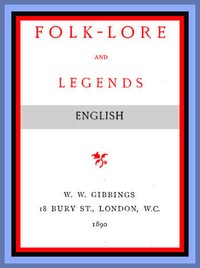
Folk-Lore and Legends: English — Background and Themes
(1 User reviews)
306
Project Gutenberg
2014
Not confirmed
Tales -- England; Legends -- England
Readers of public-domain and historical texts
Project Gutenberg digital edition
en
Edition facts
Words
48,084
Reading time
210 min
Text sections
7
For Folk-Lore and Legends: English — Background and Themes, the stored edition analysis reports 48,084 words, 3 hr 30 min estimated reading time, and 7 detected text sections.
The text analysis averages about 25.8 words per sentence, while the detected sections provide another way to judge how the source is divided.
Project Gutenberg metadata also associates the work with “Tales -- England,” connecting these edition facts with the source record’s subject description.
Source:
Project Gutenberg record #47408
This editorial note examines the authorial choices in Charles John Tibbitts's 1890 collection of English folklore, focusing on the editor's introductory remarks, the inclusion of Joseph Ritson's scholarly 'Dissertation on Fairies,' and the vigorous prose of tales like 'Thomas Hickathrift.' Observations are drawn from the editor's stated principles, the juxtaposition of academic and vernacular voices, and the physical comedy in the Hickathrift excerpt.
Editorial Edition Score
4.7/5
★★★★★
★★★★★
Calculated from edition completeness, EPUB availability, text structure and catalogue metadata. Not a user rating.
How this score is calculated
- Description quality20 pts
- Title & short description10 pts
- Source metadata20 pts
- Text length15 pts
- Chapters / structure15 pts
- EPUB file integrity20 pts
Total of 100 points, scaled to a 2.5-5.0 range. Editions with an empty description or a missing EPUB file are not scored.
Edition quality
Read the Text
oures and other holy freres, That serchen every land, and every streme, As thickke as motes in the sunnebeme, Blissing halles, chambres, kichenes, and boures, Citees and burghes, castles highe and toures, Thropes and bernes, shepenes and dairies, This maketh that ther ben no faeries.”
(_Wif of Bathes Tale._)
The fairy may be defined as a species of being partly material, partly spiritual, with a power to change its appearance, and be, to mankind, visible or invisible, according to its pleasure. In the old song, printed by Peck, Robin Goodfellow, a well–known fairy, professes that he had played his pranks from the time of Merlin, who was the contemporary of Arthur.
Chaucer uses the word _faërie_ as well for the _individual_ as for the _country_ or _system_, or what we should now call _fairy–land_, or _faryism_. He knew nothing, it would seem, of _Oberon_, _Titania_, or _Mab_, but speaks of—
“Pluto, that is the King of Faerie, And many a ladie in his compagnie, Folwing his wif, the quene Proserpina, etc.”
(_The Marchantes Tale_, i. 10101.)
From this passage of Chaucer Mr. Tyrwhitt “cannot help thinking that his _Pluto_ and _Proserpina_ were the true progenitors of _Oberon_ and _Titania_.”
In the progress of _The Wif of Bathes Tale_, it happed the knight,
“——in his way ... to ride In all his care, under a forest side, Whereas he saw upon a dance go Of ladies foure–and–twenty, and yet mo. Toward this ilke dance, he drow ful yerne, In hope that he som wisdom shulde lerne, But, certainly, er he came fully there, Yvanished was this dance, he wiste not wher.”
These _ladies_ appear to have been _fairies_, though nothing is insinuated of their size. Milton seems to have been upon the prowl here for his “forest–side.”
In _A Midsummer–Night’s Dream_, a fairy addresses Bottom the weaver—
“Hail, _mortal_, hail!”
which sufficiently shows she was not so herself.
Puck, or Robin Goodfellow, in the same play, calls Oberon,
“——King of _shadows_,”
and in the old song just mentioned,
“The King of _ghosts_ and _shadows_,”
and this mighty monarch asserts of himself, and his subjects,
“But we are _spirits_ of another sort.”
The fairies, as we already see, were male and female. Their government was monarchical, and Oberon, the King of Fairyland, must have been a sovereign of very extensive territory. The name of his queen was Titania. Both are mentioned by Shakespeare, being personages of no little importance in the above play, where they, in an ill–humour, thus encounter:
Obe. Ill met by moonlight, proud Titania.
Tita. What, jealous Oberon? Fairy, skip hence; I have forsworn his bed and company.
That the name [Oberon] was not the invention of our great dramatist is sufficiently proved. The allegorical Spenser gives it to King Henry the Eighth. Robert Greene was the author of a play entitled “The Scottishe history of James the Fourthe ... intermixed with a pleasant comedie presented by _Oberon, king of the fairies_.” He is, likewise, a character in the old French romances of _Huon de Bourdeaux_, and _Ogier le Danois_; and there even seems to be one upon his own exploits, _Roman d’ Auberon_. What authority, however, Shakespeare had for the name Titania, it does not appear, nor is she so called by any other writer. He himself, at the same time, as well as many others, gives to the queen of fairies the name of Mab, though no one, except Drayton, mentions her as the wife of Oberon:
“O then, I see, queen Mab hath been with you, She is the fairy’s midwife, and she comes In shape no bigger than an agate–stone On the fore–finger of an alderman, Drawn with a team of little atomies Athwart men’s noses as they lie asleep; Her waggon–spokes made of long spinner’s legs; The cover, of the wings of grasshoppers; The traces, of the smallest spider’s web; The collars, of the moonshine’s wat’ry beams: Her whip, of cricket’s bone; the lash, of film: Her waggoner, a small grey–coated gnat, Not half so big as a round little worm Pricked from the lazy finger of a maid: Her chariot is an empty hazel–nut, Made by the joiner squirrel, or old grub, Time out of mind the fairies’ coachmakers. And in this state she gallops night by night Through lovers’ brains, and then they dream of love! ... This is that very Mab, That plats the manes of horses in the night; And bakes the elf–locks in foul sluttish hairs, Which, once untangled, much misfortune bodes.”
(_Romeo and Juliet._)
Charles John Tibbitts opens his 1890 collection with a lament: 'The old English Folklore Tales are fast dying out.' This editorial stance—part preservationist, part elegist—shapes the volume's selection and presentation. Tibbitts claims to have sought 'the earliest editions' of nursery tales, though he admits to 'some excision and slight alteration.' The result is a hybrid work that juxtaposes scholarly apparatus, such as Joseph Ritson's 'A Dissertation on Fairies,' with robust vernacular narratives like 'The History of Jack and the Giants' and 'The History of Thomas Hickathrift.'
The excerpts reveal a deliberate contrast in diction. Ritson's dissertation employs formal, allusive prose, tracing fairies to Homer's nymphs and invoking Shakespeare. In contrast, the Hickathrift tale uses colloquial, action-driven language: 'the tinker struck a tall man, just upon the nape of the neck, with that force that his head flew off.' This editorial choice to include both registers suggests an attempt to legitimize folklore while preserving its oral vitality.
Editorial Principles and Their Traces
Tibbitts's introductory note is a rare moment of editorial transparency. He states that 'the simplicity of character necessary for the retaining of old memories and beliefs is being lost' and that he has 'taken every care to alter only as much as was absolutely necessary.' This claim is testable against the excerpts. In the Hickathrift tale, the prose is vigorous and unexpurgated: heads fly, millers are used as weapons, and the king grants knighthood with theatrical ceremony. The editor's hand may be light here, but the note itself signals a tension between fidelity and modernization. The phrase 'some excision and slight alteration' hints at bowdlerization, though the surviving text retains graphic violence and broad comedy.
The Scholarly Frame: Ritson's Dissertation
Joseph Ritson's 'A Dissertation on Fairies' occupies the opening pages, grounding the collection in antiquarian scholarship. Ritson traces fairy lore to classical nymphs, citing Homer's Iliad and Odyssey in translation: 'The wat'ry Fairies dance in mazy rings.' He aligns English fairies with the fées of French and Italian romance, emphasizing their 'inexpressible beauty' and 'magic or supernatural power.' This academic tone contrasts sharply with the tales that follow. The inclusion of Ritson—a noted but controversial antiquary—suggests Tibbitts's desire for intellectual credibility. Yet the dissertation's abstract, literary references sit uneasily beside the earthy, physical narratives of Jack and Hickathrift, creating a deliberate or perhaps unresolved generic tension.
Vernacular Vigour in 'Thomas Hickathrift'
The excerpt from 'The History of Thomas Hickathrift' showcases a markedly different register. The prose is paratactic and event-driven: 'Every blow which they struck laid twenty or thirty before them.' Dialogue is blunt and confrontational: 'Scoundrel! quoth Tom, better words should become you.' The narrative revels in physical hyperbole—a head 'carried violently fourteen feet'—and in the absurd image of Tom wielding 'a lusty, stout, raw-boned miller' as a weapon. This is folklore as popular entertainment, not scholarly artifact. The king's speech, with its mock-heroic praise ('They are the men that overcame and conquered ten thousand'), parodies courtly rhetoric. Tibbitts's editorial choice to retain such passages preserves the tale's oral, performative quality, even as the collection's framing seeks to elevate it.
Recurring Motifs: Violence, Justice, and the Supernatural
Across the excerpts, certain patterns emerge. Violence is both graphic and formulaic: heads are severed, crowds are mown down, and justice is summary. In Hickathrift, the rebels are 'made public examples of justice' after being beaten. The supernatural appears in Ritson's classical framework and in the tale titles—'The Fairies’ Cup,' 'The Worm of Lambton'—but the Hickathrift excerpt is notably secular, relying on human strength and cunning. The editor's note mourns the loss of 'the poetry of life,' yet the tales themselves are often prosaic in their brutality. This disjunction between editorial nostalgia and textual reality is one of the collection's most interesting features, suggesting that Tibbitts's 'folklore' is as much a constructed category as a living tradition.
Readers approaching this collection should attend to the interplay between its scholarly and popular elements. Tibbitts's editorial interventions, though sparingly acknowledged, shape the reader's experience. The tales reward attention to their verbal textures—the rhythm of dialogue, the escalation of violence, the intrusion of the marvelous. Rather than seeking a unified 'folk' voice, one may find greater interest in the tensions between Ritson's classical allusions and Hickathrift's raw physicality. This is a volume that, in its very unevenness, documents the late-Victorian effort to preserve and package English folklore for a literate audience.
Reading about Tibbitts’s earnest gathering of fairy lore reminds me of evenings when I’d whisper local legends to myself, half-believing. That same tender uncertainty returned with Busy Brownies — A Closer Reading, where household spirits felt less like stories and more like quiet presences lingering near the hearth, patient and unobserved.
There are no comments for this eBook.
Reader reflection
How did this book work for you?
Your answers remain private and are stored only in this browser.
Your progress
0
/
10
2
How much did you enjoy the reading experience?
3
Is this a title you would suggest to others?
4
How demanding did the text feel?
5
Was the book easy to understand?
6
How valuable was this book for your own interests?
7
Did this book create an emotional response?
8
How closely did the book connect with your experience?
9
What is the main idea you are taking away?
10
Owen Carter
1 month ago