
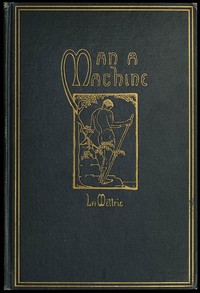
Man a Machine by Julien Offray de La Mettrie
Okay, let's set the scene. It's the mid-1700s in France. The Church and most philosophers believe humans have a special, immaterial soul that makes us different from animals. Enter Julien Offray de La Mettrie, a physician. After a serious illness, he becomes convinced that his mental states were directly tied to his physical condition. So, he writes a short, fiery essay called Man a Machine (L'Homme Machine).
The Story
There isn't a plot with characters, but there's a clear argument. La Mettrie builds his case piece by piece. He starts by looking at animals, showing how their behavior seems mechanical. Then, he turns the lens on us. He uses medical and anatomical evidence to argue that everything we consider 'human'—thought, emotion, conscience, even the sense of right and wrong—comes directly from the physical organization of our brains and bodies. For him, the soul is just a word for brain function. He paints a picture of humans as complex, self-winding clocks, governed by physical laws. The conclusion is stark: we are sophisticated biological machines, nothing more.
Why You Should Read It
I picked this up out of historical curiosity and was blown by its audacity. Reading it feels dangerous, even now. La Mettrie's writing isn't dry; it's confident, almost gleeful in its rebellion. You can feel him poking the establishment with a stick. The power isn't in modern scientific accuracy (he gets plenty wrong), but in the sheer, radical simplicity of the idea. He took a sledgehammer to the wall separating mind and body 200 years before neuroscience became a field. It makes you question the foundations of your own self-perception. Are we just matter in motion? It's a chilling, thrilling, and fundamentally unsettling question that this little book plants in your head.
Final Verdict
This isn't for everyone. If you want a comforting read, look elsewhere. But if you're fascinated by the history of ideas, love a good intellectual scandal, or enjoy books that challenge your deepest assumptions, this is a must-read. It's perfect for philosophy dabblers, science history fans, or anyone who likes to see where our big cultural debates really started. Think of it as the punk rock manifesto of the Enlightenment—short, loud, and deliberately offensive to the powers that be. Just be ready for it to mess with your head.
This content is free to share and distribute. Thank you for supporting open literature.
Michael Martinez
8 months agoMy professor recommended this, and I see why.
Amanda Walker
6 months agoThe index links actually work, which is rare!
Thomas Taylor
11 months agoText is crisp, making it easy to focus.
Melissa Smith
1 year agoWithout a doubt, the flow of the text seems very fluid. A true masterpiece.



Elizabeth Lee
7 months agoFinally found a version that is easy on the eyes.