1

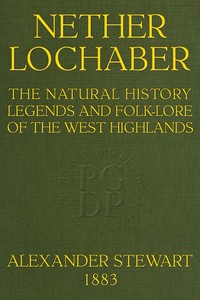
Nether Lochaber The Natural History, Legends, and Folk-lore of the West Highlands — Edition Insights
(5 User reviews)
1279
Project Gutenberg
2017
Not confirmed
Folklore -- Scotland -- Highlands; Natural history -- Scotland -- Highlands
Readers of public-domain and historical texts
Project Gutenberg digital edition
en
Edition facts
Words
142,577
Reading time
620 min
Text sections
65
The source record for Nether Lochaber The Natural History, Legends, and Folk-lore of the West Highlands — Edition Insights measures this digital text at 142,577 words, 10 hr 20 min estimated reading time, and 65 detected text sections.
The text analysis averages about 36.5 words per sentence, while the detected sections provide another way to judge how the source is divided.
Project Gutenberg metadata also associates the work with “Folklore -- Scotland -- Highlands,” connecting these edition facts with the source record’s subject description.
Source:
Project Gutenberg record #56157
A minister's collected newspaper essays on West Highland natural history and folklore, blending precise observations of flora, fauna, and landscape with local legends, Gaelic rhymes, and personal anecdotes from the 1880s.
Editorial Edition Score
4.9/5
★★★★★
★★★★★
Calculated from edition completeness, EPUB availability, text structure and catalogue metadata. Not a user rating.
How this score is calculated
- Description quality20 pts
- Title & short description10 pts
- Source metadata20 pts
- Text length15 pts
- Chapters / structure15 pts
- EPUB file integrity20 pts
Total of 100 points, scaled to a 2.5-5.0 range. Editions with an empty description or a missing EPUB file are not scored.
Edition quality
Read the Text
Primroses and Daisies in early March--"The Posie"--Burns--"The Ancient Mariner"--William Tennant, Author of "Anster Fair"--Hebridean Epithalamium--A Bard's Blessing--A Translation--Macleod of Berneray, 1
Autumnal Tints--Solomon and the Queen of Sheba--Sortes Sacræ--Sortes Virgilianæ--Charles the First and Lord Falkland--Virgilius the Magician--Thomas of Ercildoune, 8
An old Gaelic MS.--"The Bewitched Bachelor Unbewitched"--Fairy Lore--Lacteal Libations on Fairy Knowes, 18
Transit of Mercury--Improperly called an "Eclipse" of--November Meteors--Mr. Huggins--Spectrum Analyses of Cometary Light--Translation of a St. Kilda Song, 23
Bird Music--The Skylark's Song--Imitation of, by a French Poet--Alasdair Macdonald--Scott, 29
Severe Drought--The Drive by Coach from Fort-William to Kingussie--Breakfast at Moy--Where did Scott find Dominie Sampson's "Pro-di-gi-ous!"?--Professor Blackie's Poem on Glencoe, 33
O the Barren, Barren Shore--Brilliant Auroral Display--Intense Cold--Birds--Glanders--Scribblings on the Back of One Pound Notes, 39
A Wet February--A Good Time coming--Sir Walter Scott--Mr Gladstone--Death of Sir David Brewster, 44
Long-Line Fishing--Scarcity of Fish--Their Fecundity--Large Specimen of the Raia Chagrinea--The Wolf Fish--The Devil Fish, 50
Birds--Contest between a Heron and an Eel, 54
Sea-Fishing--Loch and Stream Fishing--"Brindled Worms"--Rush-Lights--Buckie-Shell Lamps--The Weasel killing a Hare--Killing a Fallow Deer Fawn, 58
Extraordinary aspect of the Sun--Sunset from Rokeby--Mr. Glaisher--"Demoiselle" or Numidian Crane at Deerness--The Snowy Owl in Sutherlandshire--Does the Fieldfare breed in Scotland?--The Woodcock, 66
Extraordinary Heat and Drought--Plentifulness of Fungi--Cows fond of Mushrooms--Shoals of Whales--A rippling breeze, and a Sail on Loch Leven, 70
Herrings--Chimæra Monstrosa--Cure for Ringworm--Cold Tea Leaves for inflamed and blood-shot Eyes--An old Incantation for the cure of Sore Eyes--A curious Dirk Sheath--A Tannery of Human Skins, 73
The Ring-Dove--A Pet Ring-Dove--Its Death--Shenstone--The Belone Vulgaris or Gar-Fish--A Rat and a Kilmarnock Night-cap--Extraordinary Roebuck's Head at Ardgour, 79
The "Annus Mirabilis" of Dryden--1870 a more wonderful Year in its way than 1666--Winter--Number of Killed and Wounded in the Franco-Prussian War--Battles of Langside, Tippermuir, Cappel--Carrier Pigeons--The Velocity with which Birds fly, 86
Signs of a severe Winter--The Little Auk or Auklet--The Gadwall--Falcons being trained by the Prussians to intercept the Paris Carrier Pigeons--Ballooning--The King of Prussia's Piety--John Forster--Solar Eclipse of 22d December 1870--The Government and the Eclipse--Large Solar Spots--Visible to the naked eye--Rev. Dr. Cumming--November Meteors, 94
November Rains: 1500 tons per Imperial Acre!--Rainfall in Skye--An old Gaelic Apologue--The Drover and his Minister--Grand Stag's Head--Scott as a Poet--Mr. Gladstone and Scott--An old Lullaby from the Gaelic, 99
Winter--Auroral Displays in the West Highlands always indicative of a coming Storm--Corvus Corax--Wonderful Ravens--Edgar Allan Poe, 106
Along the Shore after Birds--An Otter in pursuit of a Fish--Tame Otter at Bridge of Tilt: Employed in Fishing--His hatred of all sorts of Birds--"The Otter and Fox," a translation from the Gaelic, 114
Storms--An "inch" of Rain--Atherina Presbyter--Lophius Piscatorius--Mr. Mortimer Collins' misquotation from the Times, 121
Aurora Borealis--Unfavourable weather for Birds about St. Valentine's Day--The Water-Vole in the Rhi--In the Eden in Fifeshire--In the Black Water, Kinloch Leven--Does it feed on Salmon Fry and Ova?--The Kingfisher--Character of the Water-Vole--Note about the Hedgehog, 127
March--The Story of a Spanish Dollar--The Spanish Armada--The "Florida"--Faire-Chlaidh, or Watching of the Graveyard--Molehill Earth for Flowers, 133
The Beauty of the West Highland Seaboard--Dr. Aiton of Dolphinton--Dr. Norman Macleod--Specimen of Turtle-Dove (Columba Turtur) shot in Ardgour--The belief on the Continent of its value as a Household Pet--Bechstein--Male Birds dropping Eggs in confinement, 140
Thunderstorm--Potato Field in Bloom--The Hazel Tree--Hazel Nuts--Potato Shaws for Cattle--Ferns for Bedding Cattle--Marmion--Scott, 144
Harvest--Scythe and Sickle v. Reaping Machines--Potatoes--Garibaldi and Potatoes at Caprera--Fishing--Platessa Gemmatus, or Diamond Plaice--Mushrooms--The Poetry of Fairy Rings--Harvest-Home, 150
The disappearance of the glories of Autumn, and the advent of Winter--Innovations and Innovators--New Version of the Scriptures--The Milkmaid and her Fairy Lover, translated from the Gaelic, 159
Wild Birds' Nests in early April--Rook stealing Eggs frightened and almost captured--The Domestic Cock--What he was, and what he is--Sadly demoralised by intermixture with "Cochin-Chinas" and "Bramahpootras," 165
The Vernal Equinox--Beauty of Loch Leven--Astronomical Notes--How an old Woman supposed to possess the Evil Eye escaped a cruel death, 172
Midges and other Bloodsuckers--The Tsetse of South Africa--The Abyssinian Zimb--Livingstone--Adders and Grass Snakes--Lucan's Pharsalia--Celsus--Legend of St. John ante Portam Latinam, 178
The Leafing of the Oak and Ash--Splendid Stags' Heads--Edmund Waller--Old Silver-Plate buried for preservation in the '45--Mimicry in Birds--An accomplished Goldfinch, 185
Potato Culture--Sensibility of the Potato Shaw to Weather changes--The Carline Thistle--Burns--The true Carduus Scotticus--The old Dog-Rhyme, 192
A non-"Laughing" Summer--Rheumatic Pains--Old Gaelic Incantation for Cattle Ailments, 199
Early sowing recommended--Vitality of Superstitions--Capnomancy--Hazel Nuts: Frequent References to in Gaelic Poetry--How best to get at the full flavour of a ripe Hazel Nut, 204
Strength of Insects--Necrophorus Vespillo, or Burying-Beetle--Foetid smell of--How Willie Grimmond earned an Honest Penny in Glencoe, 210
Seaweed as a Fertiliser--Homer, Horace, Virgil--November Meteors--Gaelic Folk-Lore--A Curfew Prayer--A Bed Blessing--A Cattle Blessing--Rhyme to be said in driving Cattle to Pasture--"Luath," Cuchullin's Dog--Notes from the Outer Hebrides, 217
The Delights of Beltane Tide--Bishop Gawin Douglas--His Translation of the Æneid--The Fat of Deer--"Light and Shade" from the Gaelic--Mackworth Praed--Discovery of an old Flint Manufactory in the Moss of Ballachulish, 225
The Rev. Alexander Stewart’s Nether Lochaber began as a series of fortnightly papers in the Inverness Courier, and the book retains the episodic, conversational rhythm of its origin. Rather than a systematic treatise, it offers a sequence of field notes and reflections, moving from a March clump of primroses to the autumnal tints of birch and oak, from a transit of Mercury to the habits of the burying beetle. Stewart addresses his readers directly, often as if continuing an interrupted chat, and the text is punctuated by Gaelic rhymes, classical allusions, and the voices of his children or neighbours. The result is a work that feels less like a finished volume than a naturalist’s journal shared aloud.
From Newspaper Column to Book
Stewart explains in his prefatory note that he considered rewriting the papers for book publication but decided to keep them “very much the form in which they first attracted attention.” He feared that revision would interfere with their “prima cura directness of phrase and freshness of local colouring.” This decision shapes the reader’s experience: chapters begin abruptly, topics shift without transition, and the author’s voice remains that of a correspondent writing to a known audience. The book preserves the texture of serial publication, including occasional asides and the sense of a shared calendar—March primroses, autumn tints, a midsummer ramble. Readers should expect a collection of discrete essays rather than a continuous argument, and the table of contents, with its sixty-five chapters, serves as a map of subjects rather than a narrative arc.
The Naturalist’s Eye and the Storyteller’s Voice
Stewart’s observations are precise and often startling. In one extended passage, he describes a pair of burying beetles (Vespillo) working on a dead mole, noting their “indomitable perseverance” and the “foul and fœtid smell” that clings to his hand after handling the male beetle. He records the children’s reactions—they “scamper in all directions” vowing no more dealings with dead moles—and his own struggle to wash away the odour, finally resorting to “the viscous clay of the beach after the manner of soap.” Such scenes mingle scientific attention with personal anecdote, and the author’s voice is that of a participant, not a detached observer. He leans on his rake “as if it were a sceptre of prerogative and power,” and his daughters tease him with hypothetical interruptions. The natural history is never abstract; it is always embedded in a specific place and moment.
Gaelic Rhymes and Local Lore
Stewart acknowledges that the volume contains “many Gaelic rhymes and phrases which at the first blink may tend to startle and repel the southern reader.” He provides translations, but the original Gaelic remains in the text, preserving the sound and rhythm of the language. The folklore sections draw on local traditions—fairy knowes, lacteal libations, the “Bewitched Bachelor Unbewitched”—and Stewart treats these with the same seriousness he gives to natural phenomena. He does not dismiss the beliefs as superstition but records them as part of the landscape. The reader encounters a world where a fairy knowe is as real as a burying beetle, and where the author moves between the two without a change in tone. This integration of natural and supernatural, scientific and legendary, gives the book its distinctive character.
Movement Between Scenes
The book’s structure is governed by the rhythms of the West Highland year and the author’s own movements. A chapter may begin indoors, with a reference to a classical text or a newspaper, then shift to a hillside or a beach. Stewart uses the landscape as a stage: the mole and beetles are discovered in a field; the foul smell is finally washed away “sitting by a briny rock-pool.” The children’s voices and the author’s asides create a sense of ongoing life, and the reader is invited to follow the author from one observation to the next. The chapters are short, often no more than a few pages, and the transitions are abrupt, but this very abruptness mirrors the experience of walking through a varied terrain—stopping to examine a flower, then a beetle, then a legend, then moving on.
Stewart’s Nether Lochaber rewards a reader willing to move at the author’s pace, pausing over a beetle or a rhyme as the occasion demands. The book is best approached not as a reference work but as a series of encounters, each chapter a fresh start. The index is minimal, and the table of contents is the only guide; readers may wish to browse rather than read straight through. The West Highlands emerge not as a picturesque backdrop but as a place of precise detail—the smell of a beetle, the colour of a band, the sound of a Gaelic blessing—and the author’s voice, at once learned and familiar, makes the reader a companion on his rambles.
In the quiet hours, I think of Nether Lochaber’s minister, gathering Gaelic rhymes and moth-wings with equal reverence. That same patient wonder fills the old pages of Vikram and the Vampire; or, Tales of Hindu Devilry — Story, Setting & Ideas, where every jungle tale holds a careful truth. Both men listened to their landscapes, and their voices echo softly together.
William Johnson
2 weeks agoOlivia Scott
4 weeks agoCarter Williams
1 month agoJack Thomas
1 month agoThere are no comments for this eBook.
Reader reflection
How will you remember this book?
Save your reaction, strongest insight, and memorable passage.
Your progress
0
/
10
2
Was reading this book enjoyable?
3
Is this a title you would suggest to others?
4
How much effort did this book require?
5
What was its emotional impact?
6
How clearly were the main ideas presented?
7
How did the reading compare with what you expected?
8
Would this book work well in a reading group?
9
In one sentence, what did you learn?
10







Camila Brown
2 weeks ago