1

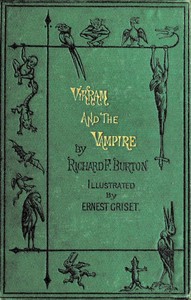
Vikram and the Vampire; or, Tales of Hindu Devilry — Story, Setting & Ideas
(5 User reviews)
1345
Project Gutenberg
2015
Not confirmed
Tales -- India; Vampires -- India -- Folklore; Hindus -- Folklore
Readers of public-domain and historical texts
Project Gutenberg digital edition
en
Edition facts
Words
82,050
Reading time
357 min
Text sections
21
The source record for Vikram and the Vampire; or, Tales of Hindu Devilry — Story, Setting & Ideas measures this digital text at 82,050 words, 5 hr 57 min estimated reading time, and 21 detected text sections.
The text analysis averages about 22.7 words per sentence, while the detected sections provide another way to judge how the source is divided.
Project Gutenberg metadata also associates the work with “Tales -- India,” connecting these edition facts with the source record’s subject description.
Source:
Project Gutenberg record #48511
Burton's frame-tale of King Vikram and a vampire's riddling stories blends Hindu folklore with ironic commentary on justice, kingship, and human folly, marked by ornate prose and a subversive narrative structure.
Editorial Edition Score
4.9/5
★★★★★
★★★★★
Calculated from edition completeness, EPUB availability, text structure and catalogue metadata. Not a user rating.
How this score is calculated
- Description quality20 pts
- Title & short description10 pts
- Source metadata20 pts
- Text length15 pts
- Chapters / structure15 pts
- EPUB file integrity20 pts
Total of 100 points, scaled to a 2.5-5.0 range. Editions with an empty description or a missing EPUB file are not scored.
Edition quality
Read the Text
e of time the father died. Thereupon his eldest heir, who was known as Shank, succeeded to the carpet of Rajaship, and was instantly murdered by Vikram, his ‘scorpion,’ the hero of the following pages.[15]
[15] History tells us another tale. The god Indra and the King of Dhara gave the kingdom to Bhartari-hari, another son of Gandharba-Sena, by a handmaiden. For some time, the brothers lived together; but presently they quarrelled. Vikram being dismissed from court, wandered from place to place in abject poverty, and at one time hired himself as a servant to a merchant living in Guzerat. At length, Bhartari-hari, disgusted with the world on account of the infidelity of his wife, to whom he was ardently attached, became a religious devotee, and left the kingdom to its fate. In the course of his travels, Vikram came to Ujjayani, and finding it without a head, assumed the sovereignty. He reigned with great splendour, conquering by his arms Utkala, Vanga, Kuch-behar, Guzerat, Somnat, Delhi, and other places; until, in his turn, he was conquered and slain by Shalivaban.
By this act of vigour and manly decision, which all younger-brother princes should devoutly imitate, Vikram having obtained the title of Bir, or the Brave, made himself Raja. He began to rule well, and the gods so favoured him that day by day his dominions increased. At length he became lord of all India, and having firmly established his government, he instituted an era—an uncommon feat for a mere monarch, especially when hereditary.
The steps,[16] says the historian, which he took to arrive at that pinnacle of grandeur, were these:
[16] The words are found, says Mr. Ward, in the _Hindu History_ compiled by Mrityungaya.
The old King calling his two grandsons Bhartari-hari and Vikramaditya, gave them good counsel respecting their future learning. They were told to master everything, a certain way not to succeed in anything. They were diligently to learn grammar, the scriptures, and all the religious sciences. They were to become familiar with military tactics, international law, and music, the riding of horses and elephants—especially the latter—the driving of chariots, and the use of the broadsword, the bow, and the mogdars or Indian clubs. They were ordered to be skilful in all kinds of games, in leaping and running, in besieging forts, in forming and breaking bodies of troops; they were to endeavour to excel in every princely quality, to be cunning in ascertaining the power of an enemy, how to make war, to perform journeys, to sit in the presence of the nobles, to separate the different sides of a question, to form alliances, to distinguish between the innocent and the guilty, to assign proper punishments to the wicked, to exercise authority with perfect justice, and to be liberal. The boys were then sent to school, and were placed under the care of excellent teachers, where they became truly famous. Whilst under pupilage, the eldest was allowed all the power necessary to obtain a knowledge of royal affairs, and he was not invested with the regal office till in these preparatory steps he had given full satisfaction to his subjects, who expressed high approval of his conduct.
The two brothers often conversed on the duties of kings, when the great Vikramaditya gave the great Bhartari-hari the following valuable advice:[17]
[17] These duties of kings are thus laid down in the _Rajtarangini_. It is evident, as Professor H. H. Wilson says, that the royal status was by no means a sinecure. But the rules are evidently the closet work of some pedantic, dogmatic Brahman, teaching kingcraft to kings. He directs his instructions, not to subordinate judges, but to the Raja as the chief magistrate, and through him to all appointed for the administration of his justice.
‘As Indra, during the four rainy months, fills the earth with water, so a king should replenish his treasury with money. As Surya the sun, in warming the earth eight months, does not scorch it, so a king, in drawing revenues from his people, ought not to oppress them. As Vayu, the wind, surrounds and fills everything, so the king by his officers and spies should become acquainted with the affairs and circumstances of his whole people. As Yama judges men without partiality or prejudice, and punishes the guilty, so should a king chastise, without favour, all offenders. As Varuna, the regent of water, binds with his pasha or divine noose his enemies, so let a king bind every malefactor safely in prison. As Chandra,[18] the moon, by his cheering light gives pleasure to all, thus should a king, by gifts and generosity, make his people happy. And as Prithwi, the earth, sustains all alike, so should a king feel an equal affection and forbearance towards every one.’
[18] Lunus, not Luna.
Sir Richard Francis Burton's Vikram and the Vampire; or, Tales of Hindu Devilry (1870) opens not with a tale but with a scholarly preface that traces the lineage of its stories through Milesian fables, Apuleius, and the Rig-Veda. The frame narrative itself is deceptively simple: King Vikram must carry a vampire (a vetala) to a sorcerer, but the creature tells a story on each journey, ending with a riddle that the king must answer—or the vampire escapes. This structure creates a tension between the king's duty and his intellectual curiosity, a pattern that recurs throughout the embedded tales.
The Vampire's Narrative Trap
The vampire's stories are not mere diversions; they are traps. Each tale ends with a question that forces Vikram to break his vow of silence. In the excerpt from “Story of the Thief Who Laughed and Wept,” the vampire narrates a convoluted account of King Randhir, a reformed libertine who becomes a paragon of virtue, and his honest magistrate Gunshankar. The tale builds to a puzzle about who is most to blame for a series of thefts. Vikram, unable to resist correcting the vampire's logic, speaks—and the vampire escapes back to the tree. This pattern repeats, suggesting that the king's wisdom is both his strength and his weakness within the frame.
Justice, Reform, and Ironic Morality
The embedded tales frequently satirize rigid notions of justice and reform. King Randhir, we are told, “reformed even his reformation,” a phrase that hints at excess. The magistrate Gunshankar is praised as “as honest as he was just,” yet his measures—registers, spies, trackers, and permission to kill thieves on sight—fail to stop the robberies. The merchants' repeated petitions and the king's theatrical promise to “adopt a new plan” underscore a cycle of ineffective authority. Burton's narrator (the vampire) delivers these observations with dry humor, undercutting any simple moral lesson. The tales do not reward virtue predictably; instead, they expose the gap between intention and outcome.
Ornamental Prose and Cultural Layering
Burton's style is deliberately ornate, mixing scholarly asides with colloquial asides. The vampire addresses Vikram with “unusual politeness” and inserts parenthetical remarks like “you see that I am particular in specifying the place.” The preface defends Milesian fables against charges of licentiousness, positioning the collection within a classical tradition. The illustrations by Ernest Griset—thirty-three in number—add a visual layer that complements the text's macabre humor. The result is a work that is simultaneously a folklore collection, a satire of colonial-era Orientalism, and a puzzle box of nested narratives. Readers should attend to the frame as much as the tales themselves.
Burton's Vikram and the Vampire rewards careful reading of its frame: the vampire's riddles are not just entertainment but tests of Vikram's—and the reader's—judgment. The tales resist easy interpretation, often leaving questions unresolved. Approach this book as a series of intellectual provocations rather than a straightforward moral fable. The vampire's final words may offer a key, but only if you have been paying attention to the patterns of speech and silence.
There’s something about Vikram’s vampire—how its riddles never quite settle into easy answers—that reminds me of sitting with old stories long after the book closes. I found that same unhurried, questioning comfort later in Chinese fables and folk stories — Themes and Context, where every tale feels like a quiet pause rather than a lesson. Both linger, the way good evenings do.
Alexander Rivera
3 weeks agoCharlotte Nguyen
3 weeks agoMatthew Young
3 weeks agoAria Baker
2 weeks ago-

Jonathon Stephens - 1 month ago
An intriguing set of Indian folktales wrapped in a clever narrative device. The stories are thought-provoking and often end with riddles that make you ponder. However, the colonial-era translation can feel stiff and occasionally patronizing, and some cultural references are obscure. Still, it's an enjoyable read for those interested in classic Indian literature. -
Russell Adam Riley - 1 month ago
Vikram and the Vampire is a thrilling collection of ancient Indian tales, filled with wit, wisdom, and supernatural intrigue. The frame narrative of King Vikram and the crafty vampire is engaging, and each story is a puzzle with a moral twist. Burton's translation is lively and colorful, bringing the exotic world of Hindu folklore to life. A must-read for lovers of classic mythology and clever storytelling. -
Harry Castro - 2 weeks ago
Despite being a classic, this book has not aged well. The translation is archaic and filled with awkward phrasing that interrupts the flow of the stories. The tales themselves are sometimes repetitive and stretched out. Moreover, the commentary and footnotes reflect a colonial mindset that can be off-putting. A modern retelling would be more accessible and respectful to the source material.
Reader reflection
What did you think of this book?
Answer a few questions and save a private reflection on this device.
Your progress
0
/
10
2
What was your overall reaction to the book?
3
Would you encourage someone else to read it?
4
How much effort did this book require?
5
How valuable was this book for your own interests?
6
How understandable was the text?
7
How strong was your personal connection to the text?
8
Did the book meet your expectations?
9
What did this book teach you most?
10









Luke Robinson
1 month ago