
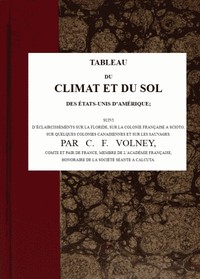
Tableau du climat et du sol des États-Unis d'Amérique by C.-F. Volney
Forget what you know about modern travelogues. Tableau du climat et du sol des États-Unis d'Amérique (or Picture of the Climate and Soil of the United States of America) is a different beast. Published in 1803, it’s the result of French philosopher Constantin-François Volney’s journey through the post-revolutionary U.S. in the 1790s. He wasn’t here as a tourist, but as an investigator. Armed with a scientist’s curiosity, he set out to systematically document the physical reality of the new nation.
The Story
There’s no traditional plot. Instead, Volney acts as a guide, walking us region by region. He starts with the big picture: the major mountain ranges, river systems, and prevailing winds. Then he gets specific. He describes the thick, humid air of the Carolinas, the fertile valleys of Pennsylvania, and the brutal cold of New England. He notes what crops flourish where, details the illnesses common to each area (blaming ‘miasmas’ from swamps for malaria), and even speculates on how the climate shapes the health and temperament of the people living there. The entire book is his attempt to build a scientific profile of the country, arguing that its political destiny is inseparable from its environmental one.
Why You Should Read It
What grabbed me was the sheer ambition of it. Here was a man trying to understand a vast, unknown land using observation and the best theories available. He’s often wrong by today’s standards (his climate theories are outdated), but he’s asking the right questions about sustainability, public health, and westward expansion. Reading it, you feel the weight of the unknown that early Americans faced. You see the continent not as a given, but as a formidable challenge. It’s also filled with strange, wonderful details—like his complaints about the mosquitoes or his notes on how to build a healthy homestead. It makes history feel physical and immediate.
Final Verdict
This isn’t a book for everyone. It’s a dense, technical read at times. But if you love early American history, the history of science, or environmental writing, it’s a fascinating document. It’s perfect for history buffs who want to go beyond battles and politics, for anyone curious about how people understood nature before modern ecology, and for readers who enjoy seeing a familiar landscape through utterly foreign eyes. Think of it as the original, philosophical prequel to all those pioneer diaries.
You are viewing a work that belongs to the global public domain. Use this text in your own projects freely.
Emily Brown
2 months agoI found the author's tone to be very professional yet accessible, the clarity of the writing makes even the most dense sections readable. It cleared up a lot of the confusion I had previously.
George Jones
1 year agoWhile browsing through various academic sources, the author doesn't just scratch the surface but goes into meaningful detail. I feel much more confident in my knowledge after finishing this.
Richard Jones
6 months agoHaving read the author's previous works, the language used is precise without being overly academic or confusing. I'll be recommending this to my students and colleagues alike.
Margaret Martinez
7 months agoVery satisfied with the depth of this material.









David Thomas
8 months agoThe layout is perfect for tablet and e-reader devices.