1

The Legend of Dah-nol-yo, Squaw Rock — Reading Notes
(4 User reviews)
1222
Project Gutenberg
2016
Not confirmed
Indians of North America -- California -- Folklore; Pomo Indians -- Legends
Readers of public-domain and historical texts
Project Gutenberg digital edition
en
Edition facts
Words
4,311
Reading time
19 min
Text sections
8
The Legend of Dah-nol-yo, Squaw Rock — Reading Notes can be approached with a clearer sense of reading commitment from its source measurements: 4,311 words, 19 min estimated reading time, and 8 detected text sections.
The text analysis averages about 24.1 words per sentence, while the detected sections provide another way to judge how the source is divided.
Project Gutenberg metadata also associates the work with “Indians of North America -- California -- Folklore,” connecting these edition facts with the source record’s subject description.
Source:
Project Gutenberg record #52233
This editorial note examines the structure and recurring imagery in Helen McCowen Carpenter's retelling of a Pomo legend, focusing on how the narrative moves between domestic scenes and supernatural encounters, and how the landscape itself becomes a character.
Editorial Edition Score
4.5/5
★★★★★
★★★★★
Calculated from edition completeness, EPUB availability, text structure and catalogue metadata. Not a user rating.
How this score is calculated
- Description quality20 pts
- Title & short description10 pts
- Source metadata20 pts
- Text length15 pts
- Chapters / structure15 pts
- EPUB file integrity20 pts
Total of 100 points, scaled to a 2.5-5.0 range. Editions with an empty description or a missing EPUB file are not scored.
Edition quality
Read the Text
Text enclosed by underscores is in italics (_italics_), and text enclosed by equal signs is in bold (=bold=).
Additional Transcriber’s Notes are at the end.
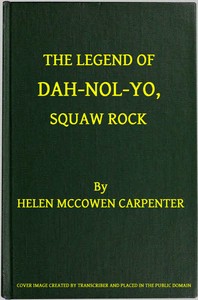
THE LEGEND OF DAH-NOL-YO, SQUAW ROCK
Compliments of THE SAN FRANCISCO AND NORTH PACIFIC RAILWAY, The Picturesque Route of California.
For forty-six miles THE SAN FRANCISCO AND NORTH PACIFIC RAILWAY, the Picturesque Route of California, skirts the Russian River. A few of the many lovely views en-route are shown in this little _brochure_.
This beautiful country was once occupied by the Pomo Indians, a brave and flourishing tribe, of whom but very few families remain. Many of the local features are hallowed by the Indian folk-lore. The legend of Dah-nol-yo--Squaw Rock, so charmingly written by Mrs. H. M. Carpenter, of Ukiah, is presented to the reader.
THE LEGEND OF DAH-NOL-YO--SQUAW ROCK.
Among the many extant Indian Legends of Squaw Rock, none has appeared which relates to the face of stone, on the summit of this noted mountain. The following is substantially as given by a direct descendant of Con-che Tadi, a Pomo Chief, who lived in the shadow of Dah-nol-yo, when time was young.
This Chief was particularly noted for preserving the peace and harmony of his own tribe and others with which he came in contact. His faithful squaw Ma-cha-ta (Kingfisher) devoted her time to her two sons, Ca-ba-ba (Brave one) and Bu-tah-so (Little Bear); and as is the custom at the present day, gathered the buckeye and acorn, as a means of subsistence, while her lord smoked his pipe or enjoyed a nap in the sunshine. As the sons approached manhood they were inseparable companions and partook of the peaceful disposition of their illustrious father.
One day, after vainly endeavoring to catch enough fish for dinner, a very beautiful Indian woman suddenly appeared before them. When she merely looked into the water, fish and turtles came out upon the sand and lay at her feet. She pointed to the east and west, and all kinds of birds and beasts were at once before her. Ca-ba-ba, the elder son, who was to be Chief of the tribe when the Tadi went to the “Happy Hunting Ground,” conceived the idea of making this young woman his wife, feeling assured that at least a good living was in store for him through this arrangement. Divining his thoughts (which did not meet with her approval, as it is supposed she was already enamored of Bu-tah-so,) she declared, in consequence of his selfish motives, he should never be the Chief of his tribe, which so enraged Ca-ba-ba that he threw a fishing spear at her. This missed its fair mark and was buried in the bosom of Bu-tah-so. All was immediately in darkness--thunder rolled, lightning flashed and the whole earth was convulsed. From out the storm the woman’s voice was heard pronouncing maledictions on the head of Ca-ba-ba and commanding him to hide himself in Dah-nol-yo, and do penance for all time. While he suffered in darkness, she said the face of Bu-tah-so should stand upon his sepulchre as a warning to all evil doers. The disappearance of the Chief’s sons and the face of one of them, engraved in stone, upon the mountain overlooking their home, so frightened the tribe that they fled to the north, and no tribe has since had the temerity to live in sight of the face on Dah-nol-yo.
Here the legend ends, and we take up the threads and weave a little net of well authenticated facts. When the San Francisco and North Pacific Railway wound through the picturesque canyon of Che-hool-be-da-dah (Russian River) a tunnel pierced the base of Dah-nol-yo, thus opening the door of Ca-ba-ba’s prison and liberating him. In fear of detection, and a return to his solitary quarters, he cautiously crept to his childhood’s home only to find desolation. Turning his eyes to the summit of Dah-nol-yo he was transfixed with terror at beholding the face of Bu-tah-so looking grimly down upon him. Held by an invisible power he gazes on, unable to turn his eyes even to the bear, deer, quail and squirrel, that venture so near, peering in wonder at the lone man who is to suffer on through all eternity as he keeps his silent vigil of Dah-nol-yo.
The way to reach the Russian River and its scenic surroundings is by the SAN FRANCISCO AND NORTH PACIFIC RAILWAY, the Picturesque Route of California.
Continuous riding over this road does not become monotonous, owing to the variety and constant change of scenery, traversing, as it does, Marin, Sonoma, Russian River, Sanel and Ukiah Valleys.
The hand of man, in dotting the country with orchards, vineyards, grain fields, homes, towns and villages, has most beautifully blended the domestic with nature’s wildness.
The legend of Dah-nol-yo, or Squaw Rock, is presented as a narrative framed by the landscape of the Russian River valley, a region once inhabited by the Pomo people. The text opens with a promotional note from the San Francisco and North Pacific Railway, positioning the story as a scenic attraction along their route. This commercial framing contrasts sharply with the intimate, domestic opening of the legend itself, which introduces Chief Con-che Tadi and his family in a scene of everyday life: his squaw Ma-cha-ta gathers buckeye and acorn while he smokes his pipe. The juxtaposition of a railway brochure and a tribal origin story sets up a tension between external tourism and internal cultural memory that runs through the work.
From Domestic Peace to Supernatural Encounter
The narrative structure moves abruptly from the tranquility of the chief's household to a sudden, unexplained event. The sons, Ca-ba-ba and Bu-tah-so, are fishing without success when a beautiful woman appears. Her power is immediate and visual: she merely looks into the water, and fish and turtles come out onto the sand. She points to the east and west, and birds and beasts appear. This shift from mundane failure to effortless abundance is typical of folktale logic, but Carpenter's prose emphasizes the suddenness of the transformation. The elder son's reaction—calculating that a good living is assured through marriage—introduces a pragmatic, almost mercenary motive that clashes with the woman's apparent supernatural nature. The excerpt breaks off before revealing her response, leaving the reader in suspense.
Recurring Images of Stone and Transformation
The title itself points to the central image: a rock formation that bears a face. Throughout the text, stone serves as both a literal landmark and a symbol of permanence. The legend is explicitly offered as an explanation for the face of stone on the summit of Dah-nol-yo. This geological feature anchors the narrative in a specific place, giving the story a tangible reference point. The motif of transformation—from human to stone, from living to landscape—is hinted at in the fragments. The woman's ability to command animals and the sons' desire to possess her power suggest a world where boundaries between human, animal, and mineral are fluid. The rock itself may be the result of such a transformation, though the excerpts do not confirm this.
Movement Between Scenes: The Role of the Landscape
The narrative moves between three distinct settings: the domestic space of the chief's home, the riverbank where the sons fish, and the mountain summit where the rock face is located. Each setting carries different connotations. The home is a place of peace and routine, where Ma-cha-ta gathers food and the chief naps. The riverbank is a site of lack and desire—the sons fail to catch fish, prompting the supernatural intervention. The mountain, Dah-nol-yo, is the ultimate destination, the place where the legend's meaning is inscribed in stone. Carpenter's descriptions of the landscape are minimal but functional, serving to guide the reader from one scene to the next. The railway brochure's mention of the Russian River as a picturesque route reinforces the idea that the landscape is both a physical and narrative pathway.
The Role of the Chief and the Preservation of Peace
Chief Con-che Tadi is introduced as a figure notable for preserving peace and harmony among his own tribe and others. This characterization is crucial because it establishes a moral framework for the legend. The chief's peaceful disposition contrasts with the potential conflict introduced by the supernatural woman. His sons, described as inseparable and peaceable like their father, are suddenly faced with a choice that could disrupt that harmony. The elder son's desire to marry the woman for material gain suggests a departure from the chief's values. The legend may thus be a cautionary tale about the consequences of greed or the disruption of natural order. However, the excerpts do not reveal the outcome, so this remains an inference based on the established character traits.
Readers approaching this brief work should attend to the way Carpenter weaves together promotional material, ethnographic detail, and folk narrative. The legend's brevity—just over 4,000 words—means that every scene and image carries weight. The recurring motifs of stone, transformation, and the tension between domestic peace and supernatural intervention reward close reading. Consider how the railway framing might color the interpretation of the story as a tourist attraction versus a genuine piece of Pomo cultural heritage.
That afternoon the rain blurred the windows, and I kept returning to Carpenter’s rendering of Dah-nol-yo—how the rock held both the ordinary and the unearthly within one gesture. It made me think of other lands where legends cling to familiar ground, and I found myself drifting, almost idly, toward Nether Lochaber The Natural History, Legends, and Folk-lore of the West Highlands — Edition Insights. The same quiet weight, the same patience in naming places.
Dylan Gonzalez
3 weeks agoJack Robinson
2 weeks agoMichael Lopez
3 weeks agoThere are no comments for this eBook.
Reader reflection
How did this book work for you?
Your answers remain private and are stored only in this browser.
Your progress
0
/
10
2
Did this book hold your interest?
3
Would you encourage someone else to read it?
4
How demanding did the text feel?
5
Which part made the strongest impression?
6
Was the book what you thought it would be?
7
Did you relate to its people, ideas, or situations?
8
Could you apply anything you learned?
9
What is the main idea you are taking away?
10








Leo Roberts
1 month ago