1

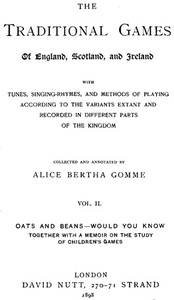
The Traditional Games of England, Scotland, and Ireland (Vol 2 of 2) With Tunes, Singing-Rhymes, and Methods of Playing etc. — Text and Context
(4 User reviews)
544
Project Gutenberg
2012
Not confirmed
Folklore -- Great Britain; Games -- Great Britain
Readers of public-domain and historical texts
Project Gutenberg digital edition
en
Edition facts
Words
164,442
Reading time
715 min
Text sections
33
The catalog record for The Traditional Games of England, Scotland, and Ireland (Vol 2 of 2) With Tunes, Singing-Rhymes, and Methods of Playing etc. — Text and Context provides practical reading context through 164,442 words, 11 hr 55 min estimated reading time, and 33 detected text sections.
The text analysis averages about 15.2 words per sentence, while the detected sections provide another way to judge how the source is divided.
Project Gutenberg metadata also associates the work with “Folklore -- Great Britain,” connecting these edition facts with the source record’s subject description.
Source:
Project Gutenberg record #41728
This volume catalogues children's singing games from the British Isles, with tunes, variants, and methods of play. The entry for 'Three Sailors' shows how a single game type shifts its characters (sailors, soldiers, kings) and rewards across locations, revealing regional adaptation.
Editorial Edition Score
4.9/5
★★★★★
★★★★★
Calculated from edition completeness, EPUB availability, text structure and catalogue metadata. Not a user rating.
How this score is calculated
- Description quality20 pts
- Title & short description10 pts
- Source metadata20 pts
- Text length15 pts
- Chapters / structure15 pts
- EPUB file integrity20 pts
Total of 100 points, scaled to a 2.5-5.0 range. Editions with an empty description or a missing EPUB file are not scored.
Edition quality
Read the Text
The apples grew ripe and beginning to fall, Beginning to fall, beginning to fall.
There came an old woman picking them up, Picking them up, picking them up; Poor Toby rose up and he gave her a kick, Gave her a kick, gave her a kick.
And the poor old woman went hipperty hop, Hipperty hop, hipperty hop; And the poor old woman went hipperty hop, Hipperty hop along.
—Belfast (W. H. Patterson).
XII. There was an old woman we buried her here, Buried her here, buried her here; There was an old woman we buried her here, He—ho! buried her here.
—Sporle, Norfolk (Miss Matthews).
(_b_) A ring is formed by children joining hands; one child, who represents Sir Roger, lays down on the ground in the centre of the ring with his head covered with a handkerchief. The ring stands still and sings the verses. When the second verse is begun, a child from the ring goes into the centre and stands by Sir Roger, to represent the apple tree. At the fourth verse another child goes into the ring, and pretends to pick up the fallen apples. Then the child personating Sir Roger jumps up and knocks the child personating the old woman, beating her out of the ring. She goes off hobbling on one foot, and pretending to be hurt. In the Ordsall game the children dance round when singing the verses instead of standing still, the action of the game being the same. In the Tong version, the action seems to be done by the ring. Miss Burne says the children go through various movements, finally all limping round. The Newark (Notts), and Bath versions are played as first described, Poor Roger being covered with a cloak, or an apron, and laying down in the middle of the ring. A Southampton version has additional features—the ring of children keep their arms crossed, and lay their hands on their chests, bending their heads and bodies backwards and forwards, in a mourning attitude, while they sing; in addition to which, in the Bath version, the child who personates the apple tree during the singing of the third verse raises her arms above her head, and then lets them drop to her sides to show the falling apples.
(_c_) Various as the game-rhymes are in word detail, they are practically the same in incident. One remarkable feature stands out particularly, namely, the planting a tree over the head of the dead, and the spirit-connection which this tree has with the dead. The robbery of the fruit brings back the dead Sir Roger to protect it, and this must be his ghost or spirit. In popular superstition this incident is not uncommon. Thus Aubrey in his _Remains of Gentilisme_, notes that “in the parish of Ockley some graves have rose trees planted at the head and feet,” and then proceeds to say, “They planted a tree or a flower on the grave of their friend, and they thought the soule of the party deceased went into the tree or plant” (p. 155). In Scotland a branch falling from an oak, the Edgewell tree, standing near Dalhousie Castle, portended mortality to the family (Dalyell, _Darker Superstitions_, p. 504). Compare with this a similar superstition noted in Carew’s _History of Cornwall_, p. 325, and Mr. Keary’s treatment of this cult in his _Outlines of Primitive Belief_, pp. 66-67. In folk-tales this incident also appears; the spirit of the dead enters the tree and resents robbery of its fruit, possession of which gives power over the soul or spirit of the dead.
The game is, therefore, not merely the acting of a funeral, but more particularly shows the belief that a dead person is cognisant of actions done by the living, and capable of resenting personal wrongs and desecration of the grave. It shows clearly the sacredness of the grave; but what, perhaps to us, is the most interesting feature, is the way in which the game is played. This clearly shows a survival of the method of portraying old plays. The ring of children act the part of “chorus,” and relate the incidents of the play. The three actors say nothing, only act their several parts in dumb show. The raising and lowering of the arms on the part of the child who plays “apple tree,” the quiet of “Old Roger” until he has to jump up, certainly show the early method of actors when details were presented by action instead of words. Children see no absurdity in being a “tree,” or a “wall,” “apple,” or animal. They simply _are_ these things if the game demands it, and they think nothing of incongruities.
The second volume of Alice Bertha Gomme's dictionary completes a methodical survey of children's traditional games across England, Scotland, and Ireland. Each entry pairs a game name with its tunes, singing-rhymes, and playing instructions, drawing on variants collected from different localities. The work's structure—alphabetical entries with cross-references—allows readers to trace how a single game type transforms as it moves from one region to another.
Gomme's preface notes the death of a key contributor, the Rev. Dr. Gregor, and acknowledges that the collection now includes all games of 'real importance.' The volume closes with a memoir arguing that games preserve evidence of ancient custom and belief, a claim the entries themselves substantiate through repeated patterns of courtship, refusal, and reward.
Recurring Dramatic Structures
Many games in this volume follow a three-part dramatic arc: an outsider group approaches, is refused lodging or marriage, and then—after revealing higher status—is accepted. The entry for 'Three Sailors' illustrates this pattern with stark clarity. In the London variant, three sailors, then soldiers, then kings each ask to court the daughter; the mother refuses the first two but welcomes the kings. The daughter is then presented as 'safe and sound' with a dowry, but the suitors reject her as 'not safe nor sound.' This reversal—from rejection of suitors to rejection of the bride—appears in multiple games, suggesting a ritualized negotiation of social worth.
Other entries, such as 'Oats and Beans,' use a marriage formula where the bride must obey and help chop wood. The consistency of these exchanges across counties points to a shared folk logic, even as the specific rhymes and rewards vary.
Regional Variation in Characters and Rewards
The 'Three Sailors' entry demonstrates how a game's details shift by location. In the Barnes and Surrey version, the suitors progress from sailors to soldiers to kings, and the daughter's dowry is 'one hundred pound' with a 'gay gold ring.' In the Norfolk variant, the suitors begin as tinkers, then soldiers, then kings, and the dowry inflates to 'five hundred pounds' and a 'five guinea gold ring.' A third variant from an unspecified location uses sweeps, bakers, and kings, with the dowry rising to 'a thousand pounds.'
These changes are not random: the social hierarchy of suitors (low-status tradesmen to royalty) remains constant, while the monetary amounts escalate with each retelling. Gomme's method of printing each variant in full allows readers to compare these adjustments directly, revealing how communities adapted a core narrative to local tastes or values.
The Role of Repetition and Refrain
Repetition is a structural backbone of these games. In 'Three Sailors,' each suitor group is introduced with the same couplet—'Here come three [sailors/soldiers/kings], three by three'—and the mother's response repeats the sleeping/waking command. The refrain 'Can we have a lodging here, here, here?' recurs verbatim across variants, creating a rhythmic predictability that children can easily follow.
This repetition serves both mnemonic and dramatic functions. It allows players to anticipate the turning point when the mother shifts from 'Sleep, daughter' to 'Wake, daughter.' The slight variation in the final stanza—where the daughter's worth is either affirmed or denied—provides a satisfying climax. Gomme's inclusion of tunes alongside the rhymes underscores how melody reinforced these repetitive structures, making them memorable across generations.
Evidence of Ancient Custom in Game Formulae
Gomme's memoir argues that games contain 'evidence of ancient custom and belief,' and the entries in this volume support that claim. The lodging-and-courtship scenario in 'Three Sailors' echoes historical practices of hospitality and marriage negotiation, where a stranger's status determined whether they were admitted. The mother's role as gatekeeper—refusing low-status suitors and accepting high-status ones—mirrors parental control over matches in earlier centuries.
Similarly, the dowry amounts (hundreds or thousands of pounds) and the gold ring are anachronistic for children's play, suggesting they derive from adult concerns. The final rejection of the daughter, despite her dowry, hints at a deeper ritual logic: the suitors' initial rejection is repaid in kind. Gomme does not overstate these parallels, but the cumulative evidence across entries makes a persuasive case for reading games as fragments of social history.
Readers approaching this volume should treat each entry as a snapshot of a living tradition, not a fixed text. The variants printed side by side invite comparison: note which details stay constant and which shift. Gomme's annotations, though sparse, often point to connections between games. For those interested in folklore or historical childhood, this collection offers a rare, systematic record of play as it was actually sung and performed in the late nineteenth century.
Reading the Traditional Games entry for "Three Sailors," watching the soldiers trade places with kings across counties, I found myself drifting toward another old acquaintance, Nether Lochaber The Natural History, Legends, and Folk-lore of the West Highlands — Edition Insights. Both hold the same quiet wonder—how a place shapes its stories, its rhymes, its sea. A shared ache for naming things as they were once known.
William Hill
1 month agoNoah Brown
1 month agoScarlett Moore
3 weeks agoThere are no comments for this eBook.
Reader reflection
Your personal reading reflection
Build a private reading journal entry for this title.
Your progress
0
/
10
2
Did this book hold your interest?
3
How likely are you to recommend this book?
4
What was the reading difficulty like?
5
Which part made the strongest impression?
6
Do you expect to return to this book?
7
Would this book work well in a reading group?
8
Did any part of the book feel personally relevant?
9
What is the main idea you are taking away?
10

Alexander Thompson
3 weeks ago