1

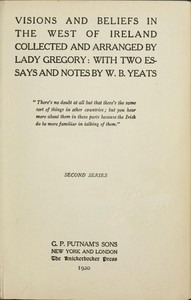
Visions and Beliefs in the West of Ireland, Second Series — Context and Discussion
(1 User reviews)
227
Project Gutenberg
2013
Not confirmed
Folklore -- Ireland; Ireland -- Social life and customs; Atlantic Coast (Ireland) -- Social life and customs
Readers of public-domain and historical texts
Project Gutenberg digital edition
en
Edition facts
Words
80,766
Reading time
352 min
Text sections
8
Visions and Beliefs in the West of Ireland, Second Series — Context and Discussion can be approached with a clearer sense of reading commitment from its source measurements: 80,766 words, 5 hr 52 min estimated reading time, and 8 detected text sections.
The text analysis averages about 25.6 words per sentence, while the detected sections provide another way to judge how the source is divided.
Project Gutenberg metadata also associates the work with “Folklore -- Ireland,” connecting these edition facts with the source record’s subject description.
Source:
Project Gutenberg record #43974
Lady Gregory's second series of Irish folklore collects firsthand accounts of charms, banshees, headless coaches, and sheoguey places, with W.B. Yeats's annotations. The excerpts reveal a world where the supernatural is ordinary, and narrators speak with precise, unadorned detail about cures, warnings, and encounters with the uncanny.
Editorial Edition Score
4.8/5
★★★★★
★★★★★
Calculated from edition completeness, EPUB availability, text structure and catalogue metadata. Not a user rating.
How this score is calculated
- Description quality20 pts
- Title & short description10 pts
- Source metadata20 pts
- Text length15 pts
- Chapters / structure15 pts
- EPUB file integrity20 pts
Total of 100 points, scaled to a 2.5-5.0 range. Editions with an empty description or a missing EPUB file are not scored.
Edition quality
Read the Text
Jews did all the harm to Him. And not one could be got to pierce His heart till a dark man came and said, "Give me the spear, and I'll do it," and the blood that sprang out touched his eyes and they got their sight.
And it was after that, His Mother and Mary and Joseph gathered their herbs and cured His wounds. These are the best of the herbs, but they are all good, and there isn't one among them but would cure seven diseases. I'm all the days of my life gathering them, and I know them all, but it isn't easy to make them out. Sunday evening is the best time to get them, and I was never interfered with. Seven "Hail Marys" I say when I'm gathering them, and I pray to our Lord and to St. Joseph and St. Colman. And there may be _some_ watching me, but they never meddled with me at all.
Monday is a good day for pulling herbs, or Tuesday, not Sunday. A Sunday cure is no cure. The _cosac_ (lichen) is good for the heart, there was Mineog in Gort, one time his heart was wore to a silk thread, and it cured him. The _slanugad_ (rib-grass) is very good, and it will take away lumps. You must go down when it's growing on the scraws, and pull it with three pulls, and mind would the wind change when you are pulling it or your head will be gone. Warm it on the tongs when you bring it and put it on the lump. The _lus-mor_ (mullein) is the only one that's good to bring back children that are away. But what's better than that is to save what's in the craw of a cock you'll kill on St. Martin's Eve and put it by and dry it, and give it to the child that's away.
There's something in green flax I know, for my mother often told me about one night she was spinning flax, before she was married and she was up late. And a man of the faeries came in. She had no right to be sitting up so late, they don't like that. And he told her to go to bed, for he wanted to kill her, and he couldn't touch her while she was handling the flax. And every time he'd tell her to go to bed, she'd give him some answer, and she'd go on pulling a thread of the flax, or mending a broken one, for she was wise, and she knew that at the crowing of the cock he'd have to go. So at last the cock crowed, and he was gone, and she was safe then, for the cock is blessed.
As to the _lus-mor_, whatever way the wind is blowing when you begin to cut it, if it changes while you're cutting it, you'll lose your mind. And if you're paid for cutting it, you can do it when you like, but if not _they_ mightn't like it. I knew a woman was cutting it one time, and a voice, an enchanted voice, called out, "Don't cut that if you're not paid, or you'll be sorry." But if you put a bit of this with every other herb you drink, you'll live for ever. My grandmother used to put a bit with everything she took, and she lived to be over a hundred.
_An Old Man on the Beach:_
I wouldn't give into those things, but I'll tell you what happened to a son of my own. He was as fine and as stout a boy as ever you saw, and one day he was out with me, and a letter came and told of the death of some one's child that was in America, and all the island gathered to hear it read. And all the people were pressing to each other there. And when we were coming home, he had a bit of a kippeen in his hand, and getting over a wall he fell, and some way the kippeen went in at his throat, where it had a sharp point and hurt the palate of his mouth, and he got paralysed from the waist up.
Lady Gregory's Visions and Beliefs in the West of Ireland, Second Series opens with a striking contrast: the practical matter of herbal cures and the assertion that an 'old woman without learning' is the one who performs charms. The compiler immediately grounds the supernatural in the domestic and the agricultural—herbs that heal 'every bone in the body' and a 'sore heart'—while also invoking the unseen book written in Irish, a language that, as one informant insists, is what 'the strange unearthly people' would naturally speak. This tension between the mundane and the otherworldly pervades the collection.
The Familiarity of the Unseen
The excerpts are remarkable for the matter-of-fact tone of the narrators. A Mayo man, walking near Warrington, asks a woman under an umbrella, 'Is it a living thing you are or dead?' and she vanishes. He then hears feet walking inside a hedge and meets two men speaking 'gibberish'—he knows they are 'no right men.' A gate-keeper recounts a carriage with bright lamps but no horses, and headless drivers. These accounts are delivered without astonishment; the speakers treat the events as noteworthy but not incredible. The supernatural is woven into the fabric of daily life, encountered on roads and in fields, and reported with the same precision as a neighbor's visit.
Patterns of Loss and Protection
Several accounts share a pattern: a family troubled by unseen forces loses children or suffers disturbances until they take a specific action. The Sheehans of Drumconnor Castle saw headless figures and things thrown about; 'all the best and the best-looking' children were taken. Their solution was to move to a new house built outside the castle, after which 'they have no trouble and have lost no more children.' Similarly, the spinning woman who appears to a narrator knows details about a neighbor's butter-theft accusation, suggesting a network of knowledge that blurs the line between human and otherworldly. These stories imply a logic of cause and effect, where certain places or behaviors invite trouble, and relocation or ritual can restore order.
The Role of the Skeptic
Not everyone in these accounts accepts the supernatural. Mrs. Madden mentions Egan, who 'would never let on to believe in such things and would make them out to be nothing—he has such a gift of talking.' This brief aside reveals a social dynamic: belief is not universal, and skepticism is itself a kind of performance or skill. Yet even the skeptics are part of the narrative landscape; their denial does not erase the experiences of others. The collection thus presents a community where the unseen is debated, affirmed, and occasionally dismissed, but always present as a topic of conversation and a force in daily life.
Readers approaching this volume should attend to the voices of the informants themselves—their rhythms, their precise details, and their unemphatic acceptance of the extraordinary. Lady Gregory's role as collector is to let these voices speak, while Yeats's annotations offer a different register, drawing connections to esoteric traditions. The result is a work that rewards careful reading of its individual accounts, each a small window into a world where the boundary between the natural and the supernatural is thin and permeable.
That rainy afternoon, Lady Gregory’s neighbors spoke of banshees as plainly as I’d speak of weather, their warnings woven into everyday chores. I closed the book feeling the weight of their quiet certainty, then drifted, almost by accident, to Stories the Iroquois Tell Their Children — A Closer Reading, where another kind of ordinary magic held the same patient, unhurried breath.
There are no comments for this eBook.
Reader reflection
Your personal reading reflection
Build a private reading journal entry for this title.
Your progress
0
/
10
2
How much did you enjoy the reading experience?
3
How likely are you to recommend this book?
4
How demanding did the text feel?
5
Would you start a conversation about this book?
6
Was the book moving at the right speed?
7
How clear did the writing feel?
8
Did any part of the book stay with you emotionally?
9
In one sentence, what did you learn?
10







Isaac King
1 month ago