1

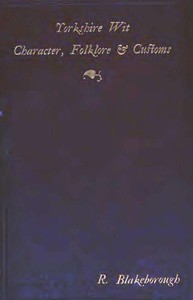
Wit, Character, Folklore & Customs of the North Riding of Yorkshire With a Glossary of over 4,000 Words and Idioms Now in Use — Edition Insights
(1 User reviews)
249
Project Gutenberg
2020
Not confirmed
Yorkshire (England) -- Social life and customs; Folklore -- England -- Yorkshire
Readers of public-domain and historical texts
Project Gutenberg digital edition
en
Edition facts
Words
156,273
Reading time
680 min
Text sections
33
The catalog record for Wit, Character, Folklore & Customs of the North Riding of Yorkshire With a Glossary of over 4,000 Words and Idioms Now in Use — Edition Insights provides practical reading context through 156,273 words, 11 hr 20 min estimated reading time, and 33 detected text sections.
The text analysis averages about 11.9 words per sentence, while the detected sections provide another way to judge how the source is divided.
Project Gutenberg metadata also associates the work with “Yorkshire (England) -- Social life and customs,” connecting these edition facts with the source record’s subject description.
Source:
Project Gutenberg record #62999
Richard Blakeborough's 1898 collection preserves North Riding Yorkshire dialect, folklore, and customs through anecdotes, tales, and a glossary of over 4,000 words, with a chatty, platform-derived style that blends humor and mythological interpretation.
Editorial Edition Score
4.9/5
★★★★★
★★★★★
Calculated from edition completeness, EPUB availability, text structure and catalogue metadata. Not a user rating.
How this score is calculated
- Description quality20 pts
- Title & short description10 pts
- Source metadata20 pts
- Text length15 pts
- Chapters / structure15 pts
- EPUB file integrity20 pts
Total of 100 points, scaled to a 2.5-5.0 range. Editions with an empty description or a missing EPUB file are not scored.
Edition quality
Read the Text
ht years of age, set off at once to trudge seven miles for a doctor, landing back again about midnight. The doctor assured the delighted mother that, having followed the old man’s advice, and with the remedies he had brought, a severe fit of croup had been staved off. Oh yes, these blunt country-people have feelings. And they are grateful.
Gratitude shows itself in different ways, sometimes in a form of self-sacrifice, as in the following, which occurred not so very long ago. Said a vicar to one of his parishioners—who, by-the-way, was a notorious poacher—‘I am very pleased to see you coming to church so regularly; very pleased, indeed, William; and I trust that it may lead you to see the error of your past life.’ ‘Well, Ah wadn’t gan sa far ez ti saay ’at owt o’ that soart’s leykley ti happen, bud Ah s’ cum ti t’ chetch, for all that.’ ‘And may I ask the reason for this sudden change in your life?’ inquired the parson. ‘Whya noo, it war i’ this waay. Me an’ Luke an’ tweea or three uthers war talking ya ower yah neet i’ t’ Swan, an’ Luke sed ’at he didn’t ho’d wi’ neea parsons ’at hunted, an’ Ah sed ’at a parson war nowt neea different ti neeabody else, when he’d ta’en t’ white goon off, an’ ‘at it maad neea odds whether ya hunted or whether ya didn’t. Bud t’ main on ’em seeamed ti ho’d ’at ya warn’t i’ t’ reet on ’t hunting. And seea Ah thowt ti mysen, t’ parson’s offens deean me a good to’n, an’ if ther’s gahin to be sike a lot o’ narrer-mahnded fau’k i’ t’ village—an’ being a bit of a sportsman mysen, ya knaw—wha, Ah sez, noo Ah’ll gan ti chetch if it’s foor nowt else bud ti back ya up a bit, an’ sa Ah cums.’
The hospitality of the Yorkshire people is so well known, and so generally admitted by all those who have been recipients of the same, that I purpose just leaving it as an established fact. Still, there is one curious offshoot from this generous branch, which needs _en passant_ a moment’s consideration.
I once heard a South-country man say, ‘Yorkshire people give you more than you want at their table, and then beg from you on the doorstep.’ And to those who know nothing of our ways, usages, and customs, such would almost seem to be the case. Of course, as put by the South-country man, the statement, if complete, would stamp Yorkshire and its people as being rather more than contemptible. But such is not the case, and when the reason for the remark was perfectly sifted, the notion which had got such a firm hold of the speaker was found to have been based on a want of knowledge of the elementary rules which govern the unwritten law of bargaining. Why, pages could be written on bargaining, and stories told by the score.
But when a bargain has been concluded, the money paid, the receipt given, a substantial meal partaken of, with grog, &c., ad lib., it becomes quite easy to understand the South-country man’s surprise, on leaving the house, to be asked ’ti gi’e summat back foor luck.’ To him, not knowing our ways, the transaction was completed; with us it was not, and therein lies the difference. It does strike one as peculiar to find such marked generosity, when run on certain lines, only to be confronted the next step with some little action which at first sight looks very much like meanness. But all this misconception vanishes if we bear in mind that _hospitality_ and _business_ are never made to clash; they, as it were, occupy separate rooms.
I have a story in my mind which illustrates fully these peculiarities, as well as others already mentioned. As it was given to me by his lordship, so briefly let me give it to you.
Richard Blakeborough, a self-described 'Society Humorist,' opens his 1898 compilation with a preface that sets the tone: he aims for a 'chatty style' drawn from his drawing-room and platform performances. The book is a patchwork of dialect words, folk tales, customs, and character sketches from the North Riding, capped by a glossary of over 4,000 entries. Blakeborough does not pretend to academic rigor; he writes as a collector and entertainer, often stepping in to interpret the tales he records. In one version of the 'gold-dropping ass' story, he pauses to explain that the ass 'is typical of spring' and the hamper 'represents the earth,' offering a mythological reading that he admits may be beyond him. This blend of anecdote and amateur analysis gives the work its particular flavour.
A Collector’s Voice Between Platform and Page
Blakeborough’s narrative voice is that of a raconteur who expects a live audience. He addresses readers as if they were listeners in a room, using colloquial asides and self-deprecating remarks. In the preface, he notes that collaboration with the Rev. M. C. F. Morris proved 'quite impracticable,' so he undertook the work 'single-handed.' This personal framing continues throughout: he recalls an old servant who taught him a nonsense rhyme, and he presents folk tales with a storyteller’s timing. The tale of the boy with the magic stick is told with direct speech and repeated cues—'Now open it,' said the boy—that mimic oral delivery. Yet Blakeborough also shifts into a scholarly mode when he interprets the tale’s 'mythological essentials,' comparing it to Eastern stories and early religious creeds. This oscillation between folk narrator and amateur mythologist is a defining feature of the book’s pace.
Dialect as Living Record: The Glossary’s Reach
The glossary, advertised as containing 'over 4,000 Words and Idioms Now in Use,' is the book’s most systematic element. Blakeborough does not simply list definitions; he embeds dialect in the surrounding chapters, so that terms like 'leeak' (to look) appear in context before being catalogued. The transcriber’s note records a correction on page 262: 'To leeak a bad leeak' was originally glossed as 'to leeak ill' but changed to 'to look ill,' showing the editor’s care with phonetic spellings. The glossary entries are cross-referenced, though some target words are missing, hinting at the work’s incomplete state. Blakeborough’s method is to capture speech as he heard it, not to standardise. This gives the glossary a documentary quality: it preserves pronunciations and usages that were already fading in 1898, making the book a valuable record of North Riding vernacular.
Pacing Through Tale and Commentary
The book’s rhythm alternates between lengthy folk narratives and brief, puzzling fragments. The 'gold-dropping ass' story unfolds over several paragraphs, with Blakeborough interrupting to explain its symbolism. Then, without transition, he presents a doggerel rhyme learned from an old servant: 'There was a man who lived in Leeds, / He set his garden full of seeds…' The rhyme’s surreal logic—snow melting into a ship without a belt—contrasts sharply with the preceding mythological analysis. Blakeborough admits the rhyme’s meaning is 'beyond me' and invites a student to work it out. This abrupt shift from interpretation to bewilderment is characteristic. The reader moves from a tale with a clear moral (the stick beats the wicked) to a nonsense verse that resists explanation. Such juxtapositions create a varied reading experience, where the pace slows for folkloric exegesis and quickens with cryptic snippets.
Blakeborough’s work is best approached as a miscellany rather than a unified treatise. Readers may dip into the glossary, sample a tale, or follow the thread of a custom. The author’s chatty voice invites browsing, but his mythological asides reward closer attention. The book’s value lies in its accumulation of detail—a word, a rhyme, a story—that might otherwise have been lost. Treat it as a cabinet of curiosities, not a systematic study.
Blakeborough’s Yorkshire volume holds its words like river stones, worn smooth by generations of telling. I find the same patient trust in Stories the Iroquois Tell Their Children — A Closer Reading, where each tale waits quietly, expecting a listener who knows that a story’s true weight lies not in its plot, but in the shared breath between teller and child. Both books keep that old, gentle faith.
There are no comments for this eBook.
Reader reflection
How did this book work for you?
Your answers remain private and are stored only in this browser.
Your progress
0
/
10
2
How much did you enjoy the reading experience?
3
Is this a title you would suggest to others?
4
How much effort did this book require?
5
Which part made the strongest impression?
6
Was the book easy to understand?
7
Did the book meet your expectations?
8
Would this book work well in a reading group?
9
What is the main idea you are taking away?
10




Sofia Flores
2 weeks ago