1

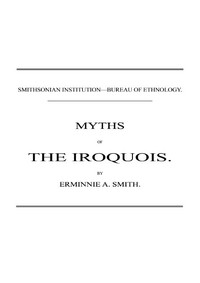
Myths of the Iroquois. (1883 N 02 / 1880-1881 (pages 47-116)) — Text and Context
(5 User reviews)
985
Project Gutenberg
2014
Not confirmed
Iroquois Indians -- Folklore; Iroquois mythology; Legends -- New York (State)
Readers of public-domain and historical texts
Project Gutenberg digital edition
en
Edition facts
Words
37,006
Reading time
161 min
Text sections
5
Myths of the Iroquois. (1883 N 02 / 1880-1881 (pages 47-116)) — Text and Context can be approached with a clearer sense of reading commitment from its source measurements: 37,006 words, 2 hr 41 min estimated reading time, and 5 detected text sections.
The text analysis averages about 21.6 words per sentence, while the detected sections provide another way to judge how the source is divided.
Project Gutenberg metadata also associates the work with “Iroquois Indians -- Folklore,” connecting these edition facts with the source record’s subject description.
Source:
Project Gutenberg record #46140
Erminnie A. Smith's 1883 collection of Iroquois myths, drawn from fieldwork and earlier sources, reveals how catalog subjects like 'Iroquois mythology' and 'Legends' only partially capture the work's blend of supernatural beings, sorcery, and mundane domestic tales.
Editorial Edition Score
4.7/5
★★★★★
★★★★★
Calculated from edition completeness, EPUB availability, text structure and catalogue metadata. Not a user rating.
How this score is calculated
- Description quality20 pts
- Title & short description10 pts
- Source metadata20 pts
- Text length15 pts
- Chapters / structure15 pts
- EPUB file integrity20 pts
Total of 100 points, scaled to a 2.5-5.0 range. Editions with an empty description or a missing EPUB file are not scored.
Edition quality
Read the Text
GODS AND OTHER SUPERNATURAL BEINGS.
The principal monuments of the once powerful Iroquois are their myths and folk-lore, with the language in which they are embodied. As these monuments are fast crumbling away, through their contact with European civilization, the ethnologist must hasten his search among them in order to trace the history of their laws of mind and the records of their customs, ideas, laws, and beliefs. Most of these have been long forgotten by the people, who continue to repeat traditions as they have been handed down through their fathers and fathers' fathers, from generation to generation, for many centuries.
The pagan Iroquois of to-day (and there are still many) will tell you that his ancestors worshiped, as he continues to do, the "Great Spirit," and, like himself, held feasts and dances in his honor; but a careful study of the mythology of these tribes proves very clearly that in the place of one prevailing great spirit (the Indian's earliest conception of the white man's God) the Iroquois gods were numerous. All the mysterious in nature, all that which inspired them with reverence, awe, terror, or gratitude, became deities, or beings like themselves endowed with supernatural attributes, beings whose vengeance must be propitiated, mercy implored, or goodness recompensed by thank-offerings. The latter were in the form of feasts, dances, or incense.
Among the most ancient of these deities, and regarding which the traditions are the most obscure, were their most remote ancestors--certain animals who later were transformed into human shape, the names of the animals being preserved by their descendants, who have used them to designate their gentes or clans.
Many races in that particular stage of savagery when the human intellect is still in its child-like state, being impressed by the awful and incomprehensible power of Thunder, have classed it foremost among their deities, with attributes proportioned to the disposition or status of the worshiper.
Hi-nuⁿ, the beneficent Thunder God of the Iroquois, compares most favorably with the same god as worshiped by other races. Ever accompanied by his equally powerful assistants, his mission was understood to be only to promote the welfare of that favored people, though isolated personal offenses might demand from him a just retribution. It was therefore safe to make unto him, on his near approach to earth, his most acceptable offering, the burning tobacco, and so firmly rooted has become that ancient custom, that the aged superstitious Iroquois of to-day can often be seen making this little offering on the near approach of every thunder-storm. It is not difficult to follow the crude reasoning by which was ascribed to Hi-nuⁿ the goodness and glory of having destroyed the giant monsters which either poisoned the waters or infested the land. That such had existed was evident from the bones often discovered, and what power other than the crashing bolt of Hi-nuⁿ could have accomplished their destruction? The similarity discoverable in the myths of many peoples regarding the Thunder God and his mission of destruction to giant animals, making this an almost universal myth, is probably traceable to this simple and natural explanation, and presents no argument that the myth itself has traveled. It may, then, be safely assumed that Hi-nuⁿ was an indigenous god of the Iroquois, the product of their own crude reasoning powers.
Brother of the great Hi-nuⁿ was the West Wind, who, with him, brought from the clouds the vivifying rain, and who finally assisted the Iroquois in the extermination of the powerful stone giants. Therefore, the West Wind ranks as a beneficent deity or spirit.
The North Wind brought only calamity in its train, often killing the unripe corn and freezing the rivers, thus depriving the people of their needed sustenance, and from the mere touch of his icy fingers the benighted hunter became stiff in death. This ranked as an evil deity ever to be feared and propitiated.
Echo, the Mars of the Iroquois, only exercised his power during their wars with other tribes, in which, by repeating among the hills their cries of Go-weh, he insured their almost certain victory. He was ever honored with special thanksgiving.
Of Tă-rhuⁿ-hyiă-wăh-kuⁿ (who bore the important office of Holder of the Heavens) there is little more known than that he brought out from their mother earth the six tribes composing the Iroquois.
These are some of the Iroquois gods, a knowledge of whose existence is contained only in myths, for they belong to the charmed "mythologic age." As, however, the Iroquois tribes have not entirely passed the boundaries of that age, it is proper to mention some of their more modern divinities, in whose worship are intermingled many of their ancient ceremonies.
Smith's Myths of the Iroquois opens with a declaration that the principal monuments of the Iroquois are their myths and folk-lore, yet the excerpts show a work that moves between grand supernatural beings—such as Hi-nuⁿ destroying giant animals—and strikingly ordinary domestic scenes. The catalog subjects list 'Iroquois Indians -- Folklore' and 'Iroquois mythology,' but the text itself includes a long, almost farcical tale of a young man and his uncle hunting a bear, where the uncle's confusing instructions lead to shooting his own finger and lips. This mismatch between the expected mythic register and the actual content is the collection's most notable feature.
Supernatural Beings and Everyday Mishaps
The chapter on gods and supernatural beings includes a Seneca legend of Hi-nuⁿ and Niagara, but the excerpts also contain a story where a young man, after repeatedly misunderstanding his uncle's hunting advice, finally leaves home 'to learn his lessons by experience, for he had become tired of his uncle's parables.' This tale occupies several pages and reads more like a folk anecdote than a myth. The uncle's method of instruction—using sticks to represent guests, pointing with his lips—is described in concrete, almost comical detail. Smith's collection thus juxtaposes the Thunderers and Stone Giants with narratives of human miscommunication and practical jokes.
Sorcery and Witchcraft as Social Practice
The chapter on sorcery includes an 'incantation to bring rain' and a 'cure for all bodily injuries,' but also a 'true witch story' and a case of 'a witch in the shape of a dog.' These are presented as reported beliefs, not as literary inventions. Smith records that witches could transform into animals, and includes a superstition about flies. The catalog subject 'Iroquois mythology' might suggest a unified belief system, but the excerpts show a fragmented collection of practices and anecdotes, some attributed to specific informants. The origin of Seneca medicine is given as a myth, yet the 'true' witch story is told with a claim to veracity, blurring the line between myth and reported fact.
Tales of Domestic Life and Moral Lessons
The tales section includes 'The hunter and his faithless wife,' 'The boy and his grandmother,' and 'The old man's lesson to his nephew.' These stories often involve family relationships, hunting, and consequences of disobedience or misunderstanding. In 'The old man's lesson,' the nephew's frustration with his uncle's indirect teaching is a recurring theme. The tales are not overtly moralistic; they end with the young man going off into the world. Smith's framing as 'Myths of the Iroquois' might lead a reader to expect sacred narratives, but many of these tales are closer to everyday folk stories, with named characters like 'Hemlock Bows' and specific details about hunting techniques.
Readers should approach this work as a late-19th-century ethnographic document that collects material under the broad heading of 'myths' but includes a wide range of narrative types. The catalog subjects are accurate but do not convey the work's uneven texture—from the cosmic to the domestic. Pay attention to the framing of each story: some are presented as myths, others as 'true' accounts, and still others as tales. Smith's voice as compiler is minimal, but her choices in organization reveal assumptions about what constitutes Iroquois mythology.
I kept thinking about how those Iroquois stories blend the sacred with the everyday—sorcerers and ordinary meals sharing the same breath. It reminded me of sitting with Hero-Myths & Legends of the British Race — Story, Setting & Ideas afterward, where the same quiet strangeness lingers, like a familiar room holding something unspoken. Some tales just stay close, don't they.
James Anderson
1 month agoMadison Wilson
1 month agoJack Wright
1 month agoSamuel Torres
3 weeks ago-

Leonard Conner - 1 month ago
{'review_type': 'Critical', 'content': "Unfortunately, this work is extremely dated and lacks any modern interpretive framework. The language is stilted and the organization is confusing, jumping between topics without clear structure. The author's approach is patronizing and colonial, treating the Iroquois as subjects rather than respecting their oral traditions. There are far better contemporary works on Iroquois mythology that are both accurate and respectful."} -
Aaron Walker - 1 month ago
{'review_type': 'Neutral', 'content': "This is a scholarly work that provides valuable information about Iroquois myths, but it reads more like an academic paper than a storytelling collection. The content is rich, but the presentation is dry and lacks narrative flow. For researchers, it's indispensable; for casual readers, it may be heavy going. Still, the myths themselves are fascinating."} -
Michael James - 3 weeks ago
{'review_type': 'Positive', 'content': "A fascinating look into the mythology of the Iroquois people, this work is a treasure trove of oral traditions and cultural insights. The author's meticulous documentation brings to life the creation stories, legends, and spiritual beliefs of the Iroquois. It's an essential read for anthropologists, historians, and anyone interested in Native American culture. The narrative is engaging, making it accessible to a broader audience."}
Reader reflection
How will you remember this book?
Save your reaction, strongest insight, and memorable passage.
Your progress
0
/
10
2
Did this book hold your interest?
3
Would you encourage someone else to read it?
4
How easy was the book to follow?
5
Which aspect of the book did you value most?
6
Would a second reading be valuable?
7
How did the pace of the book feel?
8
Would you like to discuss this book with someone?
9
In one sentence, what did you learn?
10


Theodore Taylor
1 month ago