1

Navaho Legends — Edition Insights
(4 User reviews)
695
Project Gutenberg
2019
Not confirmed
Indians of North America -- Music; Navajo Indians -- Folklore; Navajo mythology
Readers of public-domain and historical texts
Project Gutenberg digital edition
en
Edition facts
Words
147,896
Reading time
644 min
Text sections
58
The source record for Navaho Legends — Edition Insights measures this digital text at 147,896 words, 10 hr 44 min estimated reading time, and 58 detected text sections.
The text analysis averages about 18.4 words per sentence, while the detected sections provide another way to judge how the source is divided.
Project Gutenberg metadata also associates the work with “Indians of North America -- Music,” connecting these edition facts with the source record’s subject description.
Source:
Project Gutenberg record #60165
Washington Matthews's 1897 collection of Navaho origin myths, songs, and rituals, with interlinear translations, ethnographic notes, and musical transcriptions, preserving the oral tradition's diction and ceremonial detail.
Editorial Edition Score
4.9/5
★★★★★
★★★★★
Calculated from edition completeness, EPUB availability, text structure and catalogue metadata. Not a user rating.
How this score is calculated
- Description quality20 pts
- Title & short description10 pts
- Source metadata20 pts
- Text length15 pts
- Chapters / structure15 pts
- EPUB file integrity20 pts
Total of 100 points, scaled to a 2.5-5.0 range. Editions with an empty description or a missing EPUB file are not scored.
Edition quality
Read the Text
, rather than Myths, for the reason that the tales contained herein, though mostly mythical, are not altogether such. In the Origin Legend, the last chapter, "The Growth of the Navaho Nation," is in part traditional or historical, and it is even approximately correct in many of its dates, as has been shown by Frederick Webb Hodge in his paper on the "Early Navaho and Apache."[301]
HOME OF THE NAVAHOES.
3. The land which the Navahoes occupy is arid, though not an absolute desert. The precipitation at an altitude of 7,000 feet amounts on an average to only 14.10 inches during the year (at lower altitudes it is less, at higher altitudes greater), and this is generally confined to two short seasons of moisture separated from one another by months of absolute drought, which, except in specially favored localities, would destroy any of our ordinary field-crops. But there are small spots, far apart, where irrigation can be practised, and there are other places, apparently deserts, which no white man would think of cultivating, but where Indians raise meagre crops of corn, squashes, and melons.
4. Soil.--He who stands on the brow of the mesa at the Indian pueblo of Walpi, in Arizona, may unravel one secret of Indian agriculture in the arid region, and learn why ancient ruins may be found in the most desolate parts. Six hundred feet below him stretches a sandy plain which at most seasons of the year seems almost an absolute desert; yet in summer it is green with rows of dwarf corn. Little rain falls on it and there is no irrigation; yet the corn grows and furnishes a return which repays an Indian, at least, for his labor. Through the plain runs a gully which at certain seasons drains the water from a high table-land beyond. The water does not all flow off, but in part settles under the sandy surface, and keeps the subsoil moist throughout the year. By planting deep, the Indian farmers reach this moist subsoil, and place their seeds where the long drought cannot destroy them. On the side of the mesa, peach-trees flourish, with hidden moisture that comes out between the rocky strata at the mesa's edge. Localities similar to those described are found in the Navaho land, and similarly used by the Navaho for farms and peach orchards. The myths make frequent allusions to such farms or gardens.
5. A few fields have recently been made by white men in the high meadows of the Zuñi Mountains at altitudes above 8,000 feet, where potatoes, oats, barley, and garden vegetables are raised without irrigation; but farming at such altitudes was never tried by the Navahoes, and they knew nothing of cultivating the crops named above. Beside their aboriginal crops, they have for a long time raised a little wheat. Potatoes grow wild in the Navaho country.
6. Mines.--Fortunately for the Navahoes, no mines of precious metals have yet been discovered on their reservation; although for years past rumors of such discoveries have from time to time been circulated, and unwelcome prospectors have frequently invaded their territory. For many years previous to 1892 the principal attraction lay in the Carrizo Mountains.[2] A legend of a mine called the Lost Adam, and of miners murdered in these mountains, had circulated long through Colorado mining camps. Troubles between intruders and Indians became so frequent and threatening in this region that General McCook, then commanding the Department of Arizona, which included the Navaho reservation, determined to make an expedition and settle, if possible, the question of the existence of valuable mines in the Carrizo Mountains. A commission, consisting of Gen. A. McD. McCook, U.S.A., ex-Gov. John L. Barstow of Vermont, and Prof. J. G. Allyn of New Mexico, was appointed. The commission entered the mountains with a mounted escort in May, 1892, and invited prospectors who had previously visited the region to come and show where the mineral lay. They came, and then it appeared they had staked off various claims and given them felicitous names such as the western miners know how to coin,--the "Lucky Bill," the "Boggy Snoggy," etc. Specimen ores were collected from every point where they were seen, and submitted to careful expert examination; but all proved worthless. Some fine gold has been found in the sands of the San Juan River,[3] within the Navaho reservation; but it has not been found profitable to work for it.
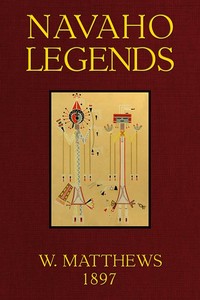
Washington Matthews's Navaho Legends opens with a detailed frontispiece plate identifying five Navaho gods as represented in dry-paintings, immediately signaling the work's dual focus on narrative and ritual practice. The compiler, a U.S. Army surgeon and former president of the American Folk-Lore Society, presents the legends not as literary artifacts but as living performances, embedding them within descriptions of sacred baskets, masks, and kethawns (sacrificial sticks). The excerpts show a careful attention to the spoken word: the repeated cry “Wuʻhuʻhuʻhú” of the god Hastseyalti, the fourfold pattern of awakening the grandmother, and the precise instructions to “shut your eyes” during magical travel. Matthews's editorial apparatus—introduction, notes, interlinear translations, and melodies—frames the Navaho texts as both linguistic documents and ethnographic records.
Diction and the Fourfold Pattern
The excerpts reveal a consistent structural rhythm built on repetition and incremental intensification. In the emergence story, the hero hears the god's call four times: first faintly, then louder, then more plainly, and finally “loud and clear, as if cried by one standing at the door.” Each time he shakes his grandmother awake; each time she dismisses him until the fourth call compels belief. This fourfold pattern—common in Navaho ceremonialism—governs not only dialogue but also action: the rainbow is turned sunwise, the cup of mush is eaten from but never emptied, and the bundle is examined after the visitor is fed. Matthews's interlinear translations preserve the Navaho phrasing, allowing readers to see how the original language embeds these repetitions. The grandmother's rebuke—“You fool. Shut your mouth and go to sleep”—contrasts sharply with the formal speech of the gods, who speak in commands and gestures.
Voice and Gesture in Dialogue
Dialogue in these legends is spare and functional, often carrying narrative weight through implication rather than explanation. When the hero tells his grandmother “I go with the divine ones, but I shall come back again to see you,” the line serves as both farewell and promise, its simplicity masking the danger of the journey. The gods communicate largely through signs: Hastseyalti makes signs over the curtain, bids the man pull it aside, and later “only nodded his head” in response to the grandmother's plea for her grandchild's return. The niece's pet turkey is taken not by force but by request, and the hero explicitly states he will not take it against her will. These exchanges reveal a social code of consent and respect even in dealings with the divine. Matthews's notes clarify that such gestures—like turning the rainbow sunwise—carry specific ceremonial meanings, grounding the dialogue in ritual practice.
Description of the Sacred and the Mundane
Matthews balances otherworldly events with concrete, domestic details. The gods' dwelling is “a house in the rock” with walls “covered with rock crystal, which gave forth a brilliant light,” yet the visitor is offered food in “a small earthen cup only so big (a circle made by the thumb and index finger joined at the tips).” The miraculous inexhaustibility of the mush and water is described in plain, observational language: “He ate, and ate, and ate, and ate, from the cup and could not empty it.” The grandmother's lodge is sketched with similar precision—the turkey roosts on a tree near the lodge, the bundle of sacrificial objects is carried out, the curtain hangs in the doorway. These details anchor the supernatural in a recognizable material world, a technique that Matthews, as an ethnographer, likely valued for its authenticity. The illustrations of huts, looms, and cradles reinforce this grounding.
The Compiler's Editorial Choices
Matthews's role as compiler is visible in the structure of the volume. The legends are divided into four parts—The Story of the Emergence, Early Events in the Fifth World, The War Gods, and Growth of the Navaho Nation—followed by two additional tales and extensive notes. The excerpts include interlinear translations, where Navaho text appears above English glosses, allowing comparison of syntax and vocabulary. Musical transcriptions of melodies are included, and the frontispiece identifies gods by name and paragraph reference, creating a cross-referenced system between text and illustration. Matthews's introduction and notes (not excerpted here) likely explain his methods of collection and translation. The reader should note that the excerpts represent only a fraction of the 147,896-word text; the full work includes many more legends, songs, and ritual descriptions that may deepen or complicate the patterns observed here.
Readers approaching Navaho Legends should attend to the interplay between Matthews's scholarly apparatus and the oral narratives themselves. The interlinear translations reward slow reading, revealing how Navaho grammar shapes the storytelling. The musical notations and descriptions of dry-paintings offer additional entry points into the ceremonial context. Because the excerpts are limited, the reader is encouraged to compare the fourfold patterns noted here with other episodes in the collection, and to consider how Matthews's editorial voice—present in footnotes and introductions—frames the Navaho material for a late-nineteenth-century audience.
I remember sitting by the fire as a child, listening to elders tell our old stories—spare words, sudden silences—and felt again how Matthews must have held those Navaho songs with care. That same quiet reverence surfaced years later, oddly, in The Aesop for Children With pictures by Milo Winter — Key Ideas to Explore; both books keep a living voice alive, not frozen, but breathing.
Sebastian Allen
3 weeks agoHarper Mitchell
3 weeks agoJames Lewis
1 month ago-

James Sanders - 1 month ago
Navaho Legends is a captivating collection of traditional stories that offers deep insight into the Navajo worldview. The tales are rich with symbolism, spirituality, and cultural history, making it a valuable read for anyone interested in Indigenous folklore. The translations preserve the oral storytelling essence, though some references may need external context. Overall, a fascinating and educational journey into Navajo heritage. -
Omar Doyle - 3 weeks ago
Navaho Legends provides a decent overview of Navajo myths and traditions, with interesting stories that showcase the culture's depth. The language is somewhat dated, and the lack of modern annotations might leave some readers confused. However, for those seeking primary source material, it's a useful starting point. -
Cathy Keith Sharp - 2 weeks ago
Navaho Legends feels dated and lacks cohesive structure. The stories are disjointed, and the cultural explanations are insufficient, making it hard for outsiders to appreciate the significance. While the content is authentic, the presentation could be greatly improved with modern scholarship and better organization.
Reader reflection
Your personal reading reflection
Build a private reading journal entry for this title.
Your progress
0
/
10
2
How much did you enjoy the reading experience?
3
Would you recommend this book to another reader?
4
How demanding did the text feel?
5
Did you relate to its people, ideas, or situations?
6
Which aspect of the book did you value most?
7
Did anything about the book feel genuinely new?
8
Was the book what you thought it would be?
9
Which lesson or insight stayed with you?
10


Henry Smith
3 weeks ago