1

Laboulaye's Fairy Book — Context and Discussion
(2 User reviews)
481
Project Gutenberg
2008
Not confirmed
Fairy tales; Picture books for children
Readers of public-domain and historical texts
Project Gutenberg digital edition
en
Edition facts
Words
50,333
Reading time
219 min
Text sections
6
This digital edition of Laboulaye's Fairy Book — Context and Discussion is described by source-level measurements including 50,333 words, 3 hr 39 min estimated reading time, and 6 detected text sections.
The text analysis averages about 18.1 words per sentence, while the detected sections provide another way to judge how the source is divided.
Project Gutenberg metadata also associates the work with “Fairy tales,” connecting these edition facts with the source record’s subject description.
Source:
Project Gutenberg record #26386
This editorial note examines the structural patterns and recurring imagery in Laboulaye's Fairy Book, focusing on how the tales move between domestic thresholds and fantastical underground realms, and how objects of copper, silver, and gold mark moral transitions.
Editorial Edition Score
4.7/5
★★★★★
★★★★★
Calculated from edition completeness, EPUB availability, text structure and catalogue metadata. Not a user rating.
How this score is calculated
- Description quality20 pts
- Title & short description10 pts
- Source metadata20 pts
- Text length15 pts
- Chapters / structure15 pts
- EPUB file integrity20 pts
Total of 100 points, scaled to a 2.5-5.0 range. Editions with an empty description or a missing EPUB file are not scored.
Edition quality
Read the Text
There was once a green book, deliciously thick, with gilt-edged pages and the name of the author in gilt script on the front cover.
Like an antique posy ring, it was a "box of jewels, shop of rarities"; it was a veritable Pandora's box, and if you laid warm, childish hands upon it and held it pressed close to your ear, you could hear, as Pandora did, soft rustlings, murmurings, flutterings, and whisperings from the fairy folk within. For this was a fairy book--Edouard Laboulaye's "Tales," and its heroes and heroines became first the daily companions, and then the lifetime possession, of the two little girls to whom it belonged.
From the New England village where it was originally given to them, it traveled to the far West and its tales were told to countless immigrant children of San Francisco, whose great eyes opened wider still as they listened, breathless, to stories beloved by their ancestors. In later years the green volume journeyed by clumsy, rattling stage and rawboned nags to Mexico, and the extraordinary adventures of "Yvon and Finette," "Carlino," and "Graceful" were repeated in freshly learned Spanish, to many a group of brown-cheeked little people on the hillsides of Sonora.
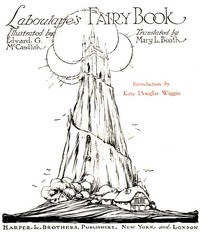
And now, long, long afterward, there stands on a shelf above my desk the very selfsame worn green volume, read and re-read a hundred times, but so tenderly and respectfully that it has kept all its pages and both its covers; and on this desk itself are the proofs of a new edition with clear, beautiful print and gay pictures by Edward McCandlish!
To be asked to write an introduction to this particular book seems insufferable patronage; yet one would do it for love of Laboulaye, or for the sake of one's own "little past," or to draw one more young reader into the charmed circle that will welcome these pages.
The two children who adored Laboulaye's "Tales" possessed many another fairy book, so why did this especial volume hold a niche apart in the gallery of their hearts?
Partly, perhaps, because of the Gallic wit and vivacity with which the tales are told, for children are never too young to appreciate the charms of style.
You remember, possibly, the French chef who, being imprisoned with no materials save the tools of his trade, and commanded on pain of death to produce an omelette, proudly emerged at last, bearing a savory dish made out of the sole of his shoe?
Of even such stuff Laboulaye could have concocted a delectable tale; but with Brittany, Bohemia, Italy, Dalmatia, Hungary, and Spain for his storehouses, one has only to taste to know how finely flavored are the dishes he sets forth.
In his preface to the first American edition Laboulaye writes a letter to Mlle. Gabrielle Laboulaye, aged two! In it he says: "When you throw away this book with your doll, do not be too severe with your old grandfather for wasting his time on such trifles as fairy stories. Experience will teach you that the truest and sweetest things in life are not those which we see, but of which we dream." Happy the children who have this philosophy set before them early in life.
Like the fairy tales Robert Louis Stevenson remembered, these of Laboulaye's have "the golden smell of broom and the shade of pine," and they will come back to the child whenever the Wind of Memory blows.
In common with the stories of Charles Perrault, literary parent of the fairy tale, Laboulaye's charming narratives have a certain unique quality due to the fact that they were intended and collected for the author's own children, were told to them round the fireside in the evening, and so received at first hand the comment and suggestion of a bevy of competent, if somewhat youthful, critics.
It is said that there is a great scarcity of fairy folk in modern France; and that, terrified by the thunders of the Revolution, they left their unhappy country in a body during its stormy years, first assembling in grateful concourse around the tomb of Perrault, upon whose memory they conferred the boon of immortality.
If this story is true--and the last reported act of the fairies on leaving France makes it appear so--then we may be sure that a few of the more hardy and adventurous fays skipped back again across the border and hid themselves in Laboulaye's box of jewels, where they give to each gem an even brighter sheen and a more magical luster.
"QUILLCOTE," HOLLIS, MAINE.
LABOULAYE'S FAIRY BOOK
Laboulaye's Fairy Book, translated by Mary L. Booth and introduced by Kate Douglas Wiggin, collects twelve tales that repeatedly hinge on a specific structural device: the passage from a known, often humble, domestic space into a hidden or subterranean world. In the excerpt from "The Gold Bread," Marienka's journey from her mother's cottage into the King of the Mines' realm—through a rock cleft that crumbles behind her—exemplifies this pattern. The tales do not merely transport characters; they transform the very materials of the landscape, turning forests to lead and meadows to silver. This note traces how such shifts in setting and substance structure the collection's moral logic.
Thresholds and Transformations
The tales in this collection frequently begin in domestic interiors—cottages, kitchens, or village houses—before propelling characters across a boundary into an altered world. In "Yvon and Finette," the siblings leave home to seek their fortune; in "The Castle of Life," the grandmother's death forces the protagonist into a journey. The most striking threshold appears in "The Gold Bread," where Marienka's wedding coach plunges into a rock opening "as large as the gate of a city," entering a realm where "the earth trembled, and the rock cracked and crumbled." This is not a gentle transition but a violent rupture, emphasizing the irreversible nature of the choice. The movement from light to darkness and back to a different light—"a thousand lights waved in the air"—underscores a pattern of death and rebirth that recurs across the collection.
Metallic Landscapes and Moral Gradations
Laboulaye assigns specific metals to different realms and characters, creating a hierarchy that mirrors moral standing. In "The Gold Bread," the suitor offers bread of copper, silver, and gold; his kingdom features "bleached forests and mountains" of lead, a "vast meadow the grass of which was of silver," and a castle "of gold, inlaid with diamonds and rubies." This progression from base to precious metal parallels Marienka's own trajectory from pride to potential downfall. Similarly, in "The Story of Coquerico," the rooster's adventures involve encounters with objects of varying worth. The repeated use of copper, silver, and gold as markers of value—and of moral weight—gives the collection a consistent symbolic vocabulary. Readers attuned to these gradations will find that a character's association with a particular metal often foreshadows their fate.
The Role of the Mother Figure
Across the excerpts, mothers function as both anchors and foils. In "The Gold Bread," Marienka's mother is a voice of caution—"pride is a device of the Evil One"—but her warnings are dismissed. The mother's anxiety and prayer contrast with Marienka's laughter and willfulness. When Marienka leaves without asking for a blessing, the mother is left "to pray alone on the threshold." This positioning at the threshold is significant: the mother remains in the domestic sphere while the daughter crosses into the unknown. In "Yvon and Finette," the siblings' mother dies early, leaving them to navigate without her guidance. The absence or marginalization of the mother figure creates a vacuum that the tales then fill with surrogate guides—often magical or ambiguous figures like the grandmother in "The Castle of Life" or the dwarfs in "The Gold Bread."
Laughter as a Narrative Signal
One of the more curious recurring details in the excerpts is the use of laughter at pivotal moments. Marienka "burst into a loud fit of laughter" while dreaming of her golden suitor, and later laughs in her sleep as her mother gazes at her. This laughter is not mirthful but ominous—it signals self-satisfaction and a refusal to heed advice. In "Yvon and Finette," laughter may appear in similar contexts, though the excerpts are incomplete. The pattern suggests that Laboulaye uses laughter as a marker of a character's moral blindness or impending reversal. When Marienka says, "You see, mother, that, as usual, I was right and you were wrong," her confidence is undercut by the reader's awareness that she is entering a dangerous bargain. The laughter thus becomes a subtle cue that pride precedes a fall.
Readers approaching Laboulaye's Fairy Book will find that its pleasures lie less in novelty of plot than in the careful orchestration of repeated motifs. Pay attention to the materials that surround each character—lead, silver, gold—and to the moments when a threshold is crossed. The tales reward a slow reading that notes how a single gesture, like a laugh or a refusal to turn back, can carry the weight of an entire moral argument. Wiggin's introduction frames the book as a childhood treasure, but its structural sophistication invites adult readers as well.
I keep thinking about how Laboulaye’s copper and silver objects mark those quiet moral turns, as if the tales themselves breathe through metal. It reminds me of the old Sleeping Beauty picture book’s gilded edges, where the palace’s gold feels less like reward and more like a held breath before waking. There’s a gentleness in that shared hesitance. The Sleeping Beauty Picture Book — Edition Insights brings that same tenderness back to me, softly, like a chair pulled closer to the fire.
Emma Lewis
1 month ago-

Katelyn Kim - 1 month ago
{'rating': 2, 'text': 'The stories in Laboulaye S Fairy Book are promising, but the translation feels outdated and lacks the lyrical quality expected from fairy tales. Some narratives drag, and the moral messages are heavy-handed. It reads more like a historical document than an engaging storybook. There are better fairy tale anthologies available that are more child-friendly and captivating.'} -
Rebecca Rodriguez - 1 month ago
{'rating': 5, 'text': 'Laboulaye S Fairy Book is a delightful collection of lesser-known European fairy tales. The stories are whimsical, with clever plots and charming characters. The translation is fluent, preserving the magic of the original tales. It offers a refreshing break from the typical Disney narratives, introducing readers to folklore they might not encounter elsewhere. Highly recommended for fairy tale enthusiasts.'} -
James Gross - 2 weeks ago
{'rating': 3, 'text': 'This fairy book provides an interesting assortment of tales, some quite original. The writing is decent, though occasionally the pacing feels uneven. It might not appeal to very young children due to some complex vocabulary, but older readers will appreciate the cultural diversity. A decent addition to any fairy tale collection.'}
Reader reflection
Take a moment to reflect on this book
Create a short personal record of your experience with this book.
Your progress
0
/
10
2
How did the book work for you overall?
3
Would you recommend this book to another reader?
4
How easy was the book to follow?
5
How useful were the ideas in this book?
6
Which part made the strongest impression?
7
How closely did the book connect with your experience?
8
Was the book easy to understand?
9
Which lesson or insight stayed with you?
10





Evelyn Thomas
1 month ago