1

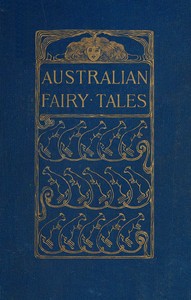
Australian fairy tales — Background and Themes
(4 User reviews)
1056
Project Gutenberg
2022
Not confirmed
Fairy tales -- Australia
Readers of public-domain and historical texts
Project Gutenberg digital edition
en
Edition facts
Words
71,741
Reading time
312 min
Text sections
10
The catalog record for Australian fairy tales — Background and Themes provides practical reading context through 71,741 words, 5 hr 12 min estimated reading time, and 10 detected text sections.
The text analysis averages about 17.8 words per sentence, while the detected sections provide another way to judge how the source is divided.
Project Gutenberg metadata also associates the work with “Fairy tales -- Australia,” connecting these edition facts with the source record’s subject description.
Source:
Project Gutenberg record #68225
Atha Westbury's 1897 collection of fairy tales set in the Australian bush, blending European folklore motifs with local fauna and landscapes, as seen in stories like 'Mothland' and 'The Laughing Jackass.'
Editorial Edition Score
4.8/5
★★★★★
★★★★★
Calculated from edition completeness, EPUB availability, text structure and catalogue metadata. Not a user rating.
How this score is calculated
- Description quality20 pts
- Title & short description10 pts
- Source metadata20 pts
- Text length15 pts
- Chapters / structure15 pts
- EPUB file integrity20 pts
Total of 100 points, scaled to a 2.5-5.0 range. Editions with an empty description or a missing EPUB file are not scored.
Edition quality
Read the Text
Come, youngsters, draw up your chairs. Come, mothers, ye who live your romantic girlhood o’er again in that of your children. Form up, gentlemen, fathers, hard men of the world, whose brows are wrinkled with care and worry, take rank in rear of your fair helpmates. Merchant, lock thy safe, close thy ledgers; horny-handed sons of toil, throw aside your implements of trade; gather near. I am going to draw aside the magic curtain which hides the great continent, marked on our map UNKNOWN. Turn down the lights—our magic lantern is quite ready. Hey presto! Look!
Why, what is this? The heart of a deep mine! A gold mine, with all its dim and rugged corridors, its tunnels and windings, lighted only by a dull taper here and there. There is no one at work, for it is Christmas Eve. Yet the underground region is not altogether untenanted. One man whose duty it is to watch the place, until relieved on the morrow, lies coiled up asleep in one of the long drives. He is a young man, not tall, but strongly made, and with limbs like another Hercules. On account of his great strength and a certain good temper combined, his mates call him, Samson the Nugget.
For what length of time the Nugget slumbered on this good Christmas Eve will never be known. Certain it is that he suddenly opened his eyes and beheld one of the biggest, and withal one of the ugliest, hulking fellows he had ever seen standing over him. The Nugget was a brave youth, but fear began to take possession of him as he looked at the intruder—a giant in stature, with a huge, flat head upon his shoulder, and a mouth as large, and about the shape of the newspaper receiver at the General Post Office. He carried a lamp in his hand, but there was a queer sheen from his eyes, which illumined the cavern with a fiery glow. His dress was a brown russet, his hat, sugar-loaf in shape, and he carried a sapling for a cudgel.
“Get up, Samson the Nugget, and follow me,” said he in a brief, gruff tone.
“Who are you?” cried our hero, rising to his feet, and seizing a heavy iron drill.
“I am the strongest man in Golden Cloud, and my name is Grapple,” rejoined the other grimly. “Will you come?”
“Where?” said the Nugget. “There is no way out of this mine except by the cage up the shaft.”
“That’s all you know about it,” returned Grapple, with a grim laugh. “If I find a way, have you courage to follow?”
The Nugget felt inclined to refuse point blank, but curiosity being strong within him, he bowed an assent.
Grapple, without a word, turned on his heel and led the way further down the dark recesses of the tunnel. Our hero followed. Of one thing the miner felt certain—that the end of the drive would effectually bar the progress of his unwelcome visitor. Strange to relate, such was not the case.
The narrow passage appeared to extend and widen out before their advance, until it took the shape of a long railway tunnel, from which the pair emerged at length into the bright beams of day. The transit from what seemed to be the bowels of a high mountain range to a landscape fairer and more beautiful than our hero had ever seen, filled his mind with wonder. His companion, now that daylight was upon him, did not seem such an ugly customer after all. He was certainly a huge, grotesque-looking personage, but there wasn’t a bit of malice in anything he said or did.
Our hero’s amazement was so great, that it was some considerable time before he found words wherewith to address his companion.
“What country is this?” he asked, turning to Grapple.
“This is Golden Cloud.”
“Golden Cloud! I never heard of such a place. Why did you bring me here?”
“Because I wanted a companion on my travels,” rejoined the other. “I heard you were a very strong man, and I determined to fetch you out of that dismal mine, so that you might enjoy your Christmas holidays with me.”
“Oh, indeed! very considerate on your part, my friend, but what if I return to the mine?” said the Nugget.
“You can’t—not without my aid,” responded Grapple. “Now don’t be a fool. I’m going on a sort of excursion into the interior, and I want a companion. We shall not be long away, and I promise to lead you safely back to the place from whence you came as soon as we return.”
Atha Westbury's Australian Fairy Tales (1897) opens with a Christmas story, 'Golden Cloud,' set on a selection adjacent to a bush paddock. The narrative voice immediately establishes a moral framework: the 'wee people'—Moths—patronise good children and punish bad ones. This blend of European fairy-tale conventions with Australian setting recurs throughout the collection, as in 'Mothland,' where the King wears a 'golden crown of flowers' and the Queen is 'decked with diamonds of dew.' Westbury's diction often juxtaposes the familiar (bread and butter, lollies) with the fantastical (rose-leaf clothes, locust-flute music), creating a distinct local flavour.
Moral Judgement and Punishment
Westbury's narrators deliver unambiguous moral verdicts. In 'Mothland,' the King of the Moths declares that Lily 'has told a decided lie, and she must be punished.' The punishment is precise: she is carried away and replaced by a Moth named Scarlet Mantle. The substitution is nearly undetectable—Scarlet Mantle 'managed to conduct herself as a civilised human child should'—yet the narrative dwells on Lily's suffering: she is tired, hungry, and 'made ridiculous.' The authorial choice to punish a lie with physical displacement and humiliation reinforces a didactic tone. Similarly, in 'Golden Cloud,' the Moths 'always patronising and favouring good boys and girls, and always punishing the bad ones.' This binary moral structure, typical of Victorian children's literature, is here mapped onto the Australian landscape, with the Moth circles serving as both fairy rings and judgment seats.
Local Fauna and Flora as Fairy Elements
Westbury draws on Australian wildlife and plants to populate her fairy world. The Moths in 'Mothland' are not generic fairies but insect-like beings: they sit on 'raised benches made of grass blades' and dance to 'music played on flutes made from the backbones of locusts.' The Queen wears 'diamonds of dew,' and the substitute child, Scarlet Mantle, wears 'rose-leaves and gossamer.' In 'The Laughing Jackass,' the titular bird appears, and 'The Kangaroo Hunter' features a kangaroo. These details ground the fantastical in the specific ecology of the bush. Westbury does not simply transplant European fairies; she reimagines them as creatures of the Australian environment, using local materials for their clothing and customs. This choice gives the collection a distinctive texture, even as the narrative structures remain familiar.
Narrative Voice and Dialogue
Westbury's narrator often addresses the reader directly, using colloquial asides. In 'Mothland,' the nurse 'took her accustomed peep into the child’s bedroom' and thinks, 'I suppose it’s only my fancy.' The narrator then comments, 'so, kissing the supposed child, she went her way, and left the Moth snugly coiled in little Lily’s bed.' This blend of omniscience and conversational tone is consistent. Dialogue, when it appears, is formal yet simple: the King of the Moths says, 'People of Mothland, you all know what an interest we take in the family near our valley.' The Queen replies, 'Carry her away from her home, and put Scarlet Mantle in her place.' The speech is direct, with little ornamentation, serving the plot rather than character development. Westbury's authorial choices in dialogue prioritise clarity and moral instruction over naturalism.
Structure and Story Length
The collection contains ten stories, some divided into chapters (e.g., 'Golden Cloud' has five chapters; 'Whiskerkiss' has two). The word count of 71,741 suggests substantial narratives, but the excerpts show that individual chapters are short—often just a few pages. For instance, 'Mothland' Chapter I ends with Lily being carried away, and Chapter II begins the next morning. This episodic structure allows for quick shifts in setting and conflict. Westbury also uses repeated motifs: the lost child, the magical substitute, the moral lesson. The variety in story length—from 'Tim' (a single entry) to 'Golden Cloud' (a multi-chapter tale)—indicates that Westbury aimed for a mix of quick fables and longer adventures. This structural choice keeps the collection varied, though the moral framework remains constant.
Readers approaching Australian Fairy Tales should attend to how Westbury adapts European fairy-tale conventions to an Australian setting. The Moths, the bush, and the local animals are not mere decoration; they shape the moral and physical world of the stories. The author's diction—simple, direct, and occasionally whimsical—reflects a Victorian didactic purpose. Notice how the punishments fit the crime and how the landscape itself becomes a character. These tales reward attention to the small details of setting and the consistent narrative voice.
There’s something tender about Westbury’s bush fairies—they feel like old friends who wandered off the page. Reading her Australian Fairy Tales again, I kept thinking how every landscape gets the stories it deserves. Then I found myself lingering over The Story of Jack and the Giants — Key Ideas to Explore, remembering how even giant-slaying carries that same quiet, particular loneliness.
Ella Baker
1 month agoIsaac Baker
2 weeks agoAnthony Johnson
2 weeks agoThere are no comments for this eBook.
Reader reflection
How will you remember this book?
Save your reaction, strongest insight, and memorable passage.
Your progress
0
/
10
2
Did this book hold your interest?
3
Would you pass this book on to a friend?
4
How demanding did the text feel?
5
What was its emotional impact?
6
Did any part of the book feel personally relevant?
7
Did you gain anything practical from the text?
8
How well did it match your expectations?
9
What changed or sharpened your thinking?
10
Owen Ramirez
2 weeks ago