1

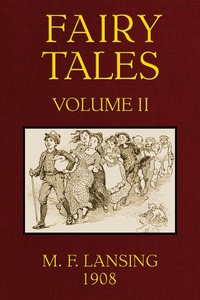
Fairy Tales, Volume 2 (of 2) — Story, Setting & Ideas
(5 User reviews)
797
Project Gutenberg
2022
Not confirmed
Fairy tales
Readers of public-domain and historical texts
Project Gutenberg digital edition
en
Edition facts
Words
32,200
Reading time
140 min
Text sections
15
Before opening Fairy Tales, Volume 2 (of 2) — Story, Setting & Ideas, the edition data offers a quick orientation: 32,200 words, 2 hr 20 min estimated reading time, and 15 detected text sections.
The text analysis averages about 20.2 words per sentence, while the detected sections provide another way to judge how the source is divided.
Project Gutenberg metadata also associates the work with “Fairy tales,” connecting these edition facts with the source record’s subject description.
Source:
Project Gutenberg record #67777
This editorial note examines how the opening, middle, and later excerpts of Lansing's 1908 fairy-tale collection guide a first reading, focusing on the compiler's preface, Thumbelina's escape, and the volume's structural parallels.
Editorial Edition Score
4.8/5
★★★★★
★★★★★
Calculated from edition completeness, EPUB availability, text structure and catalogue metadata. Not a user rating.
How this score is calculated
- Description quality20 pts
- Title & short description10 pts
- Source metadata20 pts
- Text length15 pts
- Chapters / structure15 pts
- EPUB file integrity20 pts
Total of 100 points, scaled to a 2.5-5.0 range. Editions with an empty description or a missing EPUB file are not scored.
Edition quality
Read the Text
y quick and a trifle heedless, or because the decree of the fairy has so ordained, she pierced her hand with it and fell in a swoon.
The good old woman, in great alarm, cried out for help. People came running in from all directions. They threw water on the Princess’s face; they unlaced her; they struck her on the palms of her hands and rubbed her temples with cologne water; but nothing would bring her to.
Then the King, who had come up on hearing the noise, remembered the prediction of the fairies. He knew very well that this must come to pass, since the fairies had decreed it. He had the Princess carried into the finest apartment in the palace, and laid upon a bed embroidered with gold and silver. One would have taken her for a little angel, she was so beautiful; her cheeks were carnation, and her lips like coral. Her eyes were closed, it is true, but she was heard to breathe softly, which satisfied those about her that she was not dead. The King gave orders that they should let her sleep quietly until the time came for her to awake.
The good fairy who had saved her life by condemning her to sleep a hundred years was in the kingdom of Mataquin, twelve thousand leagues away, when this accident happened to the Princess; but she was promptly told of it by a little dwarf who had a pair of seven-league boots,—that is, boots with which he could cover seven leagues of ground at a single stride. The fairy set out immediately, and arrived at the castle about an hour later in a fiery chariot drawn by dragons.
The King handed her out of the chariot. She approved everything he had done; but, as she had great foresight, she thought that when the Princess awoke she would be much perplexed and troubled at finding herself all alone in this old palace. So this is what she did. She touched with her wand everything in the palace except the King and Queen,—governesses, maids of honor, ladies of the bedchamber, gentlemen, officers, stewards, cooks, scullions, guards, porters, pages, and footmen; she touched also all the horses in the stable with their grooms, the great mastiffs in the courtyard, and even little Pouste, the Princess’s tiny spaniel that was lying on the bed beside her.
The moment she touched them they all fell asleep, not to wake again till their mistress did. This was done in order that they might be ready to serve her again when she had need of them. Even the spits that stood before the fire, as full as they could hold of partridges and pheasants, fell asleep, and the fire itself as well. All this was done in a moment. Fairies are not long in doing their business!
And now the King and Queen, having kissed their dear child without waking her, left the castle, issuing a proclamation that no one should come near it. These commands were not necessary, for in less than a quarter of an hour there grew up all around the park such a vast number of trees great and small, and of bushes and brambles, twining one within another, that neither man nor beast could pass through, and nothing could be seen but the very top of the towers of the palace, and that, too, only from a great distance. Every one knew that this was the work of the fairy in order that the Princess, while she slept, should have nothing to fear from curious people.
A hundred years passed, and the kingdom was in the hands of another royal family. The son of the reigning King was hunting one day in that part of the country, and asked what those towers were which he saw in the middle of a great dense wood. Every one answered according as he had heard. Some said it was an old haunted castle; others, that all the witches of the country held their revels there. But the common opinion was that an ogre lived there, and that he carried thither all the little children he could catch, secure that no one would follow him, for he alone had power to make his way through the wood.
The Prince did not know what to believe; but finally an aged man spoke to him thus: “May it please your Highness, more than fifty years ago I heard my father tell that there was in that castle a Princess, the most beautiful ever seen; and that she was to sleep there a hundred years, and that she would be wakened by a King’s son for whom she was waiting.”
The compiler’s preface to this 1908 collection immediately establishes a deliberate architecture. Marion Florence Lansing explains that the two volumes are designed as companions: tales in the second volume parallel those in the first, such as “Clever Alice” corresponding to “Hans in Luck,” and “The White Cat” mirroring “Beauty and the Beast.” This pairing invites readers to compare motifs—a princess under an animal spell versus a prince, six brothers becoming the Pleiades versus twelve sons seeking fortunes. The preface also distinguishes fairy tales from heroic sagas, noting that stories like “Jack the Giant Killer” are reserved for a later volume, Tales of Old England. Thus, from the outset, the reader is positioned to notice structural echoes and genre boundaries.
Parallels and Pairings in the Preface
Lansing’s preface functions as a map. She explicitly states that “some of the best stories have been reserved for this book” and that the plan “has been to gratify interest awakened in the tales of the first volume by a parallel in the second.” For instance, the first volume’s “Doll-in-the-Grass” (twelve sons) is paired with a tale of six sons who later become the Pleiades. This cross-referencing encourages readers to hold both volumes in mind. The preface also notes that “close similarity of plot has been avoided,” so the parallels are thematic or structural rather than exact duplicates. A first-time reader might use this framework to anticipate how a given story will differ from its counterpart.
Thumbelina’s Agency and the Swallow’s Return
The excerpt from “Thumbelina” offers a clear example of how the collection handles character motivation. Thumbelina actively resists the mole: she “wept and said she would not marry the disagreeable mole,” and the field mouse threatens to bite her with “white teeth.” The swallow’s return is a direct consequence of Thumbelina’s earlier kindness—she “saved my life when I lay frozen.” The dialogue is economical: the swallow says, “Do come with me, dear little Thumbelina,” and she agrees. The journey is described in sensory detail: “over forest and over sea, high above the highest mountains where the snow never melts.” The warm countries feature “green, purple, and white grapes” and “lemons and oranges.” This passage shows how the collection balances peril with rescue, and how a protagonist’s compassion is rewarded.
The Mole’s Underground World as a Contrast
Thumbelina’s story also establishes a clear opposition between light and dark, above and below. The mole’s realm is “deep under the earth, and never again to come out into the warm sunshine.” The field mouse praises the mole’s “beautiful velvet coat” and full “kitchens and cellars,” but Thumbelina finds him “tiresome” and “disagreeable.” The swallow, by contrast, represents freedom and warmth. This binary is typical of the collection’s moral landscape: the mole’s wealth is hollow, while Thumbelina’s desire for sunlight is validated. The excerpt ends with Thumbelina “admiring the beautiful things in the world beneath” from the swallow’s back, a literal shift in perspective. Readers can observe how the tale uses setting to reinforce character values.
The Collection’s Tone and Editorial Choices
Lansing’s preface also reveals her editorial stance. She states that “the atmosphere of these tales is healthful, and their tone, while not in most cases didactic, is distinctly moral and uplifting.” She explicitly excludes “tales of cruel brothers and sisters” and notes that “the grotesque and horrible have been introduced only where they are so exaggerated that no sane child would fail to appreciate their extravagance.” This suggests a curated selection aimed at a young audience, with an emphasis on clear moral outcomes. The preface also positions the volume within the “Open Road Library” series, which includes other juvenile literature. A first-time reader might use these statements to gauge the collection’s intended effect: it prioritizes constructive lessons over sensationalism.
Reading these excerpts sequentially—from the preface’s structural promises, through Thumbelina’s resistance and rescue, to the editorial framing—reveals a collection that rewards attention to pattern. The parallels between volumes, the moral clarity, and the sensory details of escape all contribute to a cohesive reading experience. A first-time reader may find it useful to note how each tale establishes its own rules of reward and consequence, and how the compiler’s choices shape the journey from one story to the next.
I kept thinking about how that old collection's quiet structure—the way Thumbelina’s escape feels both tiny and enormous—stayed with me long after closing it. It reminded me of another book with that same lingering quality, where every bird’s song seems to hold a secret. The Boy Who Knew What the Birds Said — Inside the Classic feels equally patient, almost like a friend who knows when to pause.
Camila Nguyen
2 weeks agoIsabella Clark
2 weeks agoCamila Garcia
2 weeks agoTheodore King
3 weeks ago-

Adrian Tiffany Thomas - 1 month ago
This volume disappoints with its lack of originality. Many stories are just retreads of well-known fairy tales with minor variations. The writing is often flat and lacks the spark that makes fairy tales magical. Additionally, some tales include dated and problematic stereotypes. It feels like a filler collection rather than a curated anthology. There are far better fairy tale compilations available. -
Lori Crane - 1 month ago
This second volume of fairy tales is a rich collection of lesser-known gems from various cultures. The stories are beautifully written, with vivid imagery and timeless themes that will enchant readers of all ages. The diversity of tales is impressive, and the moral lessons are woven seamlessly into the narratives. Perfect for both bedtime reading and for those who appreciate classic folklore. -
Michelle Moss - 3 weeks ago
A solid compilation of fairy tales, albeit a bit uneven in quality. Some stories are captivating, while others feel derivative or too similar to common European tales. The translation is generally good, but occasionally stilted. Still, it offers a good variety and is a nice addition to any fairy tale library.
Reader reflection
How will you remember this book?
Save your reaction, strongest insight, and memorable passage.
Your progress
0
/
10
2
How did the book work for you overall?
3
Would you recommend this book to another reader?
4
How easy was the book to follow?
5
Did anything about the book feel genuinely new?
6
How useful were the ideas in this book?
7
Was the book what you thought it would be?
8
Do you expect to return to this book?
9
In one sentence, what did you learn?
10

James Lopez
1 month ago