1

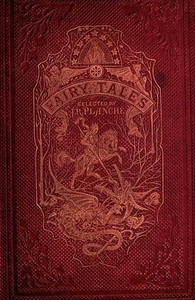
Four and Twenty Fairy Tales Selected from Those of Perrault, and Other Popular Writers — Context and Discussion
(9 User reviews)
1574
Project Gutenberg
2016
Not confirmed
Fairy tales
Readers of public-domain and historical texts
Project Gutenberg digital edition
en
Edition facts
Words
221,817
Reading time
965 min
Text sections
22
This digital edition of Four and Twenty Fairy Tales Selected from Those of Perrault, and Other Popular Writers — Context and Discussion is described by source-level measurements including 221,817 words, 16 hr 5 min estimated reading time, and 22 detected text sections.
The text analysis averages about 24.2 words per sentence, while the detected sections provide another way to judge how the source is divided.
Project Gutenberg metadata also associates the work with “Fairy tales,” connecting these edition facts with the source record’s subject description.
Source:
Project Gutenberg record #52719
J.R. Planché's 1858 translation of twenty-four French fairy tales, arranged chronologically from Perrault to Leprince de Beaumont, with a preface defending the value of fairy tales for adults and annotations tracing sources.
Editorial Edition Score
4.9/5
★★★★★
★★★★★
Calculated from edition completeness, EPUB availability, text structure and catalogue metadata. Not a user rating.
How this score is calculated
- Description quality20 pts
- Title & short description10 pts
- Source metadata20 pts
- Text length15 pts
- Chapters / structure15 pts
- EPUB file integrity20 pts
Total of 100 points, scaled to a 2.5-5.0 range. Editions with an empty description or a missing EPUB file are not scored.
Edition quality
Read the Text
he approached the wood, when all those great trees, all those brambles and thorns made way for him to pass of their own accord. He walked towards the Castle, which he saw at the end of a long avenue he had entered, and what rather surprised him was, that he found none of his people had been able to follow him, the trees having closed up again as soon as he had passed. He continued, nevertheless, to advance; a young and amorous prince is always courageous. He entered a large fore-court, where everything he saw was calculated to freeze his blood with terror. A frightful silence reigned around. Death seemed everywhere present. Nothing was to be seen but the bodies of men and animals stretched out apparently lifeless. He soon discovered, however, by the shining noses and red faces of the porters, that they were only asleep; and their goblets, in which still remained a few drops of wine, sufficiently proved that they had dosed off whilst drinking. He passed through a large court-yard paved with marble; he ascended the staircase. He entered the guard-room, where the guards stood drawn up in line, their carbines shouldered, and snoring their loudest. He traversed several apartments, with ladies and gentlemen all asleep; some standing, others seated. He entered a chamber covered with gold, and saw on a bed, the curtains of which were open on each side, the most lovely sight he had ever looked upon--a Princess, who seemed to be about fifteen or sixteen, the lustre of whose charms gave her an appearance that was luminous and supernatural. He approached, trembling and admiring, and knelt down beside her. At that moment, the enchantment being ended, the Princess awoke, and gazing upon the Prince with more tenderness than a first sight of him seemed to authorize, "Is it you, Prince?" said she; "you have been long awaited." The Prince, delighted at these words, and still more by the tone in which they were uttered, knew not how to express to her his joy and gratitude.
He assured her he loved her better than himself. His language was not very coherent, but it pleased the more. There was little eloquence, but a great deal of love. He was much more embarrassed than she was, and one ought not to be astonished at that. The Princess had had time enough to consider what she should say to him, for there is reason to believe (though history makes no mention of it) that, during her long nap, the good Fairy had procured her the pleasure of very agreeable dreams. In short, they talked for four hours without having said half what they had to say to each other.
In the meanwhile, all the Palace had been roused at the same time as the Princess. Everybody remembered their duty, and, as they were not all in love, they were dying with hunger. The lady-in-waiting, as hungry as any of them, became impatient, and announced loudly to the Princess that the meat was on the table. The Prince assisted the Princess to rise; she was full dressed, and most magnificently, but he took good care not to hint to her that she was attired like his grandmother, and wore a stand-up collar.[5] She looked, however, not a morsel the less lovely in it. They passed into a hall of mirrors, in which they supped, attended by the officers of the Princess. The violins and hautbois played old but excellent pieces of music, notwithstanding it was a hundred years since they had been performed by anybody; and after supper, to lose no time, the grand Almoner married the royal lovers in the chapel of the Castle.
Early next morning the Prince returned to the city, where his father was in great anxiety about him. The Prince told him that he had lost himself in the forest whilst hunting, and that he had slept in a woodcutter's hut, who had given him some black bread and cheese for his supper. The King, his father, who was a simple man, believed him, but his mother was not so easily satisfied; and observing that he went hunting nearly every day, and had always some story ready as an excuse, when he had slept two or three nights away from home, she no longer doubted but that he had some mistress, for he lived with the Princess for upwards of two years, and had two children by her; the first, which was a girl, was named Aurora, and the second, a son, was called Day, because he was still more beautiful than his sister.
Planché's preface frames this collection as a sequel to his earlier translation of the Countess d'Aulnoy, offering English readers the first complete versions of tales by Perrault and his successors. He arranges the stories chronologically to show the development of the genre, quoting La Fontaine and Martin Luther to defend fairy tales as literature for adults. The opening of 'Perfect Love' exemplifies the collection's narrative voice: a first-person princess narrator describes her mother's reluctance to entrust her to a fairy with a capricious reputation, setting up a tension between maternal affection and political necessity that recurs across the volume.
A Translator's Defense of Fairy Tales
Planché's preface directly addresses adult readers, citing Luther's claim that he 'would not for any quantity of gold part with the wonderful tales' from his childhood. This appeal to serious readers—'children of a larger growth'—distinguishes the volume from children's editions. The translator emphasizes that his versions are 'equally faithful' to the originals and annotated, a scholarly approach visible in the appendix. The chronological arrangement, he argues, lets readers trace how the genre evolved from Perrault's spare plots to the more elaborate moralizing of later writers like Madame Leprince de Beaumont.
The First-Person Narrator in 'Perfect Love'
The excerpt from 'Perfect Love' uses an unusual first-person princess narrator who recounts her own story. She describes her mother, the Queen, as a warrior who 'placed herself at the head of her troops' and fought for fifteen years, leaving her daughter in the care of a fairy. The fairy's reputation is ambiguous: 'she was said to be capricious in her favours,' and people 'feared more than they loved her.' This setup creates a psychological tension absent from Perrault's more straightforward tales. The narrator's gratitude toward the fairy gradually shifts as the fairy's affection becomes 'differing from that of a mother,' a turning point that the excerpt leaves unresolved.
War and Maternal Duty as Plot Engines
In 'Perfect Love,' the Queen's military campaigns drive the plot: she must leave her daughter to defend the kingdom, then repeatedly delays her return due to invasions and rebellions. The narrator notes that the Queen 'never thought of sending for me' because she kept expecting each month to be the last. This pattern—a parent absent for years due to war—appears in several tales, including 'The Sleeping Beauty in the Wood' and 'Little Thumbling,' where parental absence or neglect sets the story in motion. Planché's translation preserves the formal, slightly archaic diction of the originals, with phrases like 'she could not resolve to lose sight of me' conveying the Queen's emotional conflict.
Fairy Caprice and the Threat of Offense
The fairy in 'Perfect Love' is described as 'vindictive' and taking pleasure in hurting those who offend her. The Queen, advised by 'prudent persons,' avoids a flat refusal to avoid the fairy's resentment. This dynamic—where fairies are dangerous not because they are evil but because they are easily slighted—recurs throughout the collection. In 'Blue Beard,' the wife's curiosity triggers disaster; in 'Riquet with the Tuft,' a fairy's gift of intelligence comes with conditions. Planché's notes in the appendix likely trace these motifs across the Cabinet des Fées, but the excerpts alone show how the translator preserves the moral ambiguity of the original French.
Readers approaching this collection for the first time will benefit from noting the chronological order Planché establishes: start with Perrault's familiar tales, then move to the less-known stories by Madame de La Force and others. The preface and appendix provide context for the literary debates surrounding fairy tales in 17th- and 18th-century France. Pay attention to how each tale handles the relationship between mortal characters and fairies—whether as helpers, obstacles, or ambiguous figures whose motives remain unclear.
There’s something comforting about old translations, their patient footnotes holding stories the way a hand holds a lamp. Reading Planché’s fairy tales, I kept thinking of another bedside volume, the second night of the Thousand and One, where each tale waits like a small, quiet door. The Book of the Thousand Nights and a Night — Volume 02 (of 10) — Context and Discussion feels like that same lamplight, warm and unhurried.
Sofia White
1 month agoHarper Baker
1 month agoMichael Torres
2 weeks agoThere are no comments for this eBook.
Reader reflection
How did this book work for you?
Your answers remain private and are stored only in this browser.
Your progress
0
/
10
2
How much did you enjoy the reading experience?
3
Would you encourage someone else to read it?
4
How demanding did the text feel?
5
Could you apply anything you learned?
6
Would a second reading be valuable?
7
Did any part of the book stay with you emotionally?
8
How closely did the book connect with your experience?
9
What did this book teach you most?
10






James Jackson
3 weeks ago