1

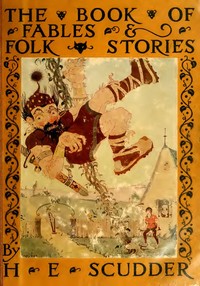
The Book of Fables and Folk Stories — Context and Discussion
(4 User reviews)
1274
Project Gutenberg
2014
Not confirmed
Fairy tales; Fables; Tales
Readers of public-domain and historical texts
Project Gutenberg digital edition
en
Edition facts
Words
34,080
Reading time
149 min
Text sections
6
The source record for The Book of Fables and Folk Stories — Context and Discussion measures this digital text at 34,080 words, 2 hr 29 min estimated reading time, and 6 detected text sections.
The text analysis averages about 14.6 words per sentence, while the detected sections provide another way to judge how the source is divided.
Project Gutenberg metadata also associates the work with “Fairy tales,” connecting these edition facts with the source record’s subject description.
Source:
Project Gutenberg record #45384
Horace E. Scudder's 1882 collection pairs Aesop's fables with folk tales like 'Little Red-Riding-Hood' and 'Sleeping Beauty,' using plain, direct prose. The catalog subjects 'Fairy Tales' and 'Fables' accurately reflect the content, though the excerpts show a mix of moral lessons and magical narratives, with some tales (e.g., 'The Fox and the Grapes') being very brief.
Editorial Edition Score
4.7/5
★★★★★
★★★★★
Calculated from edition completeness, EPUB availability, text structure and catalogue metadata. Not a user rating.
How this score is calculated
- Description quality20 pts
- Title & short description10 pts
- Source metadata20 pts
- Text length15 pts
- Chapters / structure15 pts
- EPUB file integrity20 pts
Total of 100 points, scaled to a 2.5-5.0 range. Editions with an empty description or a missing EPUB file are not scored.
Edition quality
Read the Text
cried so hard that a little stream of tears ran out of each eye. All at once a wise woman stood near her, and asked:--
“Little Two Eyes, why do you cry?” Little Two Eyes said:--
“Have I not need to cry? Because I have two eyes, like other people, my sisters and my mother cannot bear me. They knock me about and they give me shabby clothes. They feed me only with the food left over from their table. To-day they have given me so little that I am very hungry.”
The wise woman said:--
“Little Two Eyes, dry your eyes, and I will tell you what to do. Only say to your goat: ‘Little goat, bleat; little table, rise,’ and a table will stand before you, covered with food. Eat as much as you like. When you have had all you want, only say: ‘Little goat, bleat; little table, away,’ and it will be gone.” Then the wise woman disappeared. Little Two Eyes thought: “I must try at once, for I am too hungry to wait.” So she said:--
“Little goat, bleat; little table, rise,” and there stood before her a little table covered with a white cloth. On it were laid a plate, knife and fork, and silver spoon. The nicest food was on the plate, smoking hot. Then Little Two Eyes began to eat, and found the food very good. When she had had enough, she said:--
“Little goat, bleat; little table, away.” In an instant the table was gone.
“That is a fine way to keep house,” thought Little Two Eyes.
At the end of the day Little Two Eyes drove her goat home. She found a dish with some food in it. Her sisters had put it aside for her, but she did not taste it. She did not need it.
The next day she went out again with her goat, and did not take the few crusts which her sisters put aside for her. This went on for several days. At last her sisters said to each other:--
“All is not right with Little Two Eyes. She always leaves her food. She used to eat all that was given her. She must have found some other way to be fed.”
They meant to find out what Little Two Eyes did. So the next time that Little Two Eyes set out, Little One Eye came to her and said:--
“I will go with you into the field, and see that the goat is well taken care of, and feeds in the best pasture.” But Little Two Eyes saw what Little One Eye had in her mind. So she drove the goat into the long grass, and said:--
“Come, Little One Eye, we will sit down and I will sing to you.” Little One Eye sat down. She was tired after her long walk in the hot sun, and Little Two Eyes began to sing:--
“Are you awake, Little One Eye? Are you asleep, Little One Eye? Are you awake, Little One Eye? Are you asleep, Little One Eye? Are you awake? Are you asleep? Awake? Asleep?” By this time Little One Eye had shut her one eye and was fast asleep. When Little Two Eyes saw this, she said softly:--
“Little goat, bleat; little table, rise;” and she sat at the table and ate and drank till she had had enough. Then she said as before:--
“Little goat, bleat; little table, away,” and in a twinkling all was gone.
Little Two Eyes now awoke Little One Eye, and said:--
“Little One Eye, why do you not watch? You have been asleep, and the goat could have run all over the world. Come! let us go home.” So home they went, and Little Two Eyes again did not touch the dish. The others asked Little One Eye what Little Two Eyes did in the field. But she could only say:--
“Oh, I fell asleep out there.”
The next day, the mother said to Little Three Eyes:--
“This time _you_ must go with Little Two Eyes, and see if any one brings her food and drink.” Then Little Three Eyes said to Little Two Eyes:
Horace E. Scudder's The Book of Fables and Folk Stories (1882) brings together two distinct storytelling traditions under one cover. The table of contents lists Aesopic fables such as 'The Fox and the Grapes' and 'The Tortoise and the Hare' alongside longer folk tales like 'Cinderella' and 'Puss in Boots.' The excerpts reveal a plain, unadorned prose style that prioritizes clarity over ornamentation. For instance, 'Little Red-Riding-Hood' opens with a straightforward setup: 'Her mother was very fond of her, and her grandmother loved her even more.' The language is direct, with minimal description, allowing the action to drive the narrative.
The catalog subjects—Fairy Tales, Fables, and Tales—accurately describe the book's contents, but the excerpts show that the fables are often very short, sometimes only a few paragraphs, while the folk tales receive fuller treatment. This mix suggests the book was designed for young readers, offering both quick moral lessons and more immersive stories.
Plain Prose and Direct Storytelling
The excerpts consistently employ a simple, declarative style. In 'Sleeping Beauty,' the narration moves briskly: 'She touched the horses in the stable, the grooms, the great mastiff in the court-yard, and the tiny lapdog of the princess.' The sentence structure is paratactic, with clauses linked by 'and' or 'then,' creating a cumulative effect. This style mirrors the oral tradition from which many of these tales derive. Scudder avoids elaborate metaphors or psychological depth, focusing instead on sequential events. For example, when the prince enters the castle, the text notes: 'He entered the guard-room. There the guards stood drawn up in line, with their spears in their hands, but they did not move. They were fast asleep.' The repetition of 'awoke' in the waking sequence reinforces the mechanical, fairy-tale logic of the enchantment.
Moral Lessons and Their Limits
The fables in the collection are explicitly moralistic, as seen in titles like 'The Dog in the Manger' and 'The Boys and the Frogs.' However, the excerpts do not always state the moral outright. In 'Little Red-Riding-Hood,' the wolf's deception is presented without commentary, leaving the lesson implicit. By contrast, Aesop's fables traditionally end with a stated moral, but the excerpts here are incomplete. The catalog subject 'Fables' suggests a didactic purpose, yet the folk tales—such as 'Sleeping Beauty'—contain no overt moral, focusing instead on enchantment and romance. This tension between instruction and entertainment is a key feature of the collection. Readers may find that some tales reward reflection on consequences, while others simply delight in the magical resolution.
Recurring Patterns in Structure and Detail
Several structural patterns recur across the excerpts. Many tales begin with a formulaic opening: 'Once upon a time' or 'There lived.' Characters are often defined by a single trait or object—Little Red-Riding-Hood's red cloak, the princess's beauty. The excerpts also show a fondness for triadic repetition: the wolf meets Red-Riding-Hood three times in the woods; the sleeping beauty's castle has three layers of sleepers (animals, servants, princess). Another recurring detail is the use of animals as agents of fate or transformation. In 'Sleeping Beauty,' the wood grows 'so thick and thorny that nothing could get through it,' echoing the enchanted forests in other tales. These patterns give the collection a cohesive feel despite the variety of sources.
Readers approaching this edition should note that the excerpts represent only a fraction of the full text. The book's brevity—some tales are just a page long—makes it suitable for reading aloud or for young readers gaining confidence. The plain style may feel stark to those accustomed to modern retellings, but it preserves the directness of the oral tradition. Pay attention to how Scudder balances the moral weight of the fables with the wonder of the folk tales; this tension is the collection's quiet strength.
There’s something steady about Scudder’s old book, the way its plain words carry both foxes and grandmothers without fuss. It reminds me of sitting with The Book of Fables and Folk Stories on a rainy afternoon, and I find myself thinking of Four and Twenty Fairy Tales Selected from Those of Perrault, and Other Popular Writers — Context and Discussion, as if the same quiet hand had shelved them side by side, waiting for someone to pull them down again.
Amelia Sanchez
1 month agoSebastian Taylor
4 weeks agoLeo Lewis
4 weeks agoThere are no comments for this eBook.
Reader reflection
What did you think of this book?
Answer a few questions and save a private reflection on this device.
Your progress
0
/
10
2
What was your overall reaction to the book?
3
How likely are you to recommend this book?
4
How much effort did this book require?
5
Which aspect of the book did you value most?
6
Was the book what you thought it would be?
7
How closely did the book connect with your experience?
8
Was the book moving at the right speed?
9
What is the main idea you are taking away?
10


Ava Clark
3 weeks ago