1

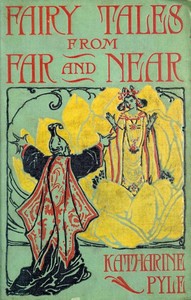
Fairy tales from far and near — A Reader’s Guide
(0 User reviews)
83
Project Gutenberg
2021
Not confirmed
Fairy tales
Readers of public-domain and historical texts
Project Gutenberg digital edition
en
Edition facts
Words
56,700
Reading time
247 min
Text sections
6
Before opening Fairy tales from far and near — A Reader’s Guide, the edition data offers a quick orientation: 56,700 words, 4 hr 7 min estimated reading time, and 6 detected text sections.
The text analysis averages about 22.1 words per sentence, while the detected sections provide another way to judge how the source is divided.
Project Gutenberg metadata also associates the work with “Fairy tales,” connecting these edition facts with the source record’s subject description.
Source:
Project Gutenberg record #66919
Katharine Pyle's 1922 collection of twelve fairy tales from India, Lithuania, France, Ireland, Norway, Scotland, England, Native America, Japan, and Greece, each retold with a distinctive narrative voice and attention to cultural detail, as seen in the opening Hindoo story and the Norse Troll tale.
Editorial Edition Score
4.7/5
★★★★★
★★★★★
Calculated from edition completeness, EPUB availability, text structure and catalogue metadata. Not a user rating.
How this score is calculated
- Description quality20 pts
- Title & short description10 pts
- Source metadata20 pts
- Text length15 pts
- Chapters / structure15 pts
- EPUB file integrity20 pts
Total of 100 points, scaled to a 2.5-5.0 range. Editions with an empty description or a missing EPUB file are not scored.
Edition quality
Read the Text
id so, and at once the leaves closed about her “ 193
As soon as he saw the oat cake he was wide awake again in a moment “ 209
When he reached the farther shore, he turned and looked back “ 232
Soon she came to the river and saw the boat lying there “ 270
FAIRY TALES FROM FAR AND NEAR
There was once a poor peasant woman who sold milk. Every day she filled her cans with milk and went to a near-by town and sold it, returning with her cans empty.
One day, when she set out she took her little baby daughter with her. In each hand the mother carried a milk can, and the baby held to her skirt and walked close beside her.
Suddenly two great eagles appeared, wheeling about in the sky, and one of them dropped down and seized the child and flew away with it; the other eagle, which was its mate, followed it.
The woman cried aloud and dropped her milk cans, and ran along after the eagles, but they quickly disappeared in the distance. The woman beat upon her breast and wailed bitterly, but nothing she could say or do could bring her child back to her.
The eagle flew on and on with the baby until they reached the tree where they lived. There the father eagle, who had carried her, laid her gently on the grass.
He and his mate were so delighted with the child and her pretty ways that they determined to keep her.
They built a house for her high in the top of the tree. The house was made of iron, and was very strong, and it had seven iron doors and there was a key for each one of them so it could be locked. In this house the little girl lived with a little dog and cat the eagles had brought her for company.
The eagles loved the child dearly and named her Surya Bai, which means Sun Lady. They brought her food and beautiful clothes,--clothes such as princesses wear, and magnificent jewels. Each day, after they had set forth, Surya Bai locked the doors so she would be safe. Then she played about the house with the little dog and cat and was well contented. In the evening, when the eagles came home, they would knock, and Surya Bai would unlock the seven doors, one after another, and let them in. Always they brought her some pretty present.
One day the mother eagle said, “Our Surya Bai has now everything she needs except a diamond ring to wear upon her finger. It makes me sad that she should not have a diamond ring.”
“Yes,” replied the father eagle, “she ought to have one, and I will go out and find one for her.”
“But an ordinary diamond ring will not do,” said his mate. “Once, far away, upon the borders of the Red Sea, I saw a princess walking, and on her finger she wore a ring so bright and dazzling it was like the sun in splendor. It is such a ring as that that I wish to give to our Sun Lady.”
“In that case we will fly away to the Red Sea and get one for her,” said the father eagle.
So the two birds arranged to set out the next day, and as it would take a long time to make the journey, they brought to Surya Bai enough food to last for six months. They then cautioned her not to open the door to any one while they were gone, and not to leave the house for any reason whatever, and to keep the fire always burning on the hearthstone. Then the two old eagles flew away, and they were sad to leave her.
Now after they had gone, Surya Bai went about the house and set it in order. Every day she cooked food for herself and the little dog and cat, and fed them, and she played with them, and they were very happy together. Then one day, when she was cooking dinner, the little cat crept close to her, and while Surya Bai was not looking stole the very choicest bits of the dinner and ate them up very quickly.
When Surya Bai turned round and saw what the cat had done, she was very angry. “Now I shall punish you because you are a thief,” she said.
Katharine Pyle's Fairy Tales from Far and Near opens with a Hindoo story, 'Little Surya Bai,' in which a baby is snatched by eagles and raised in their nest—a striking departure from the more familiar European fairy-tale openings. The narrative voice is direct and unadorned: 'The woman beat upon her breast and wailed bitterly.' Pyle's retellings, drawn from twelve distinct cultural traditions, maintain a consistent clarity while allowing each tale's unique setting and logic to emerge. The collection includes stories from India, Lithuania, France, Ireland, Norway, Scotland, England, Native America, Japan, and Greece, offering a broad geographical sweep within a single volume.
Contrasts in Scale and Power
In the Norse tale 'The Blue Belt,' a Troll's domestic arrangements are rendered in absurdly oversized terms: a cradle 'as long and wide as any bed,' a hogshead of drink, and an ox consumed 'meat and the bones and the horns and hoofs of it' in one sitting. The human characters are dwarfed by these proportions, yet the lad outwits the Troll through cleverness rather than size. This tension between physical enormity and human resourcefulness recurs across the collection. In 'Little Surya Bai,' the eagles are not monstrous but nurturing, reversing the expected predator-prey dynamic. Pyle uses these contrasts to explore power—whether it resides in strength, cunning, or the unexpected kindness of non-human beings.
Recurring Motifs of Transformation and Trickery
Several tales hinge on sudden transformations or deceptive appearances. In the Lithuanian story 'The Princes and the Friendly Animals,' the illustration caption notes that 'as fast as she touched them each one was turned into a stone figure,' suggesting a motif of petrification that punishes or tests characters. The Norse Troll's plan to 'send him down to the bottom of the quarry, and then roll a rock down on him' is foiled when the lad reverses the trap. Pyle's retellings emphasize the moment of reversal—the point at which the seemingly weaker character turns the tables. These patterns of trickery and transformation are not merely plot devices but reflect a worldview where appearances are unreliable and wit often prevails over brute force.
Cultural Specificity in Narrative Detail
Pyle grounds each tale in culturally specific details that go beyond generic fairy-tale settings. The Hindoo story begins with a milk-selling peasant woman and eagles that are 'two great eagles' circling in the sky—a detail that evokes the Indian landscape. The Japanese tale 'Schippeitaro' and the Greek 'Eros and Psyche' are included, though their excerpts are not provided in the supplied text. The table of contents lists stories from Ireland, Scotland, and Native America, each with distinct narrative traditions. Pyle's illustrations, mentioned in the front matter, likely reinforce these cultural markers. The collection does not homogenize its sources into a single fairy-tale style; instead, it preserves differences in tone, setting, and moral logic, inviting readers to compare how similar motifs—like the helpful animal or the clever youngest child—manifest across cultures.
Readers approaching this collection will find it rewarding to read the tales in sequence, noting how Pyle shifts her prose style to suit each source culture. The absence of a single overarching narrative allows each story to stand on its own terms. Pay attention to the illustrations, which are listed in the front matter and likely echo the visual traditions of the tales' origins. The book offers a compact survey of global fairy-tale motifs without sacrificing narrative momentum or cultural texture.
Sometimes, reading these old fairy tales in Katharine Pyle’s collection, so carefully rooted in their separate lands, I find myself drifting back to a different sort of evening—to the endless, layered stories inside The Book of the Thousand Nights and a Night — Volume 08 (of 10) — Inside the Classic. There, too, each tale feels like a room, just briefly opened.
There are no reviews for this eBook.
Reader reflection
What did you think of this book?
Answer a few questions and save a private reflection on this device.
Your progress
0
/
10
2
How did the book work for you overall?
3
Would you pass this book on to a friend?
4
How demanding did the text feel?
5
Would you like to discuss this book with someone?
6
How distinctive were its ideas or approach?
7
What did you appreciate most?
8
How would you describe its reading pace?
9
What changed or sharpened your thinking?
10







Jake Katie Solis - 1 month ago
Kimberly Conley - 4 weeks ago
Ryan Mcdonald - 1 week ago