1

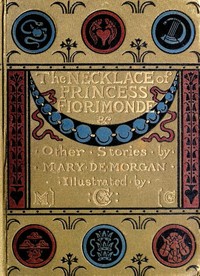
The Necklace of Princess Fiorimonde, and Other Stories — Context and Discussion
(9 User reviews)
2331
Project Gutenberg
2012
Not confirmed
Fairy tales; Children's stories
Readers of public-domain and historical texts
Project Gutenberg digital edition
en
Edition facts
Words
37,882
Reading time
165 min
Text sections
5
The Necklace of Princess Fiorimonde, and Other Stories — Context and Discussion can be approached with a clearer sense of reading commitment from its source measurements: 37,882 words, 2 hr 45 min estimated reading time, and 5 detected text sections.
The text analysis averages about 23.0 words per sentence, while the detected sections provide another way to judge how the source is divided.
Project Gutenberg metadata also associates the work with “Fairy tales,” connecting these edition facts with the source record’s subject description.
Source:
Project Gutenberg record #38976
Mary De Morgan's fairy tales use a plain, declarative narrative voice and shifts in pacing to explore themes of vanity, love, and enchantment. The opening story establishes a pattern of wickedness hidden behind beauty, while 'The Heart of Princess Joan' introduces a quest driven by a magical star.
Editorial Edition Score
4.7/5
★★★★★
★★★★★
Calculated from edition completeness, EPUB availability, text structure and catalogue metadata. Not a user rating.
How this score is calculated
- Description quality20 pts
- Title & short description10 pts
- Source metadata20 pts
- Text length15 pts
- Chapters / structure15 pts
- EPUB file integrity20 pts
Total of 100 points, scaled to a 2.5-5.0 range. Editions with an empty description or a missing EPUB file are not scored.
Edition quality
Read the Text
Princess was decked in her finest array to greet him, and when he came all the courtiers said, "This is truly a proper husband for our beautiful Princess," for he was strong and handsome, with black hair, and eyes like sloes. King Pierrot was delighted with Fiorimonde's beauty, and was happy as the day is long; and all things went merrily till the evening before the marriage. A great feast was held, at which the Princess looked lovelier than ever dressed in a red gown, the colour of the inside of a rose, but she wore no jewels nor ornaments of any kind, save one shining gold string round her milk-white throat.
When the feast was done, the Princess stepped from her golden chair at her father's side, and walked softly into the garden, and stood under an elm-tree looking at the shining moon. In a few moments King Pierrot followed her, and stood beside her, looking at her and wondering at her beauty.
"To-morrow, then, my sweet Princess, you will be my Queen, and share all I possess. What gift would you wish me to give you on our wedding day?"
"I would have a necklace wrought of the finest gold and jewels to be found, and just the length of this gold cord which I wear around my throat," answered Princess Fiorimonde.
"Why do you wear that cord?" asked King Pierrot; "it has no jewel nor ornament about it."
"Nay, but there is no cord like mine in all the world," cried Fiorimonde, and her eyes sparkled wickedly as she spoke; "it is as light as a feather, but stronger than an iron chain. Take it in both hands and try to break it, that you may see how strong it is;" and King Pierrot took the cord in both hands to pull it hard; but no sooner were his fingers closed around it than he vanished like a puff of smoke, and on the cord appeared a bright, beautiful bead--so bright and beautiful as was never bead before--clear as crystal, but shining with all colours--green, blue, and gold.
Princess Fiorimonde gazed down at it and laughed aloud.
"Aha, my proud lover! are you there?" she cried with glee; "my necklace bids fair to beat all others in the world," and she caressed the bead with the tips of her soft, white fingers, but was careful that they did not close round the string. Then she returned into the banqueting hall, and spoke to the King.
"Pray, sire," said she, "send some one at once to find King Pierrot, for, as he was talking to me a minute ago, he suddenly left me, and I am afraid lest I may have given him offence, or perhaps he is ill."
The King desired that the servants should seek for King Pierrot all over the grounds, and seek him they did, but nowhere was he to be found, and the old King looked offended.
"Doubtless he will be ready to-morrow in time for the wedding," quoth he, "but we are not best pleased that he should treat us in this way."
Princess Fiorimonde had a little maid called Yolande. She was a bright-faced girl with merry brown eyes, but she was not beautiful like Fiorimonde, and she did not love her mistress, for she was afraid of her, and suspected her of her wicked ways. When she undressed her that night she noticed the gold cord, and the one bright bead upon it, and as she combed the Princess's hair she looked over her shoulder into the looking-glass, and saw how she laughed, and how fondly she looked at the cord, and caressed the bead, again and again with her fingers.
"That is a wonderful bead on your Highness's cord," said Yolande, looking at its reflection in the mirror; "surely it must be a bridal gift from King Pierrot."
"And so it is, little Yolande," cried Fiorimonde, laughing merrily; "and the best gift he could give me. But I think one bead alone looks ugly and ungainly; soon I hope I shall have another, and another, and another, all as beautiful as the first."
Then Yolande shook her head, and said to herself, "This bodes no good."
The title story opens with a blunt moral contradiction: Princess Fiorimonde is so beautiful that everyone assumes she must be good, but she is in fact wicked and practices black magic. This direct, almost conversational statement of character sets the tone for the collection. De Morgan’s narrative voice is plain and declarative, rarely lingering on description. Instead, she moves quickly through exposition, as when the King decides his daughter should marry and summons his council in a single paragraph. The pace accelerates during scenes of secret sorcery, then slows for moments of dialogue or reflection, creating a rhythm that keeps the reader oriented.
A Voice That Tells, Not Shows
De Morgan’s narrator often tells the reader directly what a character is like, rather than demonstrating it through action. Princess Fiorimonde is introduced as “really very wicked” before any event occurs. This technique recurs throughout the excerpts: Princess Joan is described as “hard and cold as stone” because a fairy has stolen her heart. The narrator does not rely on subtle clues; instead, the moral landscape is laid out plainly. This approach gives the stories a fable-like clarity, where good and evil are immediately recognizable. The voice is consistent, almost like a storyteller speaking aloud, which suits the fairy-tale genre but also creates a sense of distance from the characters’ inner lives.
Pacing Through Repetition and Direct Speech
De Morgan controls pace by alternating between summary and direct speech. In The Necklace of Princess Fiorimonde, the King’s council scene is summarized quickly, while the Princess’s secret visits to the witch are described in a single sentence. Later, in The Heart of Princess Joan, the wizard’s warning to Prince Michael is rendered in direct dialogue, slowing the narrative to emphasize the stakes. The prince’s repeated insistence—“I will marry her, or no one”—creates a rhythmic refrain that underscores his determination. Short paragraphs and simple sentence structures keep the pace brisk, while longer speeches or descriptions of magical objects, like the piece of glass that reveals colored stars, introduce moments of pause and wonder.
Recurring Details: Magic Objects and Their Functions
Magic objects appear in both excerpts and serve as narrative shortcuts. In the title story, Fiorimonde’s beauty is maintained by witchcraft learned from an old witch. In The Heart of Princess Joan, the wizard gives Michael a small round piece of glass that allows him to see stars in different colors—blue, green, red, yellow—and to follow the deepest red star to the castle where Joan’s heart is kept. These objects are described with minimal detail; their function is more important than their appearance. The glass, for instance, is simply “a small round piece of glass,” yet it drives the entire quest. De Morgan uses such items to advance the plot without elaborate world-building, keeping the focus on the characters’ choices and the consequences of their actions.
Readers may notice how De Morgan’s narrative voice shifts between brisk summary and measured dialogue, creating a distinctive rhythm that propels each story forward. The magic objects—a necklace, a piece of glass—are never over-explained; they serve as tools for character development and plot progression. Pay attention to how the narrator’s directness shapes your understanding of each character’s moral standing, and how the pacing varies between scenes of action and moments of reflection. These choices give the collection a cohesive, oral-storytelling quality that rewards careful reading.
That rainy afternoon, I kept returning to Princess Joan’s star, its quiet pull. De Morgan’s plainness felt like a held breath. Later, half-asleep, I found another old volume, its voice gentler still. The enchantments there didn’t demand attention, just sat with me, like rain on the window. I thought of Joan again. Fairy Tales, Volume 2 (of 2) — Story, Setting & Ideas holds that same unhurried strangeness, the kind that lingers without asking.
Owen Lewis
1 month agoAnthony Brown
1 month agoLucas Torres
1 month agoCamila Hernandez
1 month agoThere are no comments for this eBook.
Reader reflection
What did you think of this book?
Answer a few questions and save a private reflection on this device.
Your progress
0
/
10
2
How did the book work for you overall?
3
Is this a title you would suggest to others?
4
Did the language feel accessible?
5
Is this a title worth rereading?
6
Did the book give you something worth debating?
7
Did the book deliver what you hoped for?
8
How clearly were the main ideas presented?
9
What is the main idea you are taking away?
10






Daniel Gonzalez
1 month ago