1

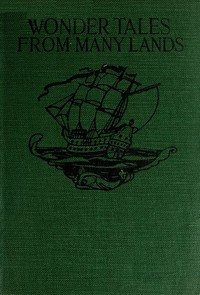
Wonder Tales from Many Lands — Themes and Context
(1 User reviews)
184
Project Gutenberg
2015
Not confirmed
Fairy tales; Folk literature
Readers of public-domain and historical texts
Project Gutenberg digital edition
en
Edition facts
Words
63,500
Reading time
277 min
Text sections
7
The source record for Wonder Tales from Many Lands — Themes and Context measures this digital text at 63,500 words, 4 hr 37 min estimated reading time, and 7 detected text sections.
The text analysis averages about 17.6 words per sentence, while the detected sections provide another way to judge how the source is divided.
Project Gutenberg metadata also associates the work with “Fairy tales,” connecting these edition facts with the source record’s subject description.
Source:
Project Gutenberg record #48351
This collection of 20 fairy tales from Bohemia, Norse, Hindu, Korean, and other traditions is introduced by Katharine Pyle's own illustrations. The opening story 'Long, Broad, and Sharpsight' establishes a pattern of enchanted objects and tests, while later tales like 'Dapplegrim' show a recurring structure of a hero aided by a magical horse. Readers can observe how Pyle adapts oral motifs into a consistent literary voice.
Editorial Edition Score
4.7/5
★★★★★
★★★★★
Calculated from edition completeness, EPUB availability, text structure and catalogue metadata. Not a user rating.
How this score is calculated
- Description quality20 pts
- Title & short description10 pts
- Source metadata20 pts
- Text length15 pts
- Chapters / structure15 pts
- EPUB file integrity20 pts
Total of 100 points, scaled to a 2.5-5.0 range. Editions with an empty description or a missing EPUB file are not scored.
Edition quality
Read the Text
avelled in many lands, and had seen many noble and beautiful ladies, there was not one among them all whom he wished to have for a wife.
One day the King called his son to him and said, “My son, for a long time now I have hoped to see you choose a bride, but you have desired no one. Take now this silver key. Go to the top of the castle, and there you will see a steel door. This key will unlock it. Open the door and enter. Look carefully at everything in the room, and then return and tell me what you have seen. But, whatever you do, do not touch nor draw aside the curtain that hangs at the right of the door. If you should disobey me and do this thing, you will suffer the greatest dangers, and may even pay for it with your life.”
The Prince wondered greatly at his father’s words, but he took the key and went to the top of the castle, and there he found the steel door his father had described. He unlocked it with the silver key, stepped inside, and looked about him. When he had done so, he was filled with amazement at what he saw. The room had twelve sides, and on eleven of these sides were pictures of eleven princesses more beautiful than any the Prince had ever seen in all his life before. Moreover, these pictures were as though they were alive. When the Prince looked at them, they moved and smiled and blushed and beckoned to him. He went from one to the other, and they were so beautiful that each one he looked upon seemed lovelier than the last. But lovely though they were, there was not one of them whom the Prince wished to have for a wife.
Last of all, the Prince came to the twelfth side of the room, and it was covered over with a curtain, and the curtain was of velvet richly embroidered with gold and precious stones. The Prince stood before it and looked at it and looked at it. He tried to peer under its edges, but he could see nothing; never in all his life had he longed for anything as he longed to lift that curtain and see what was behind it.
At last his longing grew so great that he could withstand it no longer. He laid his hand upon the folds and drew it aside, and when he had done so, his heart melted within him for love and joy. For there was the portrait of a maiden so fair and lovely that all the other eleven beauties were as nothing beside her.
The Prince stood and looked at her, and she looked back at him, and she did not blush or beckon to him as the others had done, but rather she grew pale.
“Yes,” said the Prince at last, “you and you only shall be my bride, even though I should have to go to the ends of the world to find you.”
When he said that, the picture bowed its head gravely.
Then the Prince dropped the curtain and left the room and went down to where the old King was waiting for him. As soon as he came before his father, the old man asked whether he had found the room and entered it.
“I did,” answered the Prince.
“And what did you see in the room, my son?”
“I saw a picture of the maiden whom I wish to have for a wife.”
“And which of the eleven was it?”
“It was none of the eleven; it was the twelfth—she whose portrait hangs behind the curtain.”
When the old King heard this, he gave a cry of grief. “Alas, alas, my son! What have you done! Did I not warn you not to lift the curtain and not to look behind it?”
“You warned me, my father, and yet I could not but look, and now I have seen the only one whom I will ever marry. Tell me, I pray of you, who she is, that I may go in search of her.”
The first tale, 'Long, Broad, and Sharpsight,' opens with a king giving his son a silver key to a forbidden room—a classic fairy-tale prohibition. The prince disobeys, drawing aside a curtain to find a portrait that sets him on a quest. This pattern of a magical object, a warning, and a consequence recurs throughout the collection. Pyle's prose is direct and rhythmic, with repeated phrases like 'on and on and on' that echo oral storytelling. The story introduces three companions with extraordinary abilities (Long, Broad, and Sharpsight), a motif that reappears in later tales such as 'The Dwarf with the Golden Beard.'
Opening Patterns: Forbidden Doors and Magical Helpers
The first story establishes a template: a royal figure imposes a rule, the protagonist breaks it, and a quest ensues. The prince's disobedience leads him to a portrait of a princess, whom he must rescue. He gathers three helpers—each with a single exaggerated power—who together overcome obstacles. This structure mirrors many tales in the collection. For instance, 'The Great White Bear and the Trolls' also begins with a prohibition (a bear warns a girl not to look at him by candlelight) and a subsequent journey. Pyle's version of 'The Three Billy Goat Gruff' retains the classic triple encounter with a troll, but her telling emphasizes the goats' dialogue and the troll's greedy threats. Readers will notice how Pyle streamlines each story, focusing on action and dialogue rather than descriptive detail.
The Role of Animal Companions in the Middle Tales
In 'Dapplegrim,' a tale adapted from the Norse, the hero Boots is aided by a magical grey horse who speaks and advises him. The horse instructs Boots to cover him with spiked hides and to watch a barrel of tar during a fight—a vivid test of loyalty and courage. This motif of a talking animal helper appears in several stories: the jackal in 'The Jackal and the Alligator,' the buffalo in 'The King of the Buffaloes,' and the bear in 'The Great White Bear and the Trolls.' Pyle often gives these animals specific commands and warnings, creating a rhythm of instruction and obedience. The horse Dapplegrim even predicts his own possible death, adding a layer of risk. Readers can compare how different cultures in this collection use animal guides—some as tricksters, others as loyal servants.
Recurring Structures: Threes, Tests, and Transformations
Many tales in the middle of the collection rely on a three-part structure. In 'The Story of the Three Billy Goat Gruff,' the goats cross the bridge in ascending size, each tricking the troll. 'The Four Wishes' presents a series of wishes granted by a nixie, each leading to unintended consequences. 'Princess Rosetta' involves three tasks set by a witch. Pyle also uses transformation as a plot device: in 'The Crow Peri,' a princess is turned into a crow; in 'The Fish Prince,' a prince becomes a fish. These transformations are often reversed by love or bravery. The author's voice remains consistent—she uses simple past tense and short sentences, but varies dialogue to distinguish characters. The tales from different regions share these structural similarities, suggesting Pyle selected stories that fit a common fairy-tale mold.
Later Tales: Moral Lessons and Trickster Figures
Toward the end of the collection, stories like 'Why the Animals No Longer Fear the Sheep' and 'The Farmer and the Pixy' shift toward moral or explanatory tales. The former, a French Creole story, explains why sheep are timid—a humorous fable about a boastful sheep who loses his courage. The latter, an English fairy tale, shows a pixy outwitting a farmer, reinforcing the idea that cleverness trumps strength. These later tales are shorter and more direct, often ending with a proverb or explicit lesson. Pyle's illustrations (referenced in the front matter) likely complement these narratives, though the text alone carries the humor. Readers may notice that the later stories rely less on royal characters and more on everyday folk, broadening the collection's appeal. The final tale, 'Princess Rosetta,' returns to a classic princess-and-tasks format, providing a satisfying conclusion.
As you read through these twenty tales, pay attention to how Pyle adapts each story's opening: some begin with 'Once upon a time,' others with a specific setting like 'In a great forest.' The collection moves from longer, quest-driven narratives to shorter, moral anecdotes. The author's own illustrations (not included in this text) originally accompanied the stories, so imagine the visual cues that might have reinforced the action. Whether you read sequentially or dip into individual tales, the recurring motifs of threes, magical helpers, and transformations will become familiar companions.
I often think of the old horses in Wonder Tales, patient Dapplegrim and his kin, waiting for someone to listen. There is a quieter magic in that. It lingers near The Fox That Wanted Nine Golden Tails — Reading Companion, like a shared thread of longing between two small, faithful creatures. Kindred spirits, watching by firelight.
-

Tina Thompson - 1 month ago
{'rating': 2, 'text': "A promising concept that doesn't fully deliver. The tales are unevenly told; some feel fragmented, and the language is sometimes archaic. The lack of background information about each culture's tale lessens the educational value. It seems like a rushed compilation. I'd suggest looking for more meticulously curated international folktale books."} -
William Galloway - 2 weeks ago
{'rating': 5, 'text': "Wonder Tales From Many Lands is a global gem! It brings together enchanting stories from various cultures, each beautifully retold. The diversity is refreshing, and the tales are filled with magic, adventure, and wisdom. My family and I have enjoyed reading these together, and it's sparked conversations about different traditions. A wonderful addition to any home library."} -
Laura Tom Wade - 2 weeks ago
{'rating': 3, 'text': "This collection provides a good introduction to international folk tales, with a nice variety of cultures. However, the translations vary in quality, and some stories are more compelling than others. It could benefit from richer illustrations. Still, it's a decent choice for readers wanting to explore world folklore."}
Reader reflection
How will you remember this book?
Save your reaction, strongest insight, and memorable passage.
Your progress
0
/
10
2
How much did you enjoy the reading experience?
3
Would you pass this book on to a friend?
4
How easy was the book to follow?
5
How understandable was the text?
6
Did it raise ideas you would like to talk about?
7
Do you expect to return to this book?
8
Did anything about the book feel genuinely new?
9
What did this book teach you most?
10



Ella Martinez
2 weeks ago